



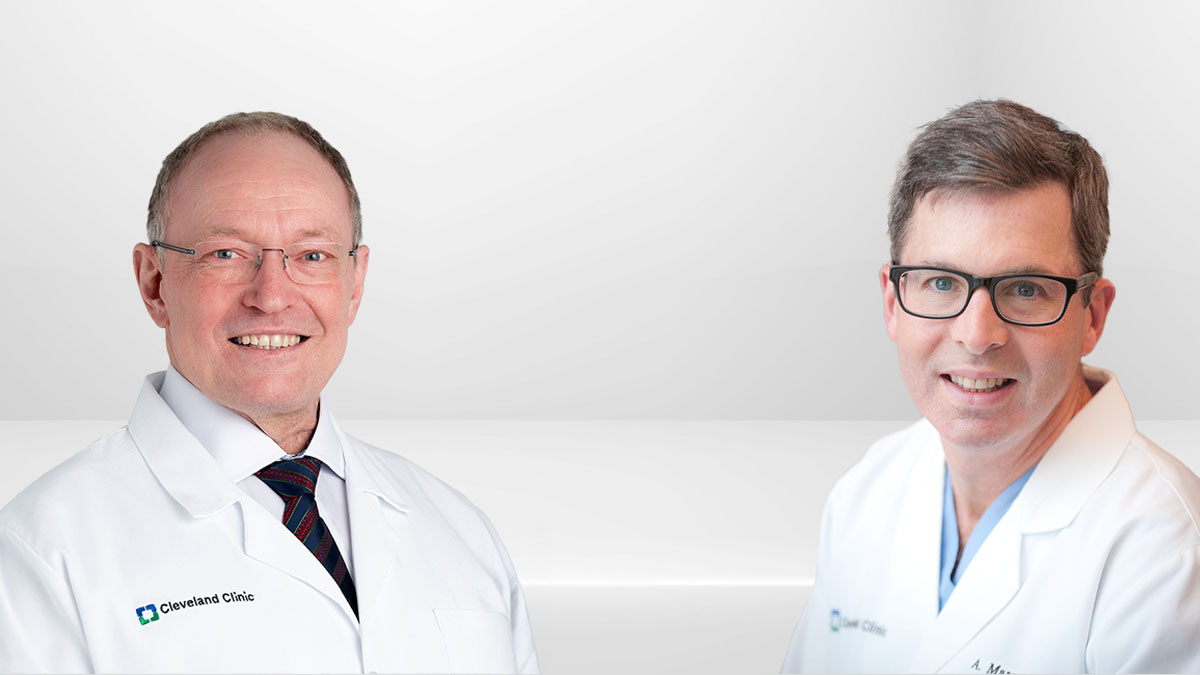
Mitral Valve: Repair, Replace, Redo
Repairs, replacements, reoperations and robots? Expert Cleveland Clinic surgeons break down exactly what to expect from mitral valve surgery.
Advertisement
Cleveland Clinic is a non-profit academic medical center. Advertising on our site helps support our mission. We do not endorse non-Cleveland Clinic products or services. Policy
Recent Episodes
Aspirin for Prevention: Latest Recommendations
Luke Laffin, MD, and Vikas Sunder, MD, discuss the latest recommendations for using low-dose aspirin to help prevent heart disease, includin…
Choosing the Right Treatment for Blocked Coronary Arteries
Faisal Bakaeen, MD, and Grant Reed, MD, explain what blocked coronary arteries mean and the risk factors that can lead to coronary artery di…
Robotic Lung Transplantation Explained
Kenneth McCurry, MD, and Gregory Jones, MD, discuss who may need a lung transplant, how patients are evaluated and how transplantation can i…
Video content: This video is available to watch online.
View video online (https://cdnapisec.kaltura.com/p/2207941/sp/220794100/playManifest/entryId/1_euxlgs82/flavorId/1_5f3sgelj/format/url/protocol/https/a.mp4)
Transcript
Announcer:
Welcome to Love Your Heart, brought to you by Cleveland Clinic's Sydell and Arnold Miller Family Heart, Vascular and Thoracic Institute. This podcast will explore disease prevention, testing, medical and surgical treatments, new innovations and more. Enjoy.
Advertisement
Cleveland Clinic is a non-profit academic medical center. Advertising on our site helps support our mission. We do not endorse non-Cleveland Clinic products or services. Policy
Marc Gillinov, MD:
I'm Marc Gillinov, Chair of the Department of Thoracic and Cardiovascular Surgery at Cleveland Clinic.
Per Wierup, MD, PhD:
I'm Per Wierup. I'm a cardiac surgeon specializing in mitral valve surgery here at the Cleveland Clinic.
Marc Gillinov, MD:
At the Cleveland Clinic, we've got the world's largest experience with mitral valve surgery. Every year, we do more than 5,000 open-heart operations. Well over 1,000 of those are mitral valve operations. Today, we want to talk with you about the types of mitral valve operations that we do. I think the most common thing we address is a leaking mitral valve or mitral valve regurgitation. Regurgitation equals leak. For those valves, we can almost always repair them. Dr. Wierup was Europe's premier mitral valve repair surgeon, and now we're thrilled he's at Cleveland Clinic. What's your feeling about mitral valve repair?
Per Wierup, MD, PhD:
Yeah, I think it's very important to have the valve repaired in comparison to having it replaced. We're using all kinds of techniques that we have developed over many, many years. I would say if you have the most common one, which is a prolapse causing regurgitation, in our hands, it's more than 99% who leave the clinic with a nice repair.
Marc Gillinov, MD:
In addition to repairing the valves, one of the things that I am most proud of about our entire group is the operative risk. The risk of this surgery is extraordinarily low. It's almost like getting your appendix out or a gallbladder operation. The risk of a mitral valve repair operation is less than 1 in 1,000 here. I think that is because we've got such an incredible team of people working together.
Advertisement
Our favorite way to do this operation is robotic surgery. It is great for the patients, with little incisions, quicker recovery, and also good for the procedure. What do you like about it?
Per Wierup, MD, PhD:
Doing it robotically, we see it perfectly. It feels like you're sitting inside the heart and seeing this valve, like it's enormously gigantic. We see every little, tiny detail. I would say we can do it not just as good, but I would say better repairs than what we can do when we do it in open cases.
Marc Gillinov, MD:
About 70% of people with isolated mitral valve issues can get a robotic operation, which is great. Now we've extended our abilities. What else can we do with the robot? Someone needs a mitral valve and-
Per Wierup, MD, PhD:
They have atrial fibrillation. We can address that at the same time. Many people have an opening between the left and the right atrium, and we close that at the same time. Many patients also have developed tricuspid regurgitation as a consequence of long-standing mitral leakage, and then we repair that as well.
Marc Gillinov, MD:
So, we really, with the surgical robot, have a lot of options. It still is the case, though, even though we can do all of these things, we'd love people to be referred early, meaning when just the mitral valve leaks and they don't yet have atrial fibrillation and don't yet have a tricuspid valve problem. We still see people referred a bit late. I would say, and tell me if you agree, if you have severe mitral valve leakage, severe mitral regurgitation, your valve is broken, and we should fix it. It's super low risk to repair it.
Per Wierup, MD, PhD:
It's very well studied and published. If you have a severe leakage, even if you don't have symptoms, if you just treat it medically, the long-term life expectancy is not as good as the background population. However, if we repair it, then their life expectancy returns to normal, but given that they haven't waited too long before surgery.
Marc Gillinov, MD:
I think you highlighted another truly amazing result of mitral valve surgery. If you've got a leaking mitral valve from prolapse, mitral regurgitation from prolapse, and you get a valve repair, you have a normal life expectancy. It's as if you don't have heart disease. In fact, I tell people if you've got mitral valve prolapse repaired, you don't have heart disease. You don't even need to think of yourself as a heart patient. You need an echo once a year, but it's a plumbing problem. We've got, I think, the best group of mitral valve plumbers in the world in this building.
When it comes to mitral valve surgery, the reason to come to the Cleveland Clinic, or I should say the reasons to come to the Cleveland Clinic, have been the same for a pretty long time. When my grandmother had mitral valve prolapse and I sent her to the Cleveland Clinic, to Toby Cosgrove, I was not yet at the Cleveland Clinic. I sent her here because she had the lowest risk of surgery, having the valve done here, and she had the highest probability of repair. It worked out as it should. She had surgery at age 76 and lived into her 90s, never had a heart problem again.
Advertisement
So, what do you want for a patient who has a leaking mitral valve, mitral regurgitation? You want the valve repaired, 99% plus, I think, in our hands, and you want an extraordinarily low risk. Of course, these days, there is a lot of enthusiasm for and discussion about the transcatheter edge-to-edge repairs, the MitraClip™ and the PASCAL device, and we have looked at our own results. Anatomically, if you've got mitral valve prolapse, our internal results suggest that with a surgical repair, you get more durable results. I think you can speak to the durability.
Per Wierup, MD, PhD:
In terms of durability, when we repair the valve, they're heart healthy again. Other parts of the valve start to leak, but that's not the problem. If they're followed, they can come back, and we'll address that as well. That's another area of our expertise that we have developed here. There have been many mitral valves repaired across the U.S., but there are some who come back for different reasons. That is the area of doing a re-repair. If we are doing that, it's much better in terms of survival for the patients if you can re-repair, meaning that the valves are not replaced, but the patient keeps their own valve. We have developed many techniques and published a lot on that. I would say that, on average, most patients who have a late failure after a previous repair can be re-repaired again with a much better survival than if they have them replaced.
Advertisement
Marc Gillinov, MD:
You've looked at our results and the techniques that we've come up with. You've got some super good illustrations of them. Again, the survival with the re-repair returns to normal, better than replacement.
Per Wierup, MD, PhD:
Yeah. Also important, we can do it practically without any mortality.
Marc Gillinov, MD:
Mitral valve re-repair here is routine. The patients just look great afterwards, and their echoes are exactly what we want.
Per Wierup, MD, PhD:
And they're happy.
Marc Gillinov, MD:
Yes, they're happy they keep their own valves. Thank you for listening to Love Your Heart.
Announcer:
Thank you for listening to Love Your Heart. We hope you enjoyed the podcast. For more information or to schedule an appointment at Cleveland Clinic, please call 844.868.4339. That's 844.868.4339. We welcome your comments and feedback. Please contact us at heart@ccf.org. Like what you heard? Subscribe wherever you get your podcasts, or listen at clevelandclinic.org/loveyourheartpodcast.
Advertisement
Recent Episodes
Aspirin for Prevention: Latest Recommendations
Luke Laffin, MD, and Vikas Sunder, MD, discuss the latest recommendations for using low-dose aspirin to help prevent heart disease, includin…
Choosing the Right Treatment for Blocked Coronary Arteries
Faisal Bakaeen, MD, and Grant Reed, MD, explain what blocked coronary arteries mean and the risk factors that can lead to coronary artery di…
Robotic Lung Transplantation Explained
Kenneth McCurry, MD, and Gregory Jones, MD, discuss who may need a lung transplant, how patients are evaluated and how transplantation can i…
Never miss a moment - subscribe now.
Listen to the Health Essentials Podcast on your favorite streaming platform.
Other Podcasts You May Love
Beyond Leadership
Hosts Jim Pae and Elizabeth Pugel escort you through a network of thought leaders, sharing world-cla…

Beyond the Pages: CCJM Podcast
Beyond the Pages: CCJM Podcast takes the listener more in-depth into Cleveland Clinic Journal of Med…

Butts & Guts
A Cleveland Clinic podcast exploring your digestive and surgical health from end to end. You’ll lear…

Cancer Advances
A Cleveland Clinic podcast for medical professionals exploring the latest innovative research and cl…