



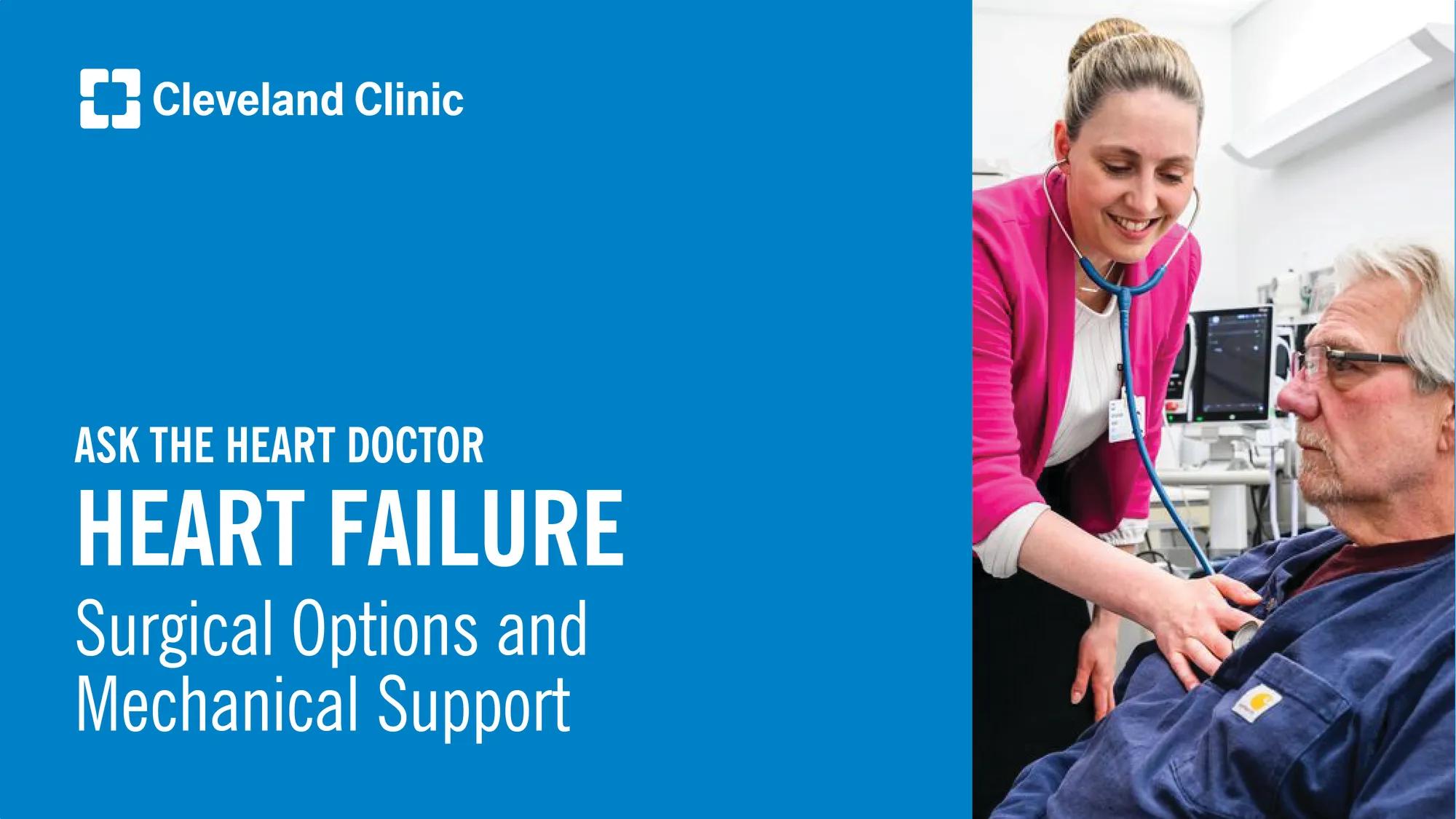
Ask the Heart Doctor | Heart Failure: Surgical Options and Mechanical Support
Heart failure affects millions of people and can range from mild symptoms to advanced disease. In this episode, discuss how heart failure is diagnosed, the latest medication and device therapies, and when advanced options such as heart transplantation and left ventricular assist devices may be considered.
Schedule an appointment at Cleveland Clinic by calling 844.868.4339.
Meet the panelists:
Edward Soltesz, MD - Cardiothoracic Surgeon
Michael Tong, MD - Cardiothoracic Surgeon
Arianne Clare Agdamag, MD - Heart Failure Cardiologist
Advertisement
Cleveland Clinic is a non-profit academic medical center. Advertising on our site helps support our mission. We do not endorse non-Cleveland Clinic products or services. Policy
Recent Episodes
Quick Questions: Mitral Valve Prolapse
Marc Gillinov, MD, explains what mitral valve prolapse is and how it is diagnosed. He also discusses when mitral valve prolapse can lead to…
New Approaches to Treating Aortic Arch Disease
Eric Roselli, MD, and Patrick Vargo, MD, discuss aortic arch aneurysms and dissections, and explain why early diagnosis and ongoing monitori…
Encore: AFib After an Ablation
This is an encore episode of "AFib After an Ablation: What to Know", originally published in June 2025. Experiencing persistent or recurrin…
Video content: This video is available to watch online.
View video online (https://cdnapisec.kaltura.com/p/2207941/sp/220794100/playManifest/entryId/1_0uydirqi/flavorId/1_5f3sgelj/format/url/protocol/https/a.mp4)
Transcript
Announcer:
Welcome to Love Your Heart, brought to you by Cleveland Clinic's Sydell and Arnold Miller Family Heart, Vascular & Thoracic Institute. This podcast will explore disease prevention, testing, medical and surgical treatments, new innovations and more. Enjoy.
Advertisement
Cleveland Clinic is a non-profit academic medical center. Advertising on our site helps support our mission. We do not endorse non-Cleveland Clinic products or services. Policy
Dr. Edward Soltesz:
Welcome to Ask the Heart Doctor here at Cleveland Clinic. I'm Ed Soltesz. I'm a cardiac surgeon here at Cleveland Clinic. I am here together with two of my colleagues, Dr. Michael Tong, another one of our heart surgeons here at Cleveland Clinic, and head of the heart transplant program, and Dr. Arianne Agdamag, who is one of our heart failure cardiologists who regularly treats patients in heart failure, and patients who've had heart transplants and left ventricular assist devices.
Today, our focus is going to be on heart failure, talking about surgical options and mechanical support, and trying to understand a bit more about what are the options that patients have. So, I'm glad to see the two of you. Thank you very much for coming.
We've gotten a lot of questions from the community about some of the aspects of heart failure, and we're going to work through these today to try to understand a bit more about what is heart failure, what can we do to treat it, what are the various medical and surgical options, and also what's on the horizon? So, stick with us as we go through.
So, how does a patient know how bad their heart failure is, Arianne? How do they know that they have heart failure?
Advertisement
Dr. Arianne Clare Agdamag:
When I see patients in the clinic, I always tell them about the first and foremost signs of heart failure. Patients typically present with shortness of breath, weight gain, leg swelling. That usually prompts their primary care physician or another provider to order an ultrasound of their heart, and that will give us a measurement of what we call an ejection fraction.
I tell patients heart failure can come in a spectrum. You can have heart failure even when your ejection fraction is normal. That's what we call heart failure with preserved ejection fraction. In that setting, the heart muscles get stiffer. You can also have heart failure with a mildly reduced ejection fraction, when that number is between 41 to 49%, or you can have what we call heart failure with reduced ejection fraction. That's when ejection fraction is less than 40%.
The symptoms can be similar across that entire spectrum, but we also do staging and classification for heart failure. Staging is classified as A, B, C and D. So, A is for patients who have risk factors for heart failure, but do not have the structural evidence yet. Stage B are those patients who have evidence of a weak heart but do not have the symptoms, meaning they may have a low ejection fraction, but they do not have any chest pain, shortness of breath, leg swelling or weight gain. Stage C are those patients who have evidence of damage in their heart on the echocardiogram, plus they have concomitant symptoms as well, while stage D are those patients who fall under what we call end stage heart failure. Those are the patients that we start considering heart transplant or LVAD devices for that end.
In terms of their functional capacity, patients are also graded according to what we call the New York Heart Association Functional Class, class I through IV. IV is when they have symptoms at risk. Class III is when they have symptoms with mild activity. Stage II is when they have symptoms with moderate activity, and stage I is when they basically have no symptoms. So, that's usually what we use in terms of classifying patients with heart failure, dependent on their ejection fraction, their stage and their New York Heart Association Functional Class.
Dr. Edward Soltesz:
A lot of patients have heart failure. It's one of the most common diseases affecting patients, not only in the United States, but in fact the world. It's more common than cancer. How do patients who have heart failure prevent it from progressing?
Dr. Arianne Clare Agdamag:
What I tell patients is, the first and foremost thing is to classify what type of heart failure they have. I tell them they fall under two categories, ischemic or non-ischemic. Ischemic means that the heart failure is brought about by significant blockages in their coronary arteries, and non-ischemic means it's due from other causes. That can be genetic or hereditary. It can be from valvular issues. It can be from prior chemotherapy, radiation therapy, prior alcohol use or even idiopathic.
Advertisement
Usually, when patients present with heart failure, we want to make sure that they don't have any significant blockages. So that's the first thing that we evaluate for these patients.
In terms of what patients can do to prevent it from worsening, I always tell them there's multiple avenues by which we approach it. One, we put you on the right medications. Being compliant with medications is always a good first step for these patients.
Number two, focusing on cardiac rehab, regular physical activity will be very helpful, getting diabetes under well control, blood pressure under good control and weight. We also focus on the weight as well too, particularly with the advent of all these weight loss medications, this is also an avenue by which patients can help prevent their heart failure from worsening.
Other associated diseases that we also consider for patients is sleep apnea, given the concomitant risk of obesity, meaning an elevated weight, that already puts these patients at risk for sleep apnea, and uncontrolled sleep apnea, as we know, also leads to worsening of heart failure.
So, managing all these risk factors in combination with taking your guideline medical therapy for heart failure can hopefully help prevent heart failure from worsening for these patients.
Advertisement
Dr. Edward Soltesz:
Now, Mike, you operate on a lot of patients for coronary blockages and do bypass surgery, and of course, valve repair and replacement surgery. How can these conditions potentially lead to heart failure if untreated, and can conventional cardiac surgery help patients from progressing with heart failure?
Dr. Michael Tong:
Yeah, that's a great question. While there are many conditions that can lead to heart failure, there are also cardiac problems themselves that can worsen heart failure over time. For example, patients that have blockages in the arteries of their heart, if we don't treat them, these blockages are going to prevent the heart muscle from getting the blood flow that it needs, and that leads to heart attacks. If patients have multiple heart attacks or they have a significant size heart attack, that can compromise the heart function.
So, a normal heart, if we think about a heart as it squeezes, a normal heart's able to pump out about 60% of the blood. When somebody has had a heart attack, that can decrease because some of that muscle dies, and it can become scarred. Once it becomes scars, the ejection fraction will decrease. Sometimes we're seeing patients that have ejection fraction as low as 10%, and sometimes even lower than that.
Advertisement
It is important for patients to recognize that once they have coronary disease, not to ignore their symptoms. If they're having chest pain, if they're having worsening chest pain, worsening angina, shortness of breath, get that treated, because there's a golden opportunity where we can intervene and make the heart better.
What happens is, when the blockages are severe enough that it decreases blood flow, one of the first adaptive responses for the heart is that it will shut itself down while still being alive. Just think about animals in the wintertime. There's no food to go around. So what does it do? It goes into hibernation so it can preserve its life while there's a minimum of food. And when the spring comes, when there's abundant food, it comes back to life.
So the heart does the same thing. At first, when there's not enough blood flow, it'll shut itself down. It's not going to work as hard. However, that muscle is still alive. But if we leave it for too long, then that muscle will die and become scars. So, when the function is down, but the muscle is still alive, if we can treat that heart at that moment with bypass surgery, for example, we can revive that part of the heart that's dormant.
Likewise, when patients have valve disease such as aortic stenosis or aortic regurgitation, or they can have atrial fibrillation and their heart rates are too high, all these conditions, if we leave them for too long, they can lead the heart to become sick and to become weak. Because when you have these lesions in the valves, what happens is the heart becomes very inefficient. It's almost like if you're walking on a treadmill. You can be walking as fast as you can, but because the treadmill is always going backwards, your effective forward progress is going to be limited.
When you have a leaking valve, the heart sometimes has to work twice or three times as hard as it normally would, and it gets tired over time. So, when we see valvular disease, once it gets to a certain stage where we feel that the valve disease is severe enough, it's critical that we address that.
There are numerous interventional options now. With surgery, we can fix almost all valve disease. And again, there's a golden opportunity where we have a chance to treat these valves, get the heart functioning efficiently, before any damages happen. And if we leave for this for too long, we can see patients with heart failure, unfortunately.
Dr. Edward Soltesz:
So, most patients with heart failure don't actually have a surgical disease that they need to be operated on. They can be treated with medications, at least initially. Arianne, can you tell us a little bit about what are the current medications for heart failure? You hear GDMT. Tell us what that is.
Dr. Arianne Clare Agdamag:
GDMT stands for guideline-directed medical therapy, and that guideline-directed medical therapy differs depending on the ejection fraction and depending on the type of heart failure that a patient has. For patients with heart failure with preserves ejection fraction, that means just as a recall when the ejection fraction is more than 50%, the GDMT that we strongly recommend at this point are what we call the SGLT2 inhibitors. You may have heard them as medications called Farxiga or Jardiance. These are some of the medications that were originally marketed as diabetes medications, but now we actually found that they are very useful for our heart failure population.
For our patients with lower ejection fraction, we put them on what we call four pillars of GDMT. Each of these drugs work on different mechanisms, with all the hope of improving the heart pumping function. We have beta blockers. This can be carvedilol, metoprolol, or bisoprolol. We also have what we call RAS inhibitors. We also have SGLT2 inhibitors, just like what was mentioned earlier, and we also have mineralocorticoid receptor antagonists. These four medications, in combination, help prevent heart failure hospitalization, improve functional capacity of our patients and also improve mortality.
Dr. Edward Soltesz:
There are obviously a lot of patients who are on appropriate medication for their heart failure, and they're managed by, ideally, a heart failure cardiology team. But occasionally they progress, and they progress to a point where their life is difficult to live, they don't feel well. What are some other options available for these advanced heart failure patients, Mike?
Dr. Michael Tong:
So, once these patients reach stage D, most of the conventional treatment options that we have for these patients are no longer going to be effective. Before they reach stage D, let's say they are stage C or stage B even, medications can provide a significant benefit. Of course, if they have valve problems or coronary problems, we want to fix those. Even if they don't, let's say they have atrial fibrillation and their heart's very fast. By controlling their heart rate to a more manageable level, that can also improve the heart. Sometimes, if they have certain electrical abnormalities, such as a left bundle branch block, or if the left heart and the right heart are not exactly in synchrony with each other, there are special devices called cardiac resynchronization therapy. They're like a pacemaker type devices that can resynchronize the left and the right heart, to get them working more as a team, and those treatments can all help.
There are some newer treatments, such as the Barostim reflex activator, and there are what's called cardiac contractility modulators. Again, these devices are designed for various aspects of the heart function, and get these patients feeling better.
Now, once a patient progresses to stage D, once they get to the point where they're having symptoms even at rest and they're severely limited, they may get to the point where they're coming in and out of hospital and they just can't keep the fluid off. At that point, the two main stage treatments that we have for these patients are heart transplant and left ventricular assist device.
Heart transplant is, of course, when we take the heart out, and we replace it with a donor heart. Left ventricular assist device has really revolutionized the treatment of these patients. Whereas heart transplant, we're always limited by the supply of organs, with left ventricular assist device, we don't have that limitation. These are devices that we implant with the patient's own heart in place, and that pump assists the heart and pumps with the patient's own heart in parallel. So, while the heart is still pumping and providing some ejection, these devices are able to provide additional ejection for the heart.
These devices are mainly used only for the left side of the heart. The left heart has to work much harder than the right side. It's rare that patients truly have right-sided failure. Most of the patients have mostly left side failure. If we can treat the left side, the right side usually is able to keep up, and these devices have truly been revolutionary in the treatment of heart failure patients.
Dr. Edward Soltesz:
Arianne, you take care of a lot of heart failure patients, and a lot of the patients we just talked about here. How do you counsel a patient who comes in with advanced heart failure, stage C or D heart failure, as to what's their survival and then what determines the next step? What determines whether or not you're going to evaluate them for, as Mike said, a transplant or an LVAD?
Dr. Arianne Clare Agdamag:
I tell patients that I look for what I call red flag signs. For me, the red flag signs that I counsel my patients on, which raise the alarm for me that I have to start considering what we call advanced therapies such as transplant and LVAD would be, one, if they end up coming in and out of the hospital, recurrent heart failure hospitalizations. Number two, if their blood pressure starts dropping to the point that I have to start backing off on these medications, the guideline-directed medical therapy. Number three, if I see evidence that some of their other organs are getting affected, the liver function is getting worse, the kidney function is getting worse, these are the main things that I look for, and I start the discussion about what we call advanced therapies.
I then counsel the patients about what does advanced therapy mean? I tell them that this is an entire process that will involve several tests, and also we need to figure out what type of therapy is best suited for a patient. Some patients may not be candidates for LVAD, and transplant may be their only option. Some patients may be a candidate for both, but we have to figure out which one is best or ideal for both of them.
But I also tell patients what are the possible barriers, so that way they and their family are aware ahead of time what we're considering for these patients. We counsel them that social support is very important. We look at body mass index, their age, their frailty, their other organ systems that have been affected. What is their status from that standpoint? What is the etiology or the reason behind their heart failure, as well?
So there are a lot of things that we consider, and I discuss this with the patient as well. Ultimately, I tell them that they will be comforted by knowing that it's actually a group effort. It's a team effort that decides what the best next step will be for them in terms of their care.
Dr. Edward Soltesz:
Now, Mike, there are a lot of patients who come who are older, who are elderly, and they have heart failure. Obviously, I think elderly patients have the most heart failure, just because they comprise the most percentage of the population. How do you discuss with patients the advantages and disadvantages of transplant or LVAD? Is someone too old for a transplant or an LVAD, or what would you recommend?
Dr. Michael Tong:
That's a great question. On paper, across the country, many programs have the listed maximum age of transplant being around 65 years old. Now having said that, we recognize that not everybody has a physiologic age that matches their chronologic age. We know people, everybody knows people who are 70 years old, and they live and act like they're 50, and they're extremely healthy. Likewise, we know people who are 50 who live and act like they're 70. So, the number in itself doesn't necessarily determine whether or not we will accept somebody for a transplant or not.
Having said that, we also have to recognize that both an LVAD surgery and a transplant surgery are going to take a significant toll on the patient's body. It's a significant stress to the body. Not only is the heart failure that's leading to that surgery taking a big toll on their organs, on their muscle strength, on their nutrition, but the surgery itself is also going to take a lot out of them.
So, we want to make sure that there's enough physiologic reserve that they can make it through the surgery. So, when we're evaluating patients, we're trying to figure out, what is the likely benefit to these patients. If the patients have very advanced multi-organ failure, or let's say they have cancer, or let's say they have some medical condition that we feel is going to limit their survival, do we really want to put them through such a major stress? These are all decisions that we'll make with the patient, and we'll guide the patient through.
However, if we have patients who are otherwise very healthy, other than the fact that they have a weak heart and they're coming to us, they're sick enough that they warrant transplant, but they're not so sick that their organs are failing, and we feel that they have enough of a runway ahead of them, we certainly will consider offering them LVADs and transplant.
We'll do transplants up to age 75 for patients. Even when patients have dual organ disease, we'll still transplant them up to the age of 70. When it comes to LVADs, we've offered LVADs to patients who are even in their 80s.
Really, it comes down to physiologic age. Do we feel that this patient has the physiologic-their bodies are capable of recovering from such a major operation, they have enough life expectancy beyond the transplant for them to fully gain all the maximum benefits that LVADs and transplant can offer them? If the answer is yes, we won't hesitate offering those treatments to them.
Dr. Edward Soltesz:
Arianne, you obviously take care of a lot of LVAD patients as well, being that we are one of the top LVAD implanting centers in the US, if not the world. What is life like for a patient with an LVAD? Obviously, patients who are listed for transplant understand what life will be like after a transplant, very much normal, of course, other than some of the medications that are required. But what is life like for an LVAD patient?
Dr. Arianne Clare Agdamag:
When I counsel patients about what life is like after an LVAD, I actually see a majority of patients in outpatient clinic doing well. They're able to do their day-to-day activities. They still drive, they exercise, they plant, they interact with their family, they do their hobbies. One thing that I tell them is, obviously life will be different now that you're connected to a pump.
But what I see is that patients get used to it. They learn how to manage their life in considering living life with the batteries, how they do with their drive line changes from all of that standpoint. They get a very good education before the VAD is implanted that will equip them with all the skills they need to be able to live more fully after the VAD is implanted as well too. I think from that standpoint, I actually see patients thrive and do well in outpatient clinic. They tell me that they've actually felt so much better after the VAD has been implanted.
Dr. Edward Soltesz:
Tremendous advancements in the field of left ventricular assist device therapy with newer pumps, and a lot to come on the horizon. We, of course, also have had advancements in the field of heart transplantation, with more hearts becoming available, and better protection of those hearts as we transport them from various parts of the US, or in fact the world, to the transplanting center.
But, we still have about 200,000 patients in stage C and D heart failure in the United States. But when you look at how many LVADs and transplants we do in the US in total each year, that only amounts to about 15 to 18,000. So, there are a lot of patients that are not being offered this therapy.
So Arianne, what do you recommend for patients when they've been on the GDMT medications, when they've really taken on their lifestyle changes, and they're still not feeling better? Who do you recommend they see?
Dr. Arianne Clare Agdamag:
So, I tell patients that it's never too early to see a heart failure cardiologist. Heart failure is a subspecialty that will be able to evaluate patients early on, and assess whether they are at the golden window where we should start evaluating them for these advanced therapies. We don't want to lose that window where they start to have other organs getting affected, and they lose the opportunity for these wonderful devices, wonderful procedures such as heart transplant that are life-saving.
So I tell patients, once you've noticed that you've been admitted once or twice to the hospital, your ejection fraction remains persistently low, you've been on good medical therapy, but you still don't feel well, it's probably about time for you to be seen by a heart failure cardiologist, just to see what your other options are.
Dr. Michael Tong:
Yeah. I think one thing that sometimes we forget is just how deadly heart failure is, and it's really comparable to many of the worst cancers that are out there. So, if you had early stage cancer and you don't treat it, that cancer is going to get bigger, it's going to affect other parts of the body, and it's going to eventually become metastatic and spread throughout the body. When that happens, the treatment options become very, very limited.
It's the same thing with heart failure. If we don't treat the heart failure, it's going to affect other parts of the body. It's going to affect the brain because there's not enough blood flow going to the brain. It's going to affect the other organs. Really, we want to make sure that we don't miss our window to treat these patients.
Unfortunately, sometimes for these patients, because they don't feel bad all the time, there are periods of time where they're really bad, they have to come into hospital and we can put them on IV medications, get them tuned up. They feel like they're in remission, and they feel pretty good. The fact that we can tune them up once, they feel that we can always do it over and over again, but that's not often the case.
Eventually, it'll get to the point where we can no longer tune them up, and there are no more options. Often what we'll see is, once patients require two hospital admissions over the course of a year for heart failure and fluid overload, that's often the golden window where we should be doing an LVAD or a transplant.
Now, transplant, although it has always been considered the gold standard, what we have to recognize is sometimes, because of the organ limitations that we have, sometimes patients have to wait many, many years. During this waiting period, they may be stable or they may decline. If they're declining, we really should be putting an LVAD in these patients, because that way we can not only get them to feel better, but it can keep them stable, it can keep them living much longer, and then we still have the option of doing a transplant after the LVAD.
So, we're often looking at these two treatments, not one or the other, but one and the other, and using these in series to maximize the life for these patients.
Dr. Edward Soltesz:
Of course, we've been talking about patients with chronic heart failure. There are occasionally patients who come in acute heart failure, and the most common cause of acute heart failure is a very large heart attack. We have developed here at Cleveland Clinic is a shock team. That is a cardiogenic shock team that can be mobilized at a moment's notice and brings together a whole group of providers to come together and decide what's the best therapy for these patients. Many of these patients we transport in with our critical care transport system from all parts of the United States actually.
Mike, as the surgical director of the shock team, can you tell us a little bit about what we offer, and what does the shock team look like?
Dr. Michael Tong:
Yeah, the shock team for our surrounding hospitals, and even for hospitals even a little further away, the shock team is probably one of the most important services that we offer. If at any point, any patient, anywhere, their providers feel that these patients need advanced support because their heart is so weak, they can call us, and within minutes you're going to have a heart failure surgeon, you're going to have a heart failure cardiologist, you're going to have a cardiac intensive care physician, as well as an interventional cardiologist get on the line with you at that time. We're going to work with you, we're going to hear what the patient has, we're going to discuss options, and more times than not, if we feel that it is appropriate, we can very quickly mobilize a team to come and transport the patient here so we can very rapidly install treatment options for them.
Now, we've been spending quite a bit of time talking about durable LVADs and heart transplantation. However, there are numerous other technologies, numerous other pumps that we can utilize to support patients when the heart is so weak, but they may still be in situations where the heart can recover if we get them on treatment quick enough.
So when we, as a shock team, talk with the referring physician, if we feel that it is appropriate, and more times than not it is, we will bring the patient over, we'll transport the patient over. Or, if the patient is already on a device locally, we can transfer the patient, and we'll manage the patient. Once the patient is here, we often may decide that the treatment technology, that the pump that they're on, may be insufficient, and we may need to upgrade to a stronger pump. Or, sometimes we feel that maybe the pump is starting to cause problems, and we want to switch to something different.
All this is to essentially buy more time for us to either allow the heart to recover. Or if the heart just truly has sustained too much damage and it's not recoverable, at least we want to make sure that the patient, all their other organs are protected. We want to make sure their brains are protected so that then it buys us more time to advance the next phase of treatment, which can be a durable LVAD, it can be a standard cardiac surgery or it can be a heart transplantation.
So, the shock team is probably the most important service we offer to our neighboring hospitals, and over the years we have been able to save countless lives with the service. And not only that, but develop really important relationships with our partnering facilities.
Dr. Edward Soltesz:
Yeah, I think that's fantastic. One theme that you will hear repeatedly here at Cleveland Clinic is team-based care. We really strive to work together day in and day out as teams, as care teams taking care of our patients. It's an extremely rewarding opportunity to do that day in and day out.
I want to really thank both of you for this wonderful opportunity to discuss heart failure. I just want to end with one question to each of you, because I think a lot of patients want to know about you, about what makes you tick and what excites you. So I want to ask you, what excites you? What's the most rewarding part of your job, Arianne?
Dr. Arianne Clare Agdamag:
I will say the most rewarding part of my job is being able to see my patients spend more time with their family. And not just time, I mean quality time, with all the advancements that we're able to provide for them in terms of their heart failure care, the added good quality years that they have. When I see the joy in their faces and not just among patients' faces, but also among their family's faces, that makes this job very much very rewarding.
Dr. Edward Soltesz:
Mike?
Dr. Michael Tong:
Yeah. The thing that I enjoy the most is giving hope. I'm not talking about false hope, I'm not talking about blind hope. I'm talking about patients who come to us every single day in very, very desperate situations sometimes. They may have been told locally that their disease has no treatment, or they're too high risk, for all kinds of reasons.
When they come and see us, the fact that we have such an experienced team, the fact that we have all the resources, all the most modern technologies under one roof, means that we can provide therapies and treatments where a lot of other centers may not have those capabilities. Often, we can provide patients options that they never thought were possible. We can deliver results that they didn't think were possible, and to give hope and give life back to patients. That's what we do every single day. We can only do this because of the phenomenal team that we have, everybody from our leadership to the physicians, to our cardiologists, to our social workers, to our physical therapists, to our nurses, and to all the support staff that we have helping us.
This is truly our ethos. This is who we are. We are Cleveland Clinic. We're a team of teams, and we're all here working together to help those patients.
Dr. Edward Soltesz:
I think it's important to realize that, here at Cleveland Clinic, as I mentioned, we work together as teams, but we don't only work together as teams here. We work together with the patient's primary team in their local hometown. We coordinate team-based care with their primary providers, whether that be their primary care provider or their cardiologist locally, so that there's a seamless connection of data and a seamless connection of the process for that patient and the treatment plan that we have recommended for them. I think that's one of the really great benefits that we offer to all of the physicians who send us patients to evaluate.
I think it's also important to recognize that patients and providers can always reach out to us for a second opinion. I think a second opinion is a fantastic opportunity to get someone else's eyes on your problem.
So, if you need a second opinion, feel free to reach out to us. You can find information on our website. You can call, and you will be appropriately triaged to the right caregiver.
So, I appreciate your time today, spending with us. Thanks for tuning in, and we look forward to seeing you again.
Announcer:
Thank you for listening to Love Your Heart. We hope you enjoyed the podcast. For more information or to schedule an appointment at Cleveland Clinic, please call 844.868.4339. That's 844.868.4339. We welcome your comments and feedback. Please contact us at heart@ccf.org. Like what you heard? Subscribe wherever you get your podcasts or listen at clevelandclinic.org/loveyourheartpodcast.
Recent Episodes
Quick Questions: Mitral Valve Prolapse
Marc Gillinov, MD, explains what mitral valve prolapse is and how it is diagnosed. He also discusses when mitral valve prolapse can lead to…
New Approaches to Treating Aortic Arch Disease
Eric Roselli, MD, and Patrick Vargo, MD, discuss aortic arch aneurysms and dissections, and explain why early diagnosis and ongoing monitori…
Encore: AFib After an Ablation
This is an encore episode of "AFib After an Ablation: What to Know", originally published in June 2025. Experiencing persistent or recurrin…
Other Podcasts You May Love
Beyond Leadership
Hosts Jim Pae and Elizabeth Pugel escort you through a network of thought leaders, sharing world-cla…
Beyond the Pages: CCJM Podcast
Beyond the Pages: CCJM Podcast takes the listener more in-depth into Cleveland Clinic Journal of Med…
Butts & Guts
A Cleveland Clinic podcast exploring your digestive and surgical health from end to end. You’ll lear…
Cancer Advances
A Cleveland Clinic podcast for medical professionals exploring the latest innovative research and cl…