



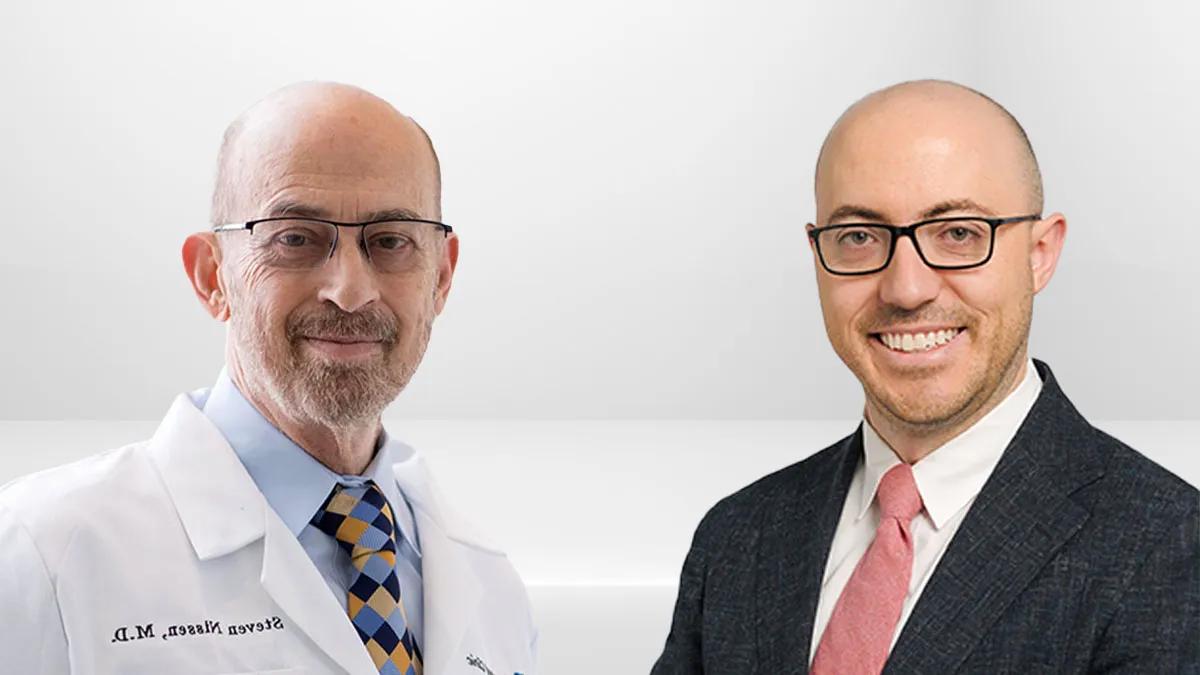
CTX310 and the Future of Gene Editing for Lipid Disorders
Steven Nissen, MD, and Luke Laffin, MD, discuss one-year follow-up data for CTX310, a CRISPR-Cas9 gene-editing therapy targeting ANGPTL3 to treat lipid disorders. They review the sustained reductions in LDL cholesterol and triglycerides, and the potential role of one-time gene-editing therapies in cardiovascular prevention and lipid management.
Read the article. https://consultqd.clevelandclinic.org/effects-of-crispr-cas9-gene-editing-for-dyslipidemia-endure-1-year
Advertisement
Cleveland Clinic is a non-profit academic medical center. Advertising on our site helps support our mission. We do not endorse non-Cleveland Clinic products or services. Policy
Recent Episodes
Talking Tall Rounds® Renal Denervation for Uncontrolled Hypertension
In this excerpt from Tall Rounds®, Luke Laffin, MD, discusses the evolving role of renal denervation for uncontrolled hypertension, includin…
Talking Tall Rounds® Cardiac Sarcoidosis: Systematic Team Approach to Diagnosis & Management
In this excerpt from Tall Rounds®, Cleveland Clinic experts discuss imaging modalities that aid the diagnosis of cardiac sarcoidosis. View…
Evolving Strategies in Aortic Arch Repair
Eric Roselli, MD, and Patrick Vargo, MD, discuss how advances in open, hybrid and endovascular techniques are changing the treatment of aort…
Video content: This video is available to watch online.
View video online (https://cdnapisec.kaltura.com/p/2207941/sp/220794100/playManifest/entryId/1_pqz8f9uh/flavorId/1_5f3sgelj/format/url/protocol/https/a.mp4)
Transcript
Announcer:
Welcome to Cardiac Consult, brought to you by the Sydell and Arnold Miller Family Heart, Vascular & Thoracic Institute at Cleveland Clinic. This podcast will explore the latest innovations, medical and surgical treatments, diagnostic testing, research, technology and practice improvements.
Advertisement
Cleveland Clinic is a non-profit academic medical center. Advertising on our site helps support our mission. We do not endorse non-Cleveland Clinic products or services. Policy
Dr. Steven Nissen:
I'm Dr. Steve Nissen, and I'm here with Dr. Luke Laffin, and we're going to talk about a really interesting therapy being developed known as CTX310. Dr. Laffin, tell us what is CTX310?
Dr. Luke Laffin:
Well, it's really an exciting innovation in medicine, Dr. Nissen. CTX310 is an infusion, and it's what we call CRISPR-Cas9 therapy. What it's meant to do is be directed towards the hepatocytes, the liver, and ultimately edit the genes with a CRISPR-Cas9 mechanism. What this does is it induces a double-stranded break within those hepatocytes. Specifically, you can target this to different lipid metabolism pathways. CTX310, for example, targets ANGPTL3, which is involved in lipid metabolism.
Dr. Steven Nissen:
Now, tell us what ANGPTL3 does.
Dr. Luke Laffin:
So, ANGPTL3 has a variety of impacts in terms of its effects on things like lipoprotein lipase, et cetera. Ultimately, if you inhibited its effects, what we've seen with other drug classes is that it reduces LDL cholesterol and can reduce also triglycerides, which is triglyceride-rich lipoproteins. The best example of this is a drug called evinacumab, which is a monoclonal antibody right now FDA-approved for the treatment of homozygous familial hypercholesterolemia. This was just another way to approach actually treating patients with lipid disorders.
Advertisement
Dr. Steven Nissen:
Now, you reported on some short-term data with CTX310 in the New England Journal of Medicine last year. You want to tell us a little bit more about what you found.
Dr. Luke Laffin:
We reported that in November of 2025, and this was really preliminary data among 15 participants looking at the safety and efficacy of the drug to change lipid biomarkers, and also ANGPTL3, other biomarkers within the blood. What we found in that is in the short term, it was safe, okay? There was only one participant who had an elevation in liver function tests. Really, the genesis of this was to figure out what the appropriate dose for this would be going forward in further or future trials. What we're reporting currently, or this most recent update, is the full one-year follow-up of these participants.
Dr. Steven Nissen:
Now, why would you want to look at one year? Wouldn't you expect the effects to be the same?
Dr. Luke Laffin:
You would, but the durability of such a treatment like this is really key. We have drugs that you can take once a day that can lower things like LDL cholesterol. We have other injectable therapies that you can take twice a year, but the promise of a one-time gene-editing therapy, almost essentially a one and done, is really exciting. What we wanted to demonstrate is those changes that were preliminary at about 60 days could be sustained up to 12 months.
Dr. Steven Nissen:
This is a once in a lifetime treatment.
Dr. Luke Laffin:
Well, theoretically, yes. I think we need to continue to follow these folks. Actually, regulatory agencies, particularly the United States FDA, suggest that they're followed for up to 15 years. But the mechanism is such that we should see durable lifelong reductions after a single treatment.
Dr. Steven Nissen:
Gene editing is kind of the next big thing, isn't it?
Dr. Luke Laffin:
It really is. When we think about things like hypertension, high cholesterol, we have good drugs for those right now. But one barrier that oftentimes comes up is adherence. We know adherence wanes even in people a year after they've had a heart attack. So, think about it as, if we could give someone a one-time treatment, what an amazing opportunity, and then we don't have to rely on an individual's adherence on a daily basis.
Dr. Steven Nissen:
Very exciting stuff. Now, what's next for this therapy, CTX310?
Dr. Luke Laffin:
This was studied in a small number of participants, 15 participants total, four at the highest dose. We're reporting this data, and that'll be published at the time of the European Society of Cardiology Congress. But what we're looking to next is more specific subgroups of patients. In this study, it was all comers with lipid disorders. Next, we're looking at patients with specific types of lipid disorders, particularly hypertriglyceridemia.
Advertisement
Dr. Steven Nissen:
So overall, the percent reduction in LDL cholesterol and triglycerides out to a year was approximately how much?
Dr. Luke Laffin:
It was right in the 50% range for both. That's what we reported at 60 days, and it didn't change very much with this time. With smaller numbers and sample size, there can be a little bit of variability, but both were right around 50% reduction. We hope that's maintained really throughout the rest of their lifetime.
Dr. Steven Nissen:
An exciting development. Thank you for updating us.
Dr. Luke Laffin:
Thanks, Dr. Nissen.
Announcer:
Thank you for listening to Cardiac Consult. We hope you enjoyed the podcast. For more information or to refer a patient to Cleveland Clinic, please call 855.751.2469. That's 855.751.2469. We welcome your comments and feedback. Please contact us at heart@ccf.org. Like what you heard? Subscribe wherever you get your podcasts or listen at clevelandclinic.org/cardiacconsultpodcast.
Advertisement
Recent Episodes
Talking Tall Rounds® Renal Denervation for Uncontrolled Hypertension
In this excerpt from Tall Rounds®, Luke Laffin, MD, discusses the evolving role of renal denervation for uncontrolled hypertension, includin…
Talking Tall Rounds® Cardiac Sarcoidosis: Systematic Team Approach to Diagnosis & Management
In this excerpt from Tall Rounds®, Cleveland Clinic experts discuss imaging modalities that aid the diagnosis of cardiac sarcoidosis. View…
Evolving Strategies in Aortic Arch Repair
Eric Roselli, MD, and Patrick Vargo, MD, discuss how advances in open, hybrid and endovascular techniques are changing the treatment of aort…
Never miss a moment - subscribe now.
Listen to the Health Essentials Podcast on your favorite streaming platform.
Other Podcasts You May Love
Beyond Leadership
Hosts Jim Pae and Elizabeth Pugel escort you through a network of thought leaders, sharing world-cla…
Beyond the Pages: CCJM Podcast
Beyond the Pages: CCJM Podcast takes the listener more in-depth into Cleveland Clinic Journal of Med…
Butts & Guts
A Cleveland Clinic podcast exploring your digestive and surgical health from end to end. You’ll lear…
Cancer Advances
A Cleveland Clinic podcast for medical professionals exploring the latest innovative research and cl…