



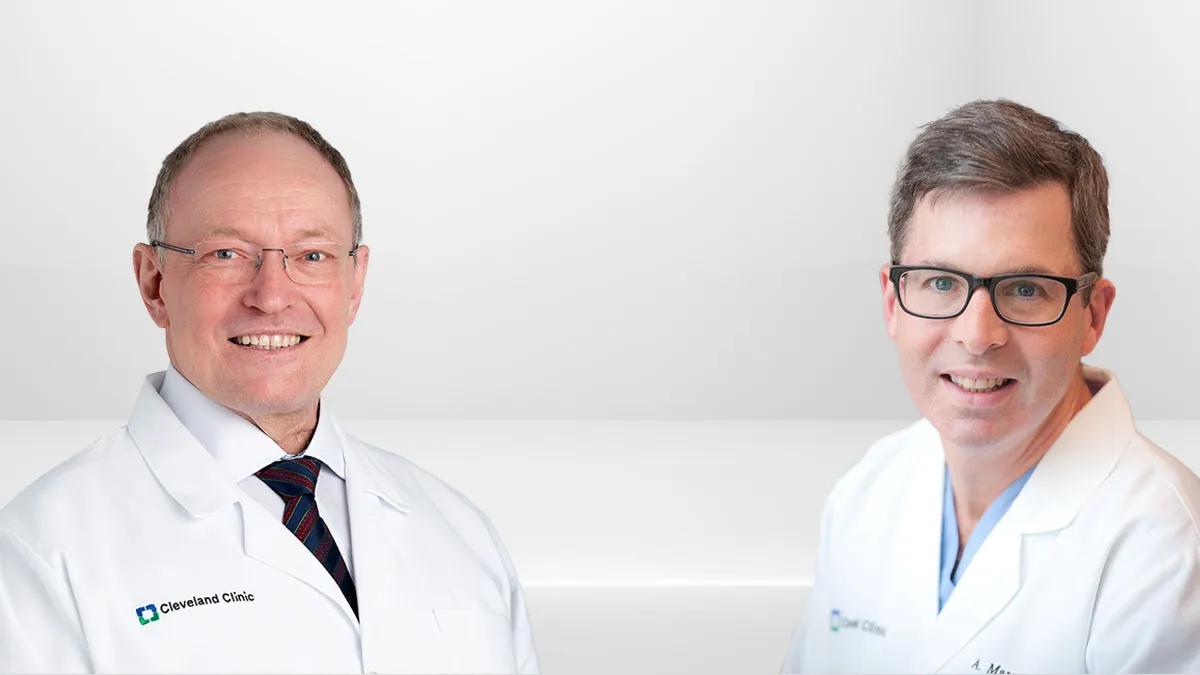
Robotic Approaches to Mitral and Aortic Valve Surgery
Marc Gillinov, MD, and Per Wierup, MD, discuss the evolution of robotic valve surgery, including advanced mitral valve repair techniques, patient selection and expanding applications for aortic valve and coronary procedures. They examine how enhanced visualization, instrument dexterity and a mature robotic program support excellent safety, durability and clinical outcomes.
Looking to refer a patient? Please reach out to our Physician Referral team Mon. - Fri., 8 a.m. - 5 p.m. (ET) at 855.751.2469.
Advertisement
Cleveland Clinic is a non-profit academic medical center. Advertising on our site helps support our mission. We do not endorse non-Cleveland Clinic products or services. Policy
Recent Episodes
Evolving Strategies in Aortic Arch Repair
Eric Roselli, MD, and Patrick Vargo, MD, discuss how advances in open, hybrid and endovascular techniques are changing the treatment of aort…
Management of Complex Aortic Valve Endocarditis
Milind Desai, MD, and Per Wierup, MD, discuss the evaluation and management of high-risk aortic valve endocarditis, including indications fo…
Lepodisiran and the Emerging Role of Oxidized Phospholipids in Lipoprotein(a) Risk
Luke Laffin, MD, speaks with Steven Nissen, MD, about findings from the ALPACA trial evaluating lepodisiran and its effects on oxidized phos…
Video content: This video is available to watch online.
View video online (https://cdnapisec.kaltura.com/p/2207941/sp/220794100/playManifest/entryId/1_34uufjv1/flavorId/1_5f3sgelj/format/url/protocol/https/a.mp4)
Transcript
Announcer:
Welcome to Cardiac Consult, brought to you by the Sydell and Arnold Miller Family Heart, Vascular & Thoracic Institute at Cleveland Clinic. This podcast will explore the latest innovations, medical and surgical treatments, diagnostic testing, research, technology and practice improvements.
Advertisement
Cleveland Clinic is a non-profit academic medical center. Advertising on our site helps support our mission. We do not endorse non-Cleveland Clinic products or services. Policy
Dr. Marc Gillinov:
I'm Dr. Marc Gillinov from Cleveland Clinic.
Dr. Per Wierup:
I'm Per Wierup from Cleveland Clinic.
Dr. Marc Gillinov:
Today, we're going to talk about minimally invasive and, in particular, robotic valve surgery. Why robotic? Because use of the surgical robot enables us to perform the least invasive operation that is possible, rather than the standard sternal approach. The surgical robot has a set of instruments that help us actually repair or replace a heart valve through that little incision.
The heart valves – that’s what we're talking about, fixing them and replacing them as necessary. One question patients often ask is, "Well, what do these heart valves do? How many of them are there?" We have a world-class expert in heart valves right next to me.
Dr. Per Wierup:
Every heart has four valves, and the purpose of the valves is really to make the blood circulation work. They are to open, to let the blood through, and then close to prevent the blood from leaking backwards into the heart. They are essential, and without functioning valves, you will not live a long life.
Dr. Marc Gillinov:
The most common problem we see is a leak to the mitral valve. The mitral valve is more or less the back door of the heart's main pumping chamber. When that chamber squeezes to send blood out to the body through its front door, the mitral valve, the back door, is supposed to close. If you have severe mitral valve prolapse, the valve is too stretchy and too floppy, and it doesn't close. We can most often, 99% of the time, we can repair that valve. You don't need a new valve. If you have a leaking mitral valve, we can repair it and make that valve as good as it was the day you were born and give you a normal life expectancy. The surgical robot with this little incision is an excellent tool, a perfect tool for repairing the valve. Dr. Wierup, you and I just last night were repairing valves. You could tell them, what do we do? What does the robot enable us to do so well?
Advertisement
Dr. Per Wierup:
Yeah, we repair valves all day, many valves a day, and we most of the time use the robot. There are really many techniques depending upon what's wrong with the valve. The most common, as you mentioned, is prolapse. These chordae, the thin thread that keeps them in shape, are broken or at least elongated. Then we either resect that area and rebuild the valve, or we add new cords there.
Most of the time, as part of the disease also, the opening becomes enlarged. In order to create a normal-sized opening, we finalize all our repairs by suturing in a band to create a normal-sized opening. We're very careful to avoid creating too small of an opening. We want the valve to look normal.
Dr. Marc Gillinov:
These days, the majority of people who have a leaking mitral valve can have it repaired with robotic techniques with the less invasive approach. We can also replace a valve. If somebody has a valve that has so much damage, it just can't be repaired, we can put a new one in, which could be either a mechanical metal valve or a pig valve, still through a little incision. Now here at Cleveland Clinic, we've pioneered techniques for replacing other heart valves. The most amazing to me: I saw this yesterday from one of our colleagues, Dr. Koprivanac, he replaced an aortic valve through a little incision in the neck. No chest incision at all, just a little incision in the skin line of the neck, and these heal beautifully.
All of the patients who have robotic surgery have a short hospital stay. They're only in the hospital for three or four days. Two weeks to three weeks after surgery, you might see a robotic surgery patient at a restaurant or out shopping, and you would have no idea that the person ever had heart surgery. It's a way for us to slip in, fix your valve, and then find you back to normal life very, very quickly.
Dr. Per Wierup:
One of the major advantages with robotic surgery is that not only that it transforms our movements through a very small hole, but we see the valve fantastically well. We have a 3D sense. It feels like we're practically sitting inside the heart. That is very different from when we're doing normal open surgery where we're looking down at the valve. Just look a little bit like part of my hand. But here we see it so fantastically well, so we can do everything there with, I would say, greater accuracy. The motion of the robotic system is so good that we can more or less twist our arms around it.
Dr. Marc Gillinov:
As with any medical procedure, patient selection is critical. With robotic cardiac surgery, we need to ensure that we do exactly the same operation. We don't compromise on safety or effectiveness when we use the robot in a smaller incision. Who's a candidate? Well, it turns out that the overwhelming majority of people who have mitral valve problems can have the operation done robotically. In addition, many people who need coronary artery bypass grafting can have a robotic approach. Today, even aortic valve replacement can be done robotically in a fair number of patients.
Advertisement
Patient selection depends on the results of the echocardiogram. Is this a valve that we believe we can repair or replace with the robot? The answer is almost always yes. Can we establish cardiopulmonary bypass or cannulate for the heart lung machine robotically, meaning we go through the femoral artery and vein? Can the patient tolerate that reversed blood flow? And then, on the cardiac catheterization, is there any other significant disease, coronary artery disease, that needs to be treated?
So, we go through a very detailed algorithm. At the end of the algorithm, the majority of mitral valve patients, almost all of them actually, can have a robotic approach. Many who need other procedures like aortic valves, coronary artery bypass grafting, and of course, removing cardiac tumors like myxomas, fibroelastomas, that is really very easy with the robot and an elegant operation.
Dr. Per Wierup:
When we use the robotic approach, we see the valve fantastically well. It feels like you're inside the heart. It's a great magnification, and we can move the instruments without any limitation. We repair the most complex mitral regurgitation as there is, and we have excellent results with that. When we do a robotic mitral repair, our results are, I would say, fantastic. We have absolutely the same results, both early and long-term, as with conventional surgery. We have excellent safety and long-term results.
Advertisement
Dr. Marc Gillinov:
If we say to ourselves, based on all of the patient's data, we can do this robotically with exactly the same result we'd get through a big incision in terms of your heart, but you're going to have a quicker recovery, less blood loss, lower risk of infection, then we should do it. It has been a long experience. We've been doing robotic surgery here for 20 years, more than 3,000 cases completed with our team. There was a learning curve in the beginning, and it is gratifying to say that we are really at the top of that learning curve.
Of course, every day we want to be better than we were yesterday, but it is such a standardized procedure here with our teams that every single day of the week we're doing robotic surgery in two operating rooms. We have two state-of-the-art cardiac robots. We work together, and the patients, when you make rounds, they just look fabulous.
Dr. Per Wierup:
We have been doing this robotic mitral repair for so long now, and it's such an enormous amount of patients and surgeries that we are well beyond all the technical challenges. Now we repair practically every single valve, no matter how complex they are, and we can do it robotically.
Announcer:
Thank you for listening to Cardiac Consult. We hope you enjoyed the podcast. For more information or to refer a patient to Cleveland Clinic, please call 855.751.2469. That's 855.751.2469. We welcome your comments and feedback. Please contact us at heart@ccf.org. Like what you heard? Subscribe wherever you get your podcasts or listen at clevelandclinic.org/cardiacconsultpodcast.
Advertisement
Recent Episodes
Evolving Strategies in Aortic Arch Repair
Eric Roselli, MD, and Patrick Vargo, MD, discuss how advances in open, hybrid and endovascular techniques are changing the treatment of aort…
Management of Complex Aortic Valve Endocarditis
Milind Desai, MD, and Per Wierup, MD, discuss the evaluation and management of high-risk aortic valve endocarditis, including indications fo…
Lepodisiran and the Emerging Role of Oxidized Phospholipids in Lipoprotein(a) Risk
Luke Laffin, MD, speaks with Steven Nissen, MD, about findings from the ALPACA trial evaluating lepodisiran and its effects on oxidized phos…
Other Podcasts You May Love
Beyond Leadership
Hosts Jim Pae and Elizabeth Pugel escort you through a network of thought leaders, sharing world-cla…

Beyond the Pages: CCJM Podcast
Beyond the Pages: CCJM Podcast takes the listener more in-depth into Cleveland Clinic Journal of Med…

Butts & Guts
A Cleveland Clinic podcast exploring your digestive and surgical health from end to end. You’ll lear…

Cancer Advances
A Cleveland Clinic podcast for medical professionals exploring the latest innovative research and cl…