When Amanda Cox was 14 years old, she experienced back pain that she thought was due to exercise. But a routine school screening revealed that she had scoliosis, a condition in which the spine curves side to side.
“When someone is diagnosed with scoliosis it’s important to get regular follow-up checkups to ensure that the curve is not progressing,” says J. Manuel Sarmiento, MD, a neurosurgeon at Cleveland Clinic Weston Hospital.
Amanda’s pain progressed and, once she was in her 20s, she began limiting the amount of walking she was doing.
“I was laying down a lot. I was trying to see if I (could avoid) surgery,” Amanda says. She soon realized that surgery was inevitable if she didn’t want to be in pain anymore.
She found Dr. Sarmiento after doing a lot of research and says he was “direct and honest” with her. She was happy to have found someone that really cared.
“Even though Amanda was diagnosed with scoliosis as an adolescent, she was never formally treated,” Dr. Sarmiento says. “This was going to be her first scoliosis surgery as a woman in her early 30s and that presents a little bit more challenge than in adolescence.” The bones of an adult are more mature, so you must “loosen” the spine to get as good of a correction as you would in adolescence, he added.
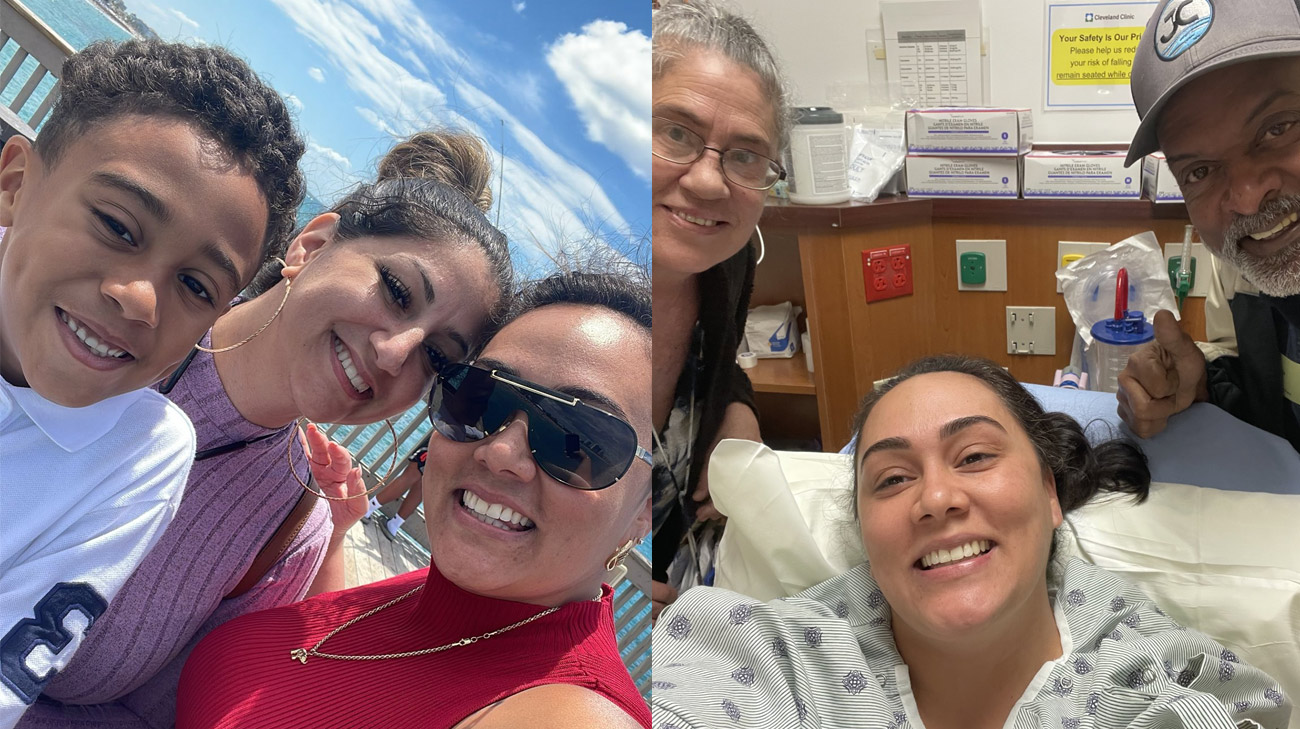
Amanda’s spine was curved in two places, which resulted in it pushing on her nerves, lungs and kidneys. The curves were symmetrical, however, which kept her head perfectly aligned over her shoulders and over her waist and pelvic area.
Amanda underwent posterior spinal fusion that involved correcting the curves in her thoracic and lumbar spine.
“The final result was a good correction of her scoliosis that kept her spine in proper balance and preserved her mobility,” Dr. Sarmiento says.
Amanda has not had any pain since the surgery. She has no restrictions and is living a fully functional life.
“I have done a 360 as far as going from not being able to do anything physical to now being able to run around with the kids and get back to who I was before all of this,” Amanda says. “Dr. Sarmiento gave me my younger life back and I am just grateful, very happy.”
Related Institutes: Neurological InstitutePatient Stories
Cleveland Clinic Team Helps Florida Patient Breathe Easier After Complex Lung Surgery
Oct 21, 2026

Teen Athlete Returns to Sports After Two Head Injuries Trigger Yearlong Headache
Oct 19, 2026