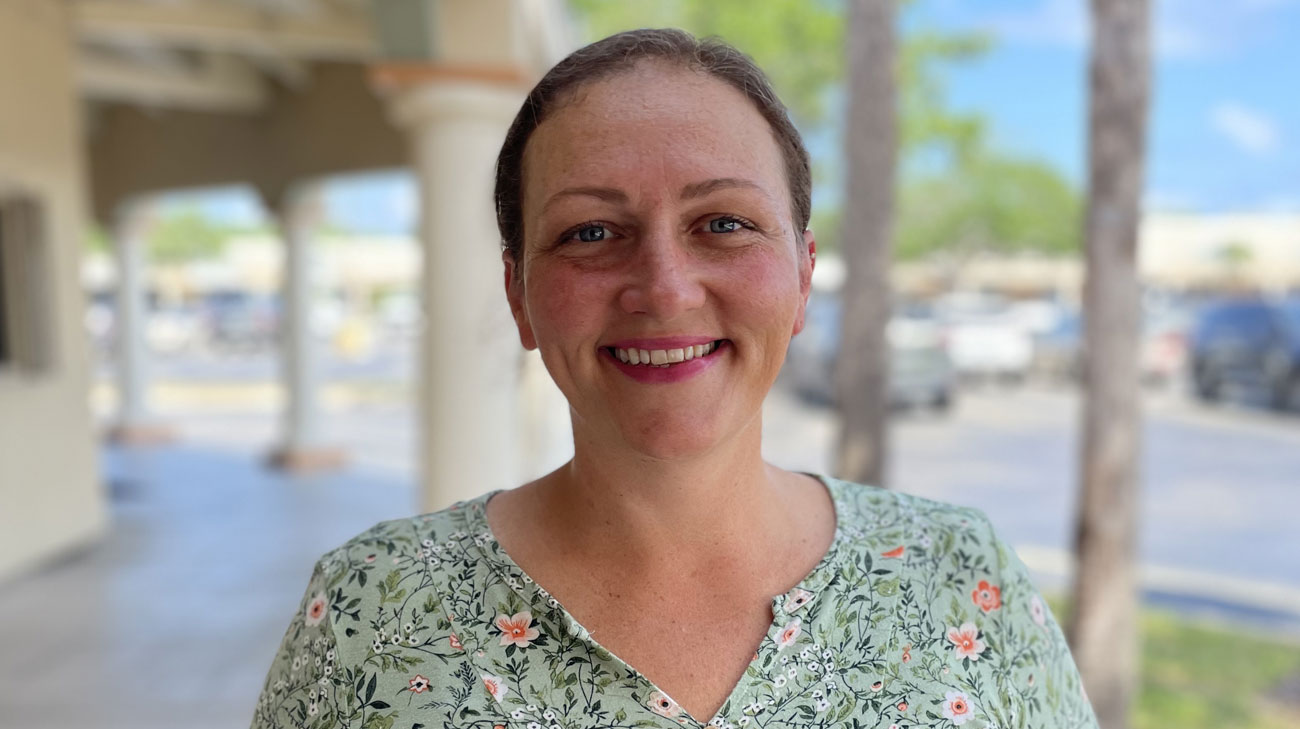
For 41-year-old Heather Leonard, it began as a normal workday in Stuart, Florida. She had no known history of brain aneurysms, no family history and no warning signs.
Shortly after 5 p.m., Heather stood up from her desk and suddenly became nauseated. Moments later, she collapsed. A coworker called for help. Heather was experiencing a ruptured brain aneurysm, a life-threatening emergency that requires immediate treatment.
Paramedics took her to Cleveland Clinic Tradition Hospital, where the Advanced Comprehensive Stroke Center team quickly evaluated her and began care. As a Joint Commission-designated Advanced Comprehensive Stroke Center, the hospital is equipped to treat complex stroke and aneurysm emergencies with advanced imaging, neuro-intervention, neurocritical care and coordinated rehabilitation.
Heather’s care team included Jeffrey Miller, MD, endovascular neurosurgery; Fouad Abuzeid, MD, neurocritical care; and Marc Alain Babi, MD, MBA, neurocritical care specialist. Dr. Miller performed endovascular coiling, a minimally invasive procedure used to treat the ruptured aneurysm and prevent further bleeding.
“Time and coordination are critical in complex stroke and aneurysm emergencies,” said Dr. Babi. “Heather’s case shows the value of having advanced stroke capabilities close to home, supported by a multidisciplinary team that can rapidly diagnose, treat and manage these high-risk neurologic conditions.”
After the procedure, Heather spent about two and a half weeks in the Neuro Intensive Care Unit, where her team monitored her for complications such as vasospasm, managed her blood pressure and closely tracked her neurologic status.
“Surviving my aneurysm changed me in ways I’m still learning”
As she improved, Heather moved from the ICU to a hospital floor and later continued rehabilitation at Encompass Health in Stuart. Therapy helped her rebuild strength and address early challenges with memory and writing.
Heather experienced headaches and weakness after the event and learned that controlling her high blood pressure would be an important part of her recovery.
Over time, her writing, memory and strength improved. Today, she has returned to work with a home health agency in Stuart. Her recovery is especially meaningful because she has a background in nursing and previously worked at Cleveland Clinic Martin Health.
Heather says recovery from a ruptured aneurysm is not only physical.
“Surviving my aneurysm changed me in ways I’m still learning,” she said. “I may look the same on the outside, but recovery has been just as much mental as physical. The fatigue and cognitive challenges aren’t visible, but they’re real. I’m learning to slow down, listen to my body and redefine what strength looks like.”
Related Institutes: Neurological InstitutePatient Stories

Young Girl Overcomes Rare Cancer That Spread to Her Lungs and Spine
Sep 30, 2026

Football Player Lewis Cine Recovers After Successful Leg Surgery
Sep 29, 2026