New World screwworm is a pest insect that was eradicated in the U.S. for decades until it returned in June 2026. It usually infects animals, especially livestock. But it can also infect humans with uncovered open wounds, or by laying eggs in openings on your body. The best way to deal with an infection is to get it treated fast or prevent it entirely.
Advertisement
Cleveland Clinic is a non-profit academic medical center. Advertising on our site helps support our mission. We do not endorse non-Cleveland Clinic products or services. Policy
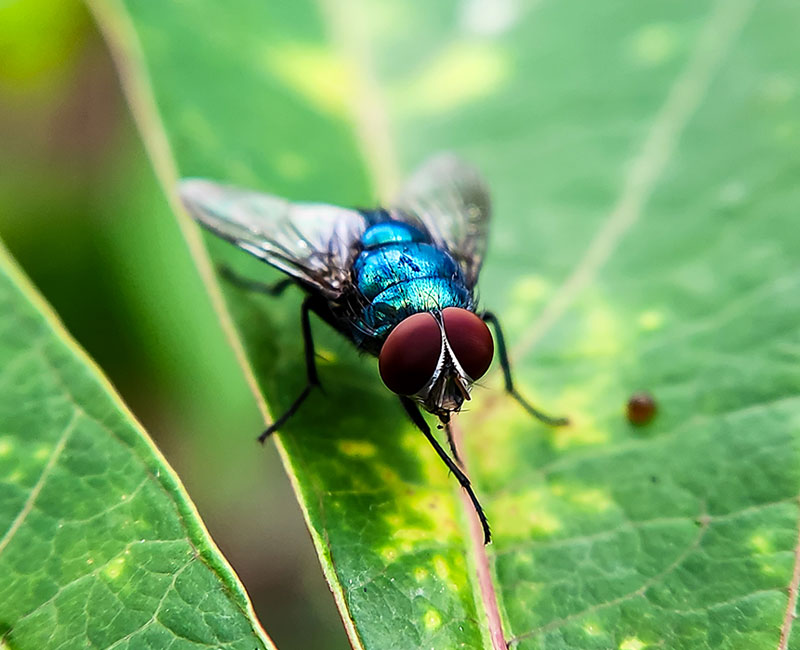
Image content: This image is available to view online.
View image online (https://my.clevelandclinic.org/-/scassets/images/org/health/articles/new-world-screwworm.jpg)
New World screwworm is a type of parasite that mainly affects animals but can also affect humans. The larvae of the New World screwworm fly cause a condition called myiasis (pronounced “my-EYE-uh-sis”). That’s where larvae from an insect grow inside you. As they do, they feed on your tissues from inside.
Advertisement
Cleveland Clinic is a non-profit academic medical center. Advertising on our site helps support our mission. We do not endorse non-Cleveland Clinic products or services. Policy
The scientific name for New World screwworm is Cochliomyia hominivorax. This insect is widespread in almost all of South America and Central America, as well as in Cuba, Haiti and the Dominican Republic. People living or traveling to those places have the highest risk of getting this parasite. It was wiped out in the U.S. in the 1960s, but returned in June 2026.
New World screwworm refers to this insect in its larval stage. You might also see the adult stage called a “screwworm fly.” But that term can also refer to more than one species. People also sometimes refer to these as “flesh-eating.” That’s because the larvae feed on soft tissue. But the term can be misleading. Several different parasitic insects can damage tissue in similar ways.
New World screwworm infections happen in wounds or sores. This includes wounds that are tiny and that you might not even notice at first. These don’t heal and get worse unexpectedly or for reasons you can’t explain. The symptoms you might have include:
You can have these wounds and sores anywhere on your skin. The flies can also lay eggs in your:
Advertisement
This parasitic infection happens when a New World screwworm fly lays its eggs somewhere vulnerable, like a wound or opening. Once the eggs hatch, the maggots (larvae) burrow into the surrounding tissue and start to feed on it. This insect gets its name from how it looks like a screw digging into a piece of wood.
The New World screwworm life cycle takes just under three weeks. The cycle has four phases:
There are a few main risk factors for infection from New World screwworm:
New World screwworm infections can be severe. And the longer they go untreated, the worse the complications are likely to be. Some severe complications can include:
The infection can also be severe if it happens in sensitive areas. That’s especially true when the infection is in your ears or nose. In those cases, larvae can make their way into your brain. This is most likely to happen in children.
Healthcare providers can usually diagnose New World screwworm by looking at an infected wound. They’ll also ask about symptoms you’ve had and any recent injuries or travel. Those questions can help your provider rule out other types of parasites that cause similar infections.
New World screwworm is very treatable, especially when caught early. But the longer it takes to get treatment, the more damage the larvae can do inside your body.
Treating New World screwworm usually involves a combination of medicine and surgery. Surgery is important for removing New World screwworm because of how they embed themselves inside your body. You should never try to pull them out yourself, as that will just make them dig in deeper.
Medicines are important for treatment, too, because they can stop the larva from doing more damage during removal. Some medicines paralyze or knock out the parasites, making them much easier to remove. Other medicines, like antibiotics, can treat or prevent follow-up infections in wounds left behind by the parasites.
Advertisement
Surgery after removing the larvae may also help in other ways. For instance, it can repair damage left behind and minimize scarring.
Treatment options can also vary somewhat, depending on where the infection is on your body and other factors. Your healthcare provider can tell you more about possible treatments and how they may help.
Yes, ivermectin works on many types of parasites, including New World screwworm infections. But it isn’t the only treatment you’ll need. You’ll also need removal of the larvae and eggs, plus surgery to remove any dead or dying tissue.
You should also only use ivermectin if your healthcare provider prescribes it. That’s because ivermectin comes in multiple forms, and it can cause serious or even deadly reactions. Your healthcare provider can prescribe the proper form, tell you how to use it safely, and help you get the other care you’ll need to remove the larvae and eggs.
Any wound that’s slow to heal and increasingly painful needs professional medical care. It’s also important to get care sooner rather than later. That’s especially true if you live or have traveled someplace where New World screwworm is present. You may also want to talk to a provider if you have symptoms and remember a New World screwworm fly on your skin near a wound or sore, or saw one on or around an animal near you.
Advertisement
New World screwworm is extremely treatable, especially early on. But the longer it takes to get treatment, the worse it can get. Don’t hesitate to get care if you think you might have it.
It’s also important to get treatment quickly so your healthcare providers can notify local authorities. (Your providers and authorities will keep your identity confidential.) Notifying authorities is critical because it lets them take steps to interrupt the flies’ life cycle. That can stop more cases from happening.
New World screwworm infections are extremely preventable. Some of the most important things you can do include:
Advertisement
While the U.S. successfully wiped out this pest in the 1960s, New World screwworm returned in early June 2026. Over a dozen animal cases were confirmed in Texas and New Mexico within the first three weeks of the month. These early cases were mainly in cattle, but there were also dog and goat cases. No human cases were confirmed in that same timeframe.
Maybe you have a wound that’s slow to heal and very painful. Or maybe you have a disturbing sensation that something is moving around under your skin near a wound. If the thought of a parasite infecting a wound on your body sends shivers down your spine, you’re not alone.
But New World screwworm is very treatable, especially when caught early. And better yet, it’s extremely preventable.
If you live in or travel to Central or South America or parts of the Caribbean, don’t forget to protect yourself.
The best way to deal with a parasitic infection is not to get one in the first place. The next best way to deal with an infection is to get it treated fast.



Sign up for our Health Essentials emails for expert guidance on nutrition, fitness, sleep, skin care and more.
Learn more about the Health Library and our editorial process.
Cleveland Clinic’s health articles are based on evidence-backed information and review by medical professionals to ensure accuracy, reliability and up-to-date clinical standards.
Cleveland Clinic’s health articles are based on evidence-backed information and review by medical professionals to ensure accuracy, reliability and up-to-date clinical standards.
Need care fast? Cleveland Clinic’s Express Care and Urgent Care locations treat everything from sprains to sinus infections — no appointment needed.