Equinus contracture happens when something makes your ankle joint stiffer than usual. This extra stiffness prevents your foot from flexing up, toward your shin, like normal. It can affect the way you walk and move. A healthcare provider will treat the underlying cause, usually with physical therapy and other nonsurgical options.
Advertisement
Cleveland Clinic is a non-profit academic medical center. Advertising on our site helps support our mission. We do not endorse non-Cleveland Clinic products or services. Policy
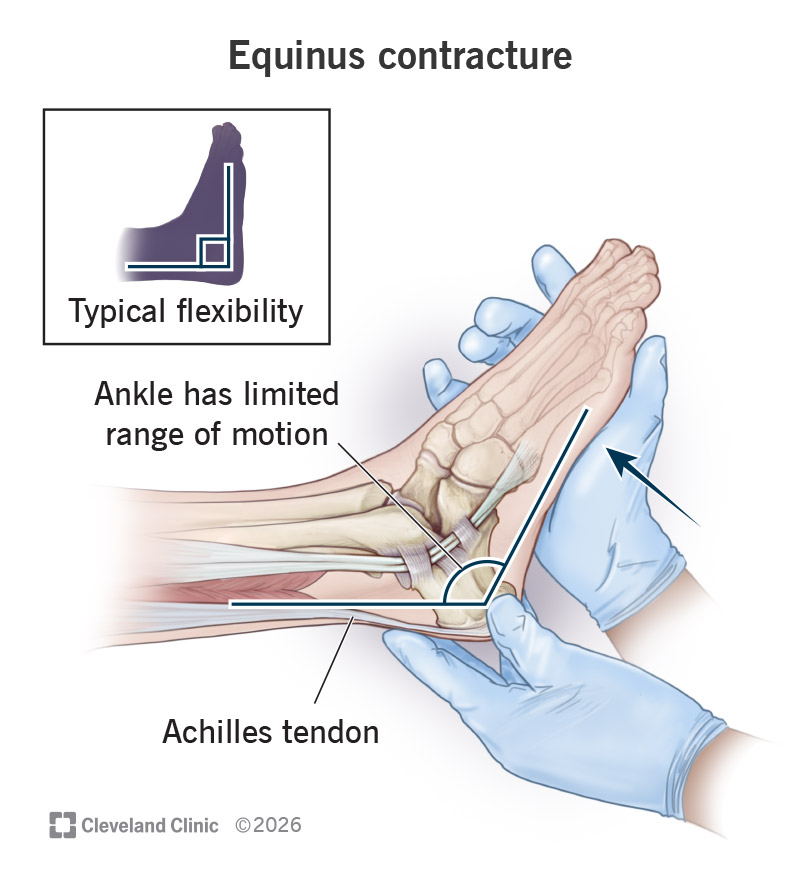
Image content: This image is available to view online.
View image online (https://my.clevelandclinic.org/-/scassets/images/org/health/articles/equinus-contracture)
Equinus contracture is when your ankle is too stiff to bend your foot upward as far as it should. Healthcare providers also call it ankle equinus, equinus deformity or just equinus.
Advertisement
Cleveland Clinic is a non-profit academic medical center. Advertising on our site helps support our mission. We do not endorse non-Cleveland Clinic products or services. Policy
Knowing what the words in equinus contracture mean can help you understand it better. Equine is a word that means like or related to a horse. A contracture is the medical term for a body part being stiffer than normal and unable to move as far.
Normally, your foot can move up, toward your shin. This helps you keep your balance and push off when you walk. It also absorbs impacts from moving.
Equinus makes your ankle stiffer and less flexible than it should be. Your foot won’t be able to move as far. You might walk on your toes with your heels off the ground. This can make your leg look a bit like a horse’s. A horse holds all its weight on the front of its hoof and doesn’t have a heel that touches the ground.
Mild tightness in your ankle isn’t usually a problem. And it’s normal for kids to lose some ankle flexibility as they develop. Equinus matters most when it causes symptoms or changes how you walk.
Your ankle being stiffer than usual is the main symptom of equinus contracture. But you probably won’t be able to notice this in yourself. A loved one might point out that you’ve started walking differently. If your child has equinus, you might notice them toe walking.
Most people with equinus can’t feel the stiffness. Your body will compensate automatically, and symptoms somewhere else are often what you’ll notice first.
Advertisement
Over time, the changes to your posture and how you move put extra pressure on other parts of your feet and legs. This can lead to pain and other symptoms that are more noticeable. You might have:
Ankle equinus usually happens when your calf muscles or Achilles tendon are tighter or shorter than they should be. You might be born with naturally tight tendons and muscles.
Anything that changes how you hold your foot and ankle can lead to equinus. If you’re not using your ankle joint’s full range of motion often, your muscles and Achilles tendon can stiffen up over time. Some common causes of this tightness include:
Health conditions and injuries that affect your ankles can lead to equinus, including:
A healthcare provider will diagnose equinus with a physical exam and some tests. Because most people don’t know they have equinus or any extra tightness in their ankle, there’s a good chance your provider will diagnose it when you visit them for issues like foot or ankle pain.
Your provider will ask about your health history. Let them know if you’ve had any injuries or if you have any health conditions that affect your joints.
Your provider will examine your foot and ankle. They’ll measure how far your ankle bends up with your knee straight, and again with your knee bent. If your ankle moves farther with your knee bent, the tightness is more likely to be in your upper calf muscle. They may have you stand and walk. This is called a gait analysis.
Your provider might order X-rays to take pictures of your ankle. This can show any current or past injuries or issues that might affect how much your ankle can move.
Your healthcare provider will suggest equinus treatments based on the cause. For example, if you develop equinus from wearing a cast or needing crutches, it may go away on its own once you’ve recovered enough to use your foot and ankle like normal. You might have to change the kinds of shoes you wear, or avoid certain types.
Advertisement
Your provider will recommend treatments for specific health conditions. They’ll tell you what to expect based on your unique needs and circumstances.
Some ankle equinus treatments include:
It’s rare to need surgery. Your provider will usually only suggest it if you have an old fracture, a congenital issue or a neurological condition that affects how much you can move your ankle. They might recommend surgery if you have severe symptoms and other treatments haven’t helped after several months.
Visit a healthcare provider if you have foot or ankle pain that lasts more than a few days in a row. Or if you have pain in your knees, hips, back or any muscles.
You probably won’t notice ankle equinus in yourself. But talk to a provider if a loved one points out that you’re holding your body or moving in a way that’s noticeably different. Some of the causes can be subtle, and the sooner you get changes checked out, the better.
It depends on what causes it. Most people are able to manage pain and other issues with nonsurgical treatments. But there’s always a chance that equinus could come back. This is more likely if you have a chronic condition and not a temporary injury.
Advertisement
Talk to your healthcare provider. They’ll help you set realistic goals and expectations. Even if you experience symptoms again, you should be able to manage them once you find the right combination of exercises, stretches and other treatments.
Equinus contracture might sound like a spell from a fantasy movie. But the truth is much closer to home. And anything that affects how you can move and use your foot is less like magic and more like a frustrating annoyance.
The good news is that it’s treatable. What you’ll need to do depends on what’s causing the equinus. But your healthcare provider is there to help you find the right ways to manage it.
Advertisement



Sign up for our Health Essentials emails for expert guidance on nutrition, fitness, sleep, skin care and more.
Learn more about the Health Library and our editorial process.
Cleveland Clinic’s health articles are based on evidence-backed information and review by medical professionals to ensure accuracy, reliability and up-to-date clinical standards.
Cleveland Clinic’s health articles are based on evidence-backed information and review by medical professionals to ensure accuracy, reliability and up-to-date clinical standards.
From sudden injuries to chronic conditions, Cleveland Clinic’s orthopaedic providers can guide you through testing, treatment and beyond.