



Coffin-Siris syndrome is a rare disease that’s present at birth. It can affect your child’s development, appearance and overall health. Symptoms can range from mild to complex. Coffin-Siris syndrome affects every child differently. Early support and ongoing care can help your child grow, learn and reach important milestones.
Advertisement
Cleveland Clinic is a non-profit academic medical center. Advertising on our site helps support our mission. We do not endorse non-Cleveland Clinic products or services. Policy
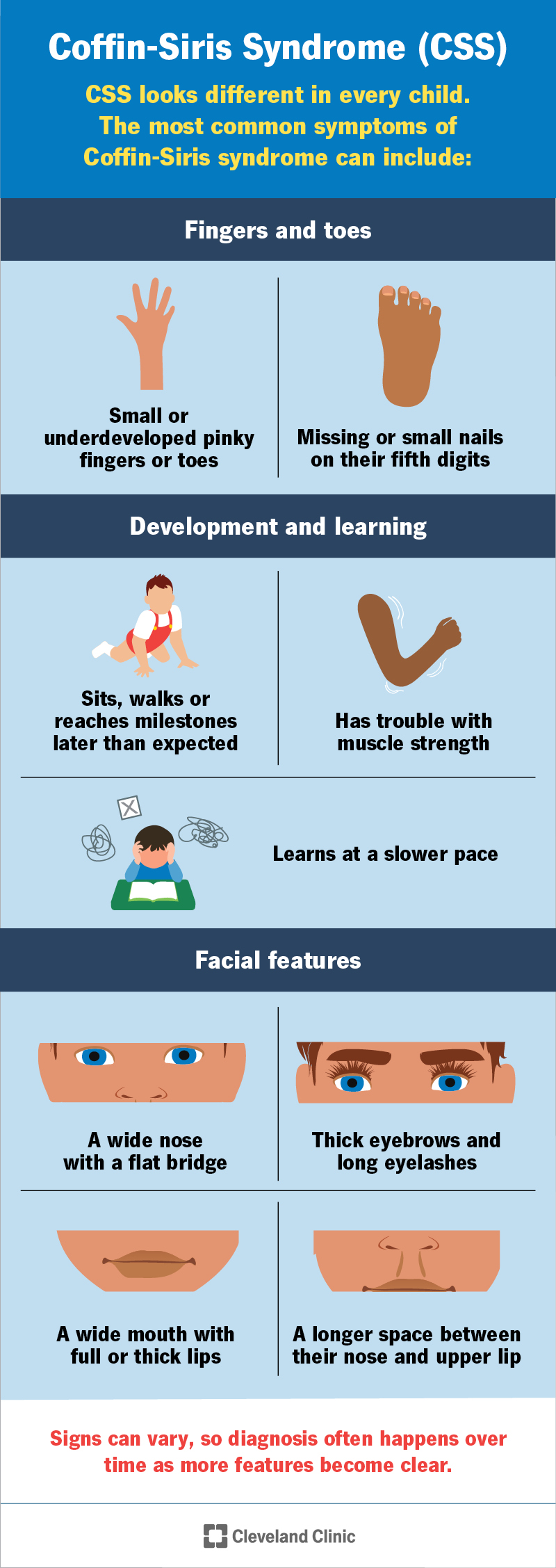
Image content: This image is available to view online.
View image online (https://my.clevelandclinic.org/-/scassets/images/org/health/articles/coffin-siris-syndrome.jpg)
Coffin-Siris syndrome (CSS) is a rare genetic condition that can affect many parts of your child’s body. Signs and symptoms vary widely, but most children will experience:
Advertisement
Cleveland Clinic is a non-profit academic medical center. Advertising on our site helps support our mission. We do not endorse non-Cleveland Clinic products or services. Policy
CSS looks different in every child. Treatment focuses on managing your child’s specific needs and helping them grow and develop over time. Another name for the condition is fifth digit syndrome.
Healthcare providers look at Coffin-Siris syndrome on a spectrum. That means symptoms and their severity can be very different from one child to another. Some children have mild differences, and others have more complex medical needs.
Many children with Coffin-Siris syndrome have facial features that may look different from what’s typical. Providers sometimes call these “coarse facial features.” This doesn’t mean anything negative. It’s just a medical term providers use to describe certain shared traits. These may include:
Hair differences are also common. These features may be subtle at birth and become more noticeable as your child grows. Your child might have:
Advertisement
One of the most common signs of Coffin-Siris syndrome involves your child’s fifth fingers and toes (their “pinkies”). They may have:
Feeding challenges and growth issues are very common, especially in babies and young children. You might notice:
Most children with Coffin-Siris syndrome have some level of developmental delay or intellectual disability. This can range from mild to more severe. Your child may:
Some kids with Coffin-Siris syndrome talk. But speech delays are common. Children with the condition usually understand more than they can say. First words may come later, and building sentences can take time. Some children have limited or no spoken language, especially if delays are more severe.
Behavioral issues with Coffin-Siris syndrome can include:
Children with Coffin-Siris syndrome may have issues in other parts of their body. Symptoms and conditions may include:
A change (variant) in a gene causes Coffin-Siris syndrome. The most common gene involved is ARID1B. But changes in one of 13 other genes can also cause the condition. These include:
About 4 out of 10 people with CSS have normal genetic testing. So, there are likely more genes yet to be discovered.
These genes help control how other genes turn “on” and “off.” Your body has many instructions, but it doesn’t use them all at once. These genes help decide which instructions to use and when. When there’s a change in one of these genes, it can disrupt the process. That’s why CSS can affect many parts of your child’s body.
Coffin-Siris syndrome follows an autosomal dominant inheritance pattern. That means you only need one copy of the changed gene to develop the condition. But most cases of Coffin-Siris syndrome aren’t inherited. Instead, the gene change usually happens by chance. A new, or “de novo,” variant forms early in fetal development. If a person with CSS were to have a child, then the chance would be 50%.
Nothing you did before or during pregnancy caused this condition. These gene changes happen randomly. Researchers are still learning more about Coffin-Siris syndrome and the related genes.
Advertisement
Researchers don’t know why, but Coffin-Siris syndrome appears to affect females more frequently.
It’s rare, but sometimes an unaffected parent can pass the gene change down. If your child has CSS, you may want to consider genetic counseling. It can help you understand what caused the condition and the chances of it happening again.
Your child’s healthcare provider may suspect Coffin-Siris syndrome based on their symptoms and physical features. Signs can vary, so diagnosis often happens over time as more features become clear.
The only way to confirm Coffin-Siris syndrome is through genetic testing. This test looks for changes in the genes known to be linked to CSS.
If a known gene change runs in your family, testing during pregnancy may be an option. These tests include chorionic villus sampling (CVS) and amniocentesis.
After diagnosis, your child’s provider may recommend other tests to better understand how Coffin-Siris syndrome affects their body. These tests may include:
There’s no cure for Coffin-Siris syndrome. Treatment is ongoing and may change as your child grows. It focuses on managing your child’s symptoms and helping them reach their full potential.
Advertisement
Early intervention is a key part of treatment. Your child may benefit from:
Some children may also use tools like communication devices, eyeglasses or hearing aids.
Feeding problems are common in children with Coffin-Siris syndrome. Treatment may include:
Treatment may also include care for specific symptoms or conditions, like:
Researchers are studying new approaches, like gene therapy. But right now, it’s unclear how these treatments might work.
If your child has Coffin-Siris syndrome, regular checkups are an important part of their care. These visits help providers track your child’s growth and development. During these appointments, their provider will:
You should also keep up with routine care, like vision, hearing and dental checkups.
Advertisement
In general, don’t wait for something to feel “wrong.” Ongoing care helps catch concerns early and ensures your child gets the right support as they grow.
There isn’t enough long-term research to know exactly how Coffin-Siris syndrome affects life expectancy. But many people with CSS can live into adulthood. Adults with this condition have been reported in their 20s, 30s and beyond, including at least one person who lived into their late 60s.
Outcomes can vary widely depending on your child’s symptoms and overall health. In rare cases, serious complications, like aspiration pneumonia and seizures, can affect life expectancy. Children who need significant breathing support or have complex medical needs may have a higher risk of serious complications, especially at younger ages.
Every child with Coffin-Siris syndrome has their own strengths, challenges and path forward. The condition can affect many areas of development. But early support and ongoing care can make a big difference. Living with Coffin-Siris syndrome means taking things one step at a time. Don’t hesitate to lean on your child’s providers for guidance, resources and reassurance along the way.



Sign up for our Health Essentials emails for expert guidance on nutrition, fitness, sleep, skin care and more.
Learn more about the Health Library and our editorial process.
Cleveland Clinic’s health articles are based on evidence-backed information and review by medical professionals to ensure accuracy, reliability and up-to-date clinical standards.
Cleveland Clinic’s health articles are based on evidence-backed information and review by medical professionals to ensure accuracy, reliability and up-to-date clinical standards.
Do certain health conditions seem to run in your family? Are you ready to find out if you’re at risk? Cleveland Clinic’s genetics team can help.
