



Microcephaly is a condition that causes your baby’s head to be smaller than expected. It may be the only condition your baby has. Or it can happen alongside other birth differences. Microcephaly can affect their ability to learn and meet developmental milestones for their age. Each case is unique.
Advertisement
Cleveland Clinic is a non-profit academic medical center. Advertising on our site helps support our mission. We do not endorse non-Cleveland Clinic products or services. Policy
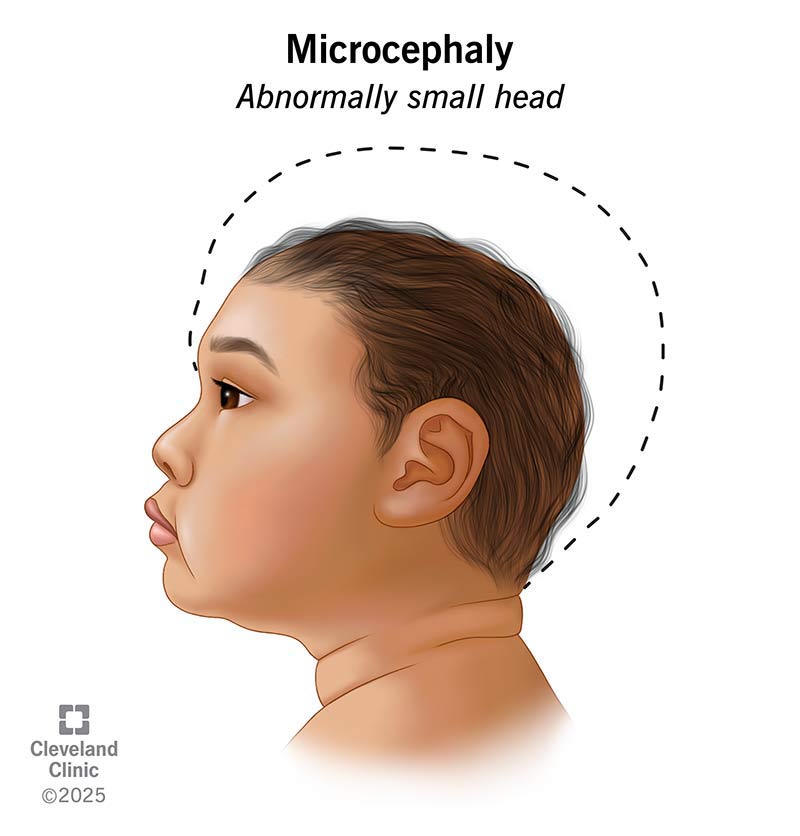
Image content: This image is available to view online.
View image online (https://my.clevelandclinic.org/-/scassets/images/org/health/articles/9843-microcephaly)
Microcephaly is a rare condition where your baby’s head is much smaller than expected for their size and age. It can happen because their brain didn’t develop properly during pregnancy. Or it doesn’t grow typically after birth.
Advertisement
Cleveland Clinic is a non-profit academic medical center. Advertising on our site helps support our mission. We do not endorse non-Cleveland Clinic products or services. Policy
To receive a microcephaly (my-crow-SEF-uh-lee) diagnosis, your baby’s head circumference must be in the 3rd percentile or lower. A head circumference in the 3rd percentile means 3% of all infants have a smaller head size, and 97% have a larger head size.
Microcephaly can happen alongside other birth defects. Or it may be the only condition your baby has. The brain is key to countless body and mind functions. Because of this, your baby may have difficulty with things like learning and movement.
But it’s impossible to predict what challenges microcephaly may bring. Your child’s healthcare team will guide you through the next steps.
There are two types of microcephaly:
A small head is the main symptom of microcephaly. The size of your baby’s brain affects the size of their head.
As your child grows older, their face continues to grow while their skull doesn’t. This may lead to a large face in comparison to their head size. They may also have a:
Microcephaly happens when there’s a lack of brain growth or changes to how your child’s brain grows. Healthcare providers can’t always find the exact cause. But it can be genetic or due to environmental factors.
Advertisement
Some causes of microcephaly include:
Microcephaly can lead to complications, like:
Healthcare providers can sometimes diagnose microcephaly before birth with a prenatal ultrasound. This happens late in the second trimester or in the third trimester.
But a diagnosis most often happens within 24 hours after birth. A provider will measure your baby’s head circumference (all the way around). Then, they’ll compare it to growth charts for their age. This also considers your baby’s length and weight.
If your baby has secondary microcephaly, a provider will diagnose the condition when it becomes noticeable.
Your child’s provider will likely suggest more tests to find the underlying cause. Tests may include:
There’s no treatment to make your baby’s brain and head grow. But certain therapies can help with issues related to microcephaly, like:
Your child’s care team will likely include pediatricians, neurologists and therapists. They can provide treatment and education to help your baby’s health and well-being.
Visit your child’s healthcare provider if they:
Call 911 or your local emergency services number if your child has a seizure.
It may be helpful to ask your child’s care team the following questions:
Advertisement
Microcephaly is a lifelong condition. Your child’s outlook depends on the cause and its severity.
Healthcare providers usually don’t know the effects of it until your child grows and develops. Their provider will monitor them to catch any complications that arise.
Life expectancy also varies. According to one study, about 80% of infants with severe microcephaly survived to 4 years of age. In general, children with just microcephaly are more likely to live longer than children with microcephaly and other conditions, like chromosomal syndromes.
But these are just statistics. Each case is unique.
Microcephaly isn’t always preventable. You can’t control genetics. But you can reduce the risk of environmental causes by taking care of yourself during pregnancy. This could include:
Talk to your provider about other ways to stay healthy during pregnancy.
Birth defects are still possible even if you’ve done everything your healthcare provider recommends to have a healthy pregnancy. Learning about a microcephaly diagnosis can lead to a lot of worry and unknowns. Your healthcare team will be there to answer all your questions. They’ll help you and your child adapt to challenges that may arise.
Advertisement
It may help to find comfort in talking with a mental health professional, joining a support group or surrounding yourself with friends and family.
Advertisement



Sign up for our Health Essentials emails for expert guidance on nutrition, fitness, sleep, skin care and more.
Learn more about the Health Library and our editorial process.
Cleveland Clinic’s health articles are based on evidence-backed information and review by medical professionals to ensure accuracy, reliability and up-to-date clinical standards.
Cleveland Clinic’s health articles are based on evidence-backed information and review by medical professionals to ensure accuracy, reliability and up-to-date clinical standards.
As your child grows, you need healthcare providers by your side to guide you through each step. Cleveland Clinic Children’s is there with care you can trust.
