



Amelanotic melanoma is a rare skin cancer that doesn’t look dark like typical melanomas. It may appear pink or skin-colored and grow quickly. It’s harder to see, but it’s still serious. An early diagnosis is key. A dermatologist can help confirm and treat it.
Advertisement
Cleveland Clinic is a non-profit academic medical center. Advertising on our site helps support our mission. We do not endorse non-Cleveland Clinic products or services. Policy
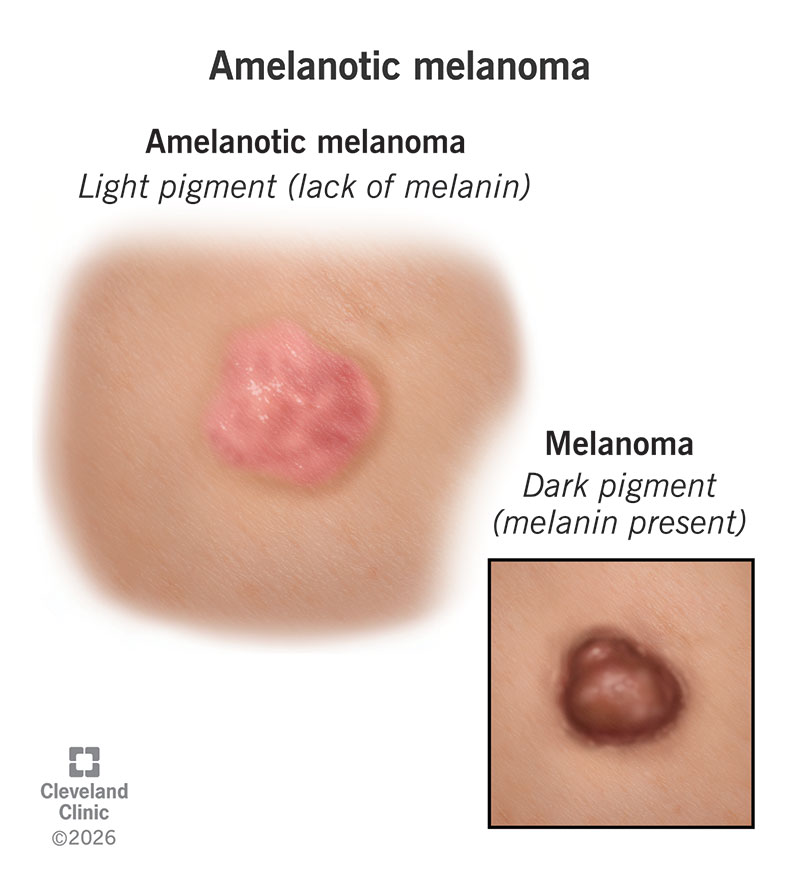
Image content: This image is available to view online.
View image online (https://my.clevelandclinic.org/-/scassets/images/org/health/articles/amelanotic-melanoma)
Amelanotic melanoma is a rare type of skin cancer that doesn’t have dark color (melanin). Instead, it may look pale, pink to red, skin-toned or even white. Because of this, it can look like a scar, a pimple or a harmless skin bump. This makes it harder to notice and may delay a diagnosis.
Advertisement
Cleveland Clinic is a non-profit academic medical center. Advertising on our site helps support our mission. We do not endorse non-Cleveland Clinic products or services. Policy
As it doesn’t look dark, it often doesn’t follow the usual ABCDE signs of skin cancer. Instead, providers may look for different warning signs, like a spot (tumor) that’s elevated, firm or growing. These changes can happen quickly.
Because it can grow and spread faster, seeing a dermatologist early is important if you notice a new or changing skin spot.
Amelanotic means “without color.” Many types of melanoma can lose their pigment, including:
It’s important to get any new or changing skin bumps — dark or not — checked by a healthcare provider.
Advertisement
Most melanomas have a dark color that’s easy to see on your skin. But these are different. You might notice a small bump or patch that’s:
The bump might be painful or itchy. If you scratch it, it may bleed. The wound may take a very long time to heal or may not heal at all. Pain, itchiness and slow healing are signs that you should talk to a provider.
Amelanotic melanoma can develop anywhere on your skin. But it appears more often found in areas that get a lot of sun exposure over time. These commonly include your:
It can also develop in areas that get little sun, like the palms of your hands, the soles of your feet or under your nails.
This type of skin cancer happens when changes (mutations) occur in melanocytes. These are skin cells that make pigment. These changes cause cells to grow out of control to form cancer.
The main known environmental trigger for these changes is ultraviolet (UV) radiation from the sun or tanning beds. This can damage skin cell DNA. In this type of melanoma, cancer cells make little or no melanin. This is why the tumor lacks color and can be harder to notice.
Amelanotic melanoma can affect anyone. But your risk may be higher if you:
This can lead to several challenges, including:
Amelanotic melanoma can be harder to notice because it lacks color, so a provider will take several steps to diagnose it. First, a dermatologist will examine your skin closely. They may use a special magnifying tool called dermoscopy. This tool helps them see patterns in your skin, like blood vessels, that may suggest melanoma even without dark pigment.
To confirm the diagnosis, they’ll perform a biopsy. This is where your provider will remove part or all of the tumor. They’ll send the skin sample to a lab. A pathologist will look at the tissue under a microscope to check for cancer cells. They’ll confirm whether it’s melanoma.
Staging helps your healthcare provider see if cancer is spreading and the tumor’s size:
Advertisement
This is an important step to help your provider plan treatment.
Treatment depends on how early a healthcare provider finds the cancer, whether it has spread and your overall health. Your provider might recommend:
You should see a healthcare provider if you notice skin changes, especially if it’s a skin bump that’s:
If you notice a concerning bump, take a photo of it with a ruler next to it. Take another photo every few weeks using the same ruler to check for changes in size or shape. If you notice a change, it’s time to see your provider.
Advertisement
After a diagnosis, what happens next depends mainly on the stage.
If it’s found early and hasn’t spread beyond your skin (stages I or II), surgery may be enough to remove it. You’ll still need regular skin checks and follow-up visits to make sure the cancer stays away. But there’s a risk that it could come back after removal.
If you have a later stage (stages III or IV) that has spread to your lymph nodes or other parts of your body, treatment is more involved. Your provider will explain what you can expect, as everyone’s outcome may be a little different.
You can’t prevent all cases. But you can reduce your risk by protecting your skin and watching for changes. Helpful tips include:
Amelanotic melanoma doesn’t look like the skin cancers most of us are taught to watch for. Without the typical dark color, it can be easy to miss or mistake the bump for something harmless. But changes like a pale or pink bump that doesn’t heal or keeps growing are worth getting checked out.
Advertisement
Spotting this type early can make a big difference. If something on your skin doesn’t seem right, trust your gut and talk to a provider. Keeping an eye on your skin — and taking steps to protect it — is a powerful way you can care for your health.



Sign up for our Health Essentials emails for expert guidance on nutrition, fitness, sleep, skin care and more.
Learn more about the Health Library and our editorial process.
Cleveland Clinic’s health articles are based on evidence-backed information and review by medical professionals to ensure accuracy, reliability and up-to-date clinical standards.
Cleveland Clinic’s health articles are based on evidence-backed information and review by medical professionals to ensure accuracy, reliability and up-to-date clinical standards.
Every day, people see your skin, hair and nails. At Cleveland Clinic, our expert and caring dermatology team will make sure they’re healthy and strong.
