



Hirsutism causes excessive hair growth in certain parts of your body. It often occurs when you have high androgen levels, which trigger the development of male characteristics, like facial and body hair. Maintaining a healthy weight for you can help reduce growth. But medications and procedures can also help treat the condition.
Advertisement
Cleveland Clinic is a non-profit academic medical center. Advertising on our site helps support our mission. We do not endorse non-Cleveland Clinic products or services. Policy
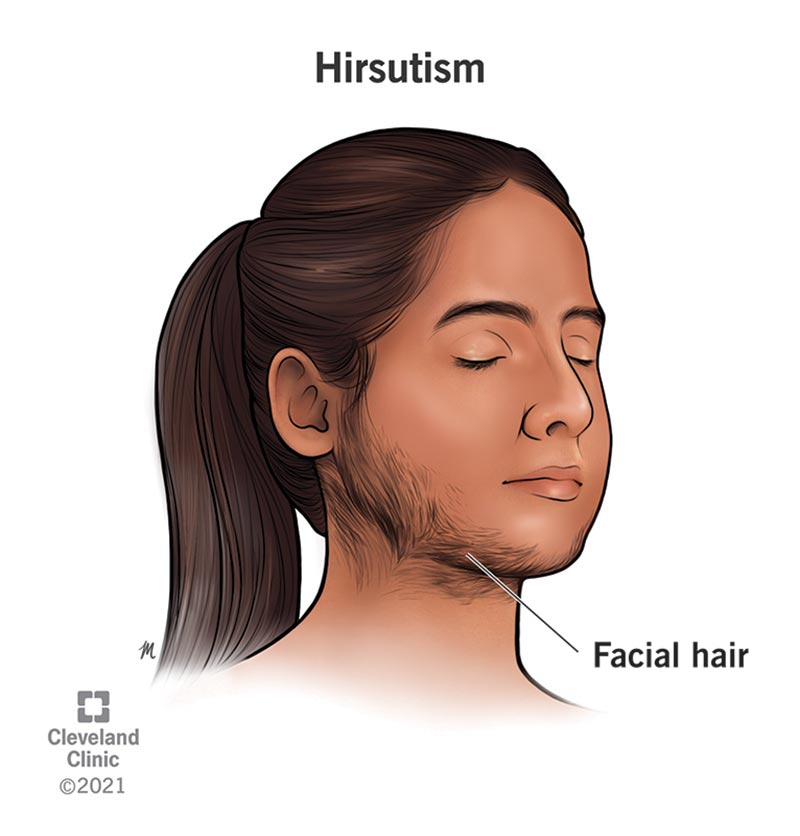
Image content: This image is available to view online.
View image online (https://my.clevelandclinic.org/-/scassets/images/org/health/articles/14523-hirsutism)
Hirsutism is a condition that mostly affects females and causes excessive hair growth. You may develop coarse, dark hair in a male-like pattern. It may appear on your:
Advertisement
Cleveland Clinic is a non-profit academic medical center. Advertising on our site helps support our mission. We do not endorse non-Cleveland Clinic products or services. Policy
Hirsutism (pronounced “HUR-soo-tiz-uhm”) is common. Over 4 out of every 10 females will have it at some point in their lives. High levels of certain hormones are the most common cause. It doesn’t hurt, and it won’t affect your physical health. But unwanted hair can affect how you think about yourself or cause you to worry about how others may think of you.
Home remedies are an easy, common way to remove unwanted hair. But medications and hair removal procedures can also treat it.
The main symptom is dark, thick hair growth (terminal hair) instead of the fine “peach fuzz” hair that normally grows in certain areas.
You may also develop symptoms of virilization. This is when females make too many androgens. Everybody has androgens. But males make more of them. Virilization symptoms may include:
The most common cause of hirsutism is polyendocrine metabolic ovarian syndrome (PMOS). This is a common condition that causes females to make too many androgens. PMOS is formerly known as polycystic ovary syndrome (PCOS).
Advertisement
Other causes may include:
Some medications can also cause excessive hair growth. These include:
It’s also possible for mild cases to develop without a clear cause (idiopathic hirsutism).
You’re more likely to have hirsutism if you have a biological family history of conditions that cause it. This includes PMOS and congenital adrenal hyperplasia. Having a body mass index (BMI) greater than 30 (having obesity) also increases your risk.
You may also have an increased risk if you’re:
The underlying cause of hirsutism may also lead to complications. Your provider will explain any possible risks in not treating the cause.
Any changes to your physical appearance can be distressing. Hirsutism may make you feel self-conscious. You may be less likely to wear the clothes you want or even tie your hair up. This may cause complications like:
Reach out to your healthcare provider if hirsutism affects your mental or emotional health.
A healthcare provider will:
Providers often use the Ferriman-Gallwey scale to help diagnose hirsutism. The scale looks at the areas that are likely to have the most hair growth. Your provider will assign a score between 0 and 4 for each area. A lower number means hair growth is mild. A high number means there’s more growth than expected. They’ll diagnose you with hirsutism if the combined score of the areas is 8 or higher.
They may also recommend tests to help diagnose the cause. These may include:
If there isn’t an underlying cause, you don’t necessarily need treatment. But maintaining a healthy weight for you can help lower androgen levels and stop excessive hair growth. You can also remove unwanted hair with temporary remedies, like shaving or waxing. More permanent hair removal procedures, like electrolysis or laser hair removal, are also options.
If you have an underlying cause, your provider may recommend medications. These treatments aren’t permanent. But the results last longer than home remedies.
Advertisement
Medications may include:
It depends on the severity of hirsutism and the treatment.
Shaving immediately cuts down the hair. But it doesn’t remove the roots, so stubble may appear within a few hours. Waxing the hair removes the roots. The results should last from three to six weeks.
You may need to schedule electrolysis appointments every week or every other week. You’ll likely need regular treatments for up to a year and a half.
For laser hair removal, you’ll likely need six to eight treatments. The appointments are about six to eight weeks apart.
Medications may take weeks or months before you notice hair starting to go away.
See a healthcare provider as soon as you notice hirsutism symptoms, especially if you also have irregular periods or acne. These may be signs of PMOS, Cushing syndrome or other conditions that need treatment.
Your provider may also refer you to a gynecologist or endocrinologist if you have hirsutism along with:
Advertisement
None of the treatments make unwanted hair go away completely. But they can make it grow more slowly or decrease the amount of hair. Most people are happy with their results once they find a treatment that works best for them. Once you find an effective treatment, you may use it long term.
You can’t prevent all causes of hirsutism. But you may be able to reduce your risk by maintaining a healthy weight for you, especially if you have PMOS.
If you’re taking any medications that cause hirsutism, talk to your healthcare provider. They may be able to adjust your dosage or prescribe different medications.
While hirsutism doesn’t cause any physical pain, it can really affect how you feel about yourself. Many people can treat unwanted hair with home remedies. But if hirsutism affects large areas, home hair removal can be time-consuming and frustrating to maintain. Talk to your healthcare provider. They can help diagnose the cause and find the best treatment. They can also recommend support groups or a counselor if hirsutism affects your self-esteem.
Advertisement



Sign up for our Health Essentials emails for expert guidance on nutrition, fitness, sleep, skin care and more.
Learn more about the Health Library and our editorial process.
Cleveland Clinic’s health articles are based on evidence-backed information and review by medical professionals to ensure accuracy, reliability and up-to-date clinical standards.
Cleveland Clinic’s health articles are based on evidence-backed information and review by medical professionals to ensure accuracy, reliability and up-to-date clinical standards.
Every day, people see your skin, hair and nails. At Cleveland Clinic, our expert and caring dermatology team will make sure they’re healthy and strong.
