



Healthcare providers perform lung biopsies to see if you have a condition that affects your lungs. They remove lung tissue samples and send them to a lab for testing. There are different approaches to collecting a sample — during some, you’ll be asleep. Risks include anesthesia problems, infection, bleeding and a collapsed lung.
Advertisement
Cleveland Clinic is a non-profit academic medical center. Advertising on our site helps support our mission. We do not endorse non-Cleveland Clinic products or services. Policy
A lung biopsy is when a healthcare provider removes a small sample of tissue from your lung to examine under a microscope. Providers usually recommend it if they see signs of a lung condition (like a lung nodule) on an imaging test like an X-ray or CT scan. They most commonly use it to diagnose lung cancer. But it can diagnose other types of lung disease.
Advertisement
Cleveland Clinic is a non-profit academic medical center. Advertising on our site helps support our mission. We do not endorse non-Cleveland Clinic products or services. Policy
Another name for a lung biopsy is a pulmonary biopsy.
Healthcare providers often suggest a lung biopsy if they notice a lung nodule after a screening test or an unrelated imaging test. They commonly use it to diagnose and stage lung cancer. But they may use it to diagnose other lung diseases, like:
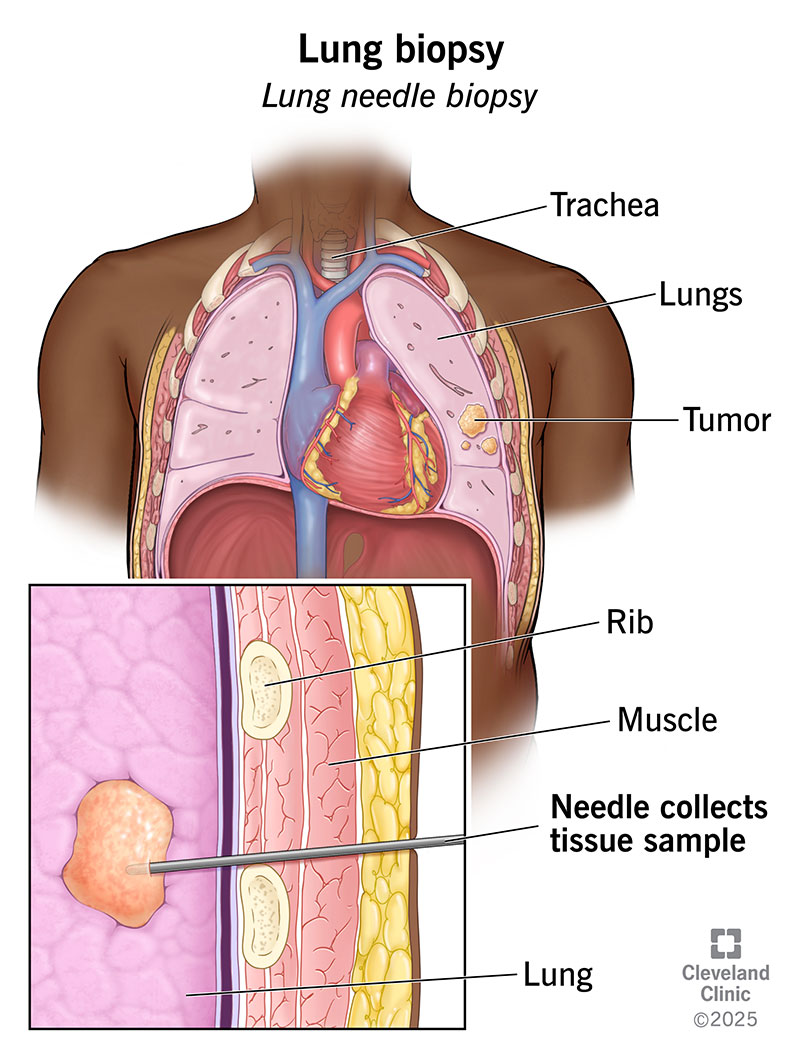
Image content: This image is available to view online.
View image online (https://my.clevelandclinic.org/-/scassets/images/org/health/articles/lung-biopsy)
A lung biopsy is a relatively safe procedure. It’s usually minimally invasive. Most people go home on the same day as the procedure and recover relatively quickly.
In general, there are three approaches to a lung biopsy. Healthcare providers perform each type a little differently.
During a bronchoscopy (transbronchial biopsy), providers guide a special tool through your nose or mouth, down your windpipe (trachea) and into your lungs to collect tissue. You’re under general anesthesia during the procedure.
Providers insert a thin needle between two of your ribs to remove tissue from the outside of your lungs.
A healthcare provider will explain the procedure and ask for your consent. They’ll perform a physical exam to ensure you’re healthy enough for surgery. They’ll also ask questions about:
Advertisement
They may also give you specific directions on:
Food or drink in your stomach can increase your aspiration risk during the biopsy.
During a lung needle biopsy, providers will:
After a lung needle biopsy, you’ll move to a recovery room. Providers will monitor your overall health and manage your pain. They’ll also take chest X-rays to make sure your lungs are OK.
Once they determine you’re healthy enough, you can go home.
During an open lung biopsy, a surgeon makes one cut (incision) in your chest that may run to your back. They remove a sample from this incision. This approach is rare. Providers only recommend it if they can’t get a sample from the other types.
Another name for an open lung biopsy is a limited thoracotomy.
Providers will explain the procedure and ask for your consent. They’ll check to make sure you’re healthy enough for surgery and that you have no bleeding or allergy risks. They’ll also give you specific directions on eating and drinking before the procedure and when to stop taking any medications. You must have someone available to drive you home and help take care of you for at least a few days.
During an open lung biopsy, providers will:
Providers will track your health and manage your pain in a recovery room. They’ll also encourage you to get out of bed and walk. Walking helps your body recover. It also helps reduce your risk of developing blood clots and pneumonia.
Advertisement
Most people need to stay at the hospital for at least one day after an open lung biopsy.
A surgeon makes three small incisions in your chest between your ribs. They insert a thin tube with a camera at the end (thoracoscope) into one incision. In the others, they insert instruments to remove a sample.
Other names for a thoracoscopic lung biopsy include thoracoscopy and video-assisted thoracic surgery (VATS).
Providers will explain the procedure and ask for your consent. They’ll review your health history, ensure you’re healthy enough for surgery and check for any bleeding or allergy risks. They’ll give you directions on when to stop eating and drinking before the procedure. If you take medications, they’ll also tell you if you need to stop and when you can start again. Finally, they’ll ensure you have someone to take you home and help take care of you.
During a thoracoscopic lung biopsy, providers will:
Advertisement
You’ll move to a recovery room. Providers will track your health and manage your pain. They’ll also help you walk to help your body recover and reduce any post-surgery risks, like blood clots and pneumonia.
Most people need to stay at the hospital for at least one day after a thoracoscopic lung biopsy.
Open and thoracoscopic lung biopsy risks include:
Bronchoscopy and lung needle biopsy risks include:
If your lung biopsy results are positive, that means you have a condition that affects your lungs. Healthcare providers may recommend more tests, like:
Your test results can help your providers figure out the best treatment plan for you.
If a healthcare provider notices a lung nodule in an imaging test, keep in mind that the odds of it being lung cancer are low. Only about 3 or 4 in 100 lung nodules are cancerous.
It usually takes a few business days to get your results. But it may take up to 10 days. A healthcare provider will give you a better idea of when to expect your results.
Advertisement
After a lung biopsy, call a healthcare provider if you:
It depends on the type. Bronchoscopy and lung needle biopsy are minimally invasive procedures. An open lung biopsy and thoracoscopy are more invasive, use general anesthesia and take longer to heal.
It depends on the type of procedure. Bronchoscopy and needle biopsy usually only take about one day to recover. But you should take at least two days off school or work. Other types may take longer. Your healthcare provider will give you a better idea of what to expect.
It can be stressful to hear you need a lung biopsy. It’s easy to jump to worst-case scenarios. But a lung biopsy is the only way to know for sure whether you have certain lung conditions. Healthcare providers understand your feelings. They’ll explain the procedure to you, answer any questions you have, address any of your concerns and, if necessary, help you plan the next steps in your care.



Sign up for our Health Essentials emails for expert guidance on nutrition, fitness, sleep, skin care and more.
Learn more about the Health Library and our editorial process.
Cleveland Clinic’s health articles are based on evidence-backed information and review by medical professionals to ensure accuracy, reliability and up-to-date clinical standards.
Cleveland Clinic’s health articles are based on evidence-backed information and review by medical professionals to ensure accuracy, reliability and up-to-date clinical standards.
If you have lung cancer, you might feel alone and afraid. You don’t have to be. Cleveland Clinic is here to help find and treat your cancer at any stage.
