



Renal corpuscles help make up the nephrons in your kidneys. Each kidney has about 1 million nephrons. Renal corpuscles help carry out the first step in filtering waste products and excess water from your blood, which leave your body when you pee.
Advertisement
Cleveland Clinic is a non-profit academic medical center. Advertising on our site helps support our mission. We do not endorse non-Cleveland Clinic products or services. Policy
The renal corpuscle is like a tiny pouch or bag of blood vessels in your kidneys. Renal corpuscles are part of the nephrons in your kidneys. Nephrons filter your blood by reabsorbing certain substances and removing waste products and excess water, which leave your body through your pee. Most people have two kidneys, and each kidney has about 1 million nephrons.
Advertisement
Cleveland Clinic is a non-profit academic medical center. Advertising on our site helps support our mission. We do not endorse non-Cleveland Clinic products or services. Policy
“Renal” means it has to do with your kidneys. “Corpuscle” means a tiny body. Other names for the renal corpuscle (REEN-ul KAWR-puhs-uhl) include:
Renal corpuscles allow the nephrons in your kidneys to carry out the initial blood-filtering step. In healthy kidneys, nephrons work around the clock to remove waste products (filtrate) from your blood — they filter all the blood in your body over 50 times each day. The filtered waste products eventually leave your body in your pee. If nephrons didn’t filter waste products, the waste products would build up in your blood, which can make you sick and eventually cause death.
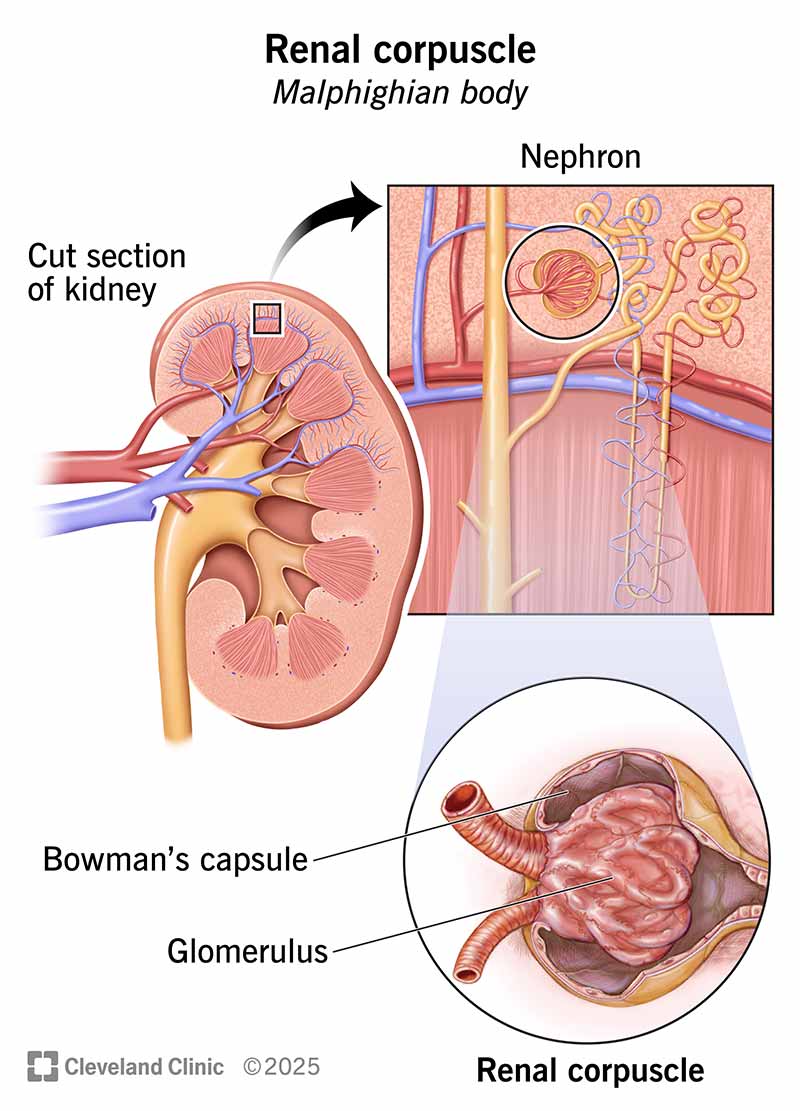
Image content: This image is available to view online.
View image online (https://my.clevelandclinic.org/-/scassets/images/org/health/articles/renal-corpuscle)
Renal corpuscles exist only in the renal cortex of your kidneys. The kidney cortex is the outer part of the kidney. It covers the inside part of your kidneys (renal medulla). Most people have a kidney on either side of their spines, between their intestines and diaphragm.
The renal corpuscle is made up of the glomerulus and Bowman’s capsule:
Advertisement
Renal corpuscles are tiny, spherical structures that you need a microscope to see. They’re about 200 micrometers in diameter, slightly wider than a strand of your hair. They resemble a pouch or bag. But some also describe them as jellyfish-like.
The glomerulus consists of endothelial cells and mesangial cells. Vascular endothelial cells line all your blood vessels and help with blood flow. Mesangial cells also help with blood flow and help remove proteins and other molecules from the glomerulus.
The Bowman’s capsule consists of two layers. The other layer (parietal layer) is made of body tissue (simple squamous epithelium). The inner layer (visceral layer) consists of podocytes. Podocytes are cells that have stalks (pedicles) that link together to help filter protein and cell content from your blood.
Conditions and diseases that affect your kidneys also affect your renal corpuscle. These include:
Common signs that something is affecting your renal corpuscles — and kidneys as a whole — include:
You can help keep your renal corpuscles healthy and prevent kidney problems in general by:
It’s also a good idea to schedule annual checkups with your primary care provider. Annual checkups typically include blood tests or pee tests (urinalyses) to check your kidney health.
The Bowman’s capsule and glomerulus make up the renal corpuscle. The renal corpuscle is part of a nephron, which makes pee while removing waste products and other excess substances from your blood.
Renal corpuscles are tiny parts of your kidneys that play a big role in the process of filtering your blood and balancing the fluids in your body. You can help keep them healthy by adopting habits that keep your overall kidneys healthy. These include cutting back on salt, drinking plenty of water, managing your blood pressure and quitting smoking. Reach out to a healthcare provider if you have any signs of kidney problems.
Advertisement



Sign up for our Health Essentials emails for expert guidance on nutrition, fitness, sleep, skin care and more.
Learn more about the Health Library and our editorial process.
Cleveland Clinic’s health articles are based on evidence-backed information and review by medical professionals to ensure accuracy, reliability and up-to-date clinical standards.
Cleveland Clinic’s health articles are based on evidence-backed information and review by medical professionals to ensure accuracy, reliability and up-to-date clinical standards.
If you have a condition that’s affecting your kidneys, you want experts by your side. At Cleveland Clinic, we’ll work with you to craft a personalized treatment plan.
