



Your sensory organs are how you experience everything — including these words. These organs help you understand what’s happening around you and inside your body. Your brain uses input from these organs to make your senses. And those senses are an essential part of everything you do, every minute of every day, for your entire life.
Advertisement
Cleveland Clinic is a non-profit academic medical center. Advertising on our site helps support our mission. We do not endorse non-Cleveland Clinic products or services. Policy
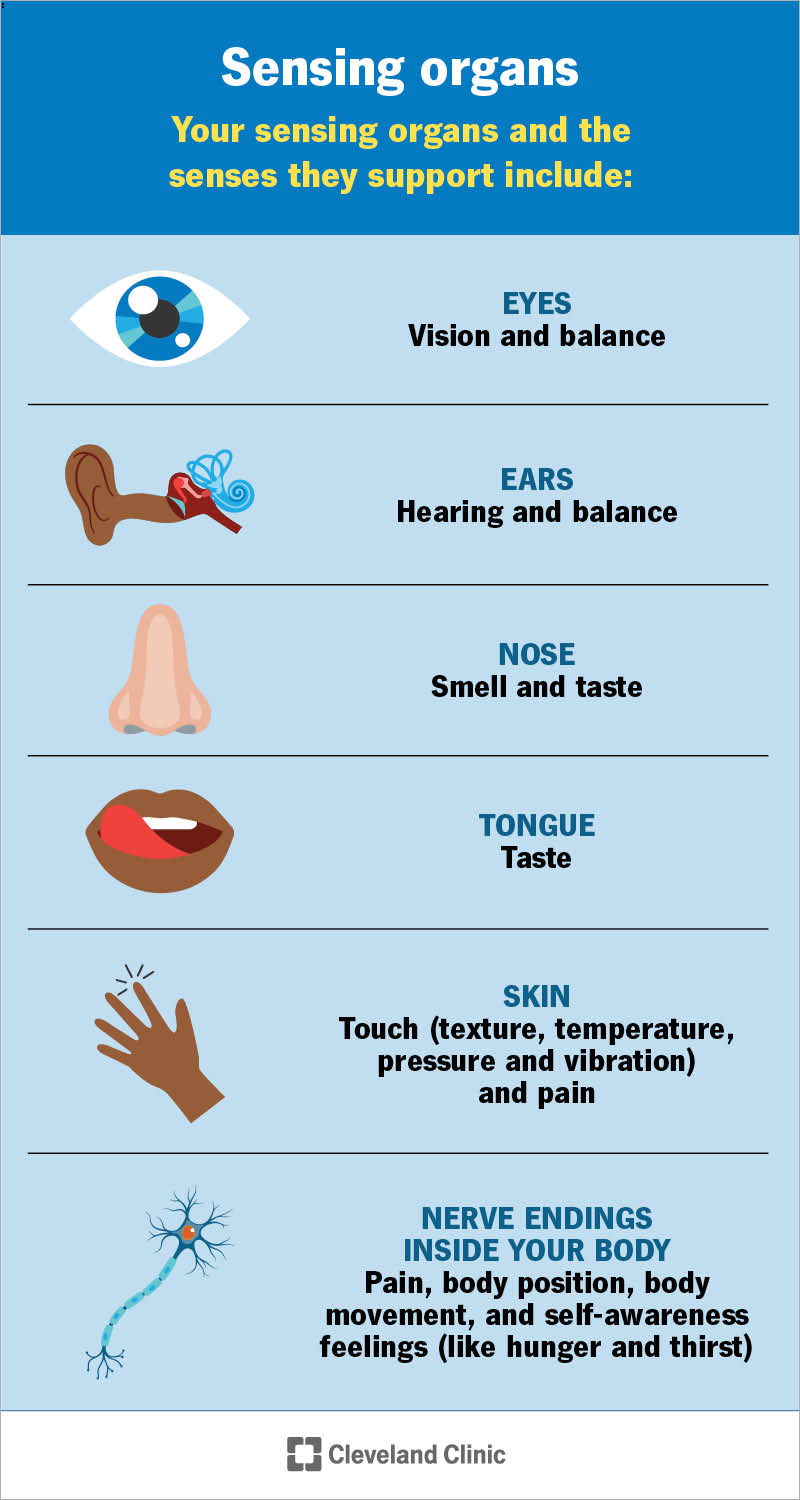
Image content: This image is available to view online.
View image online (https://my.clevelandclinic.org/-/scassets/images/org/health/articles/sensing-organs.jpg)
Your sensing organs are like detectors for what’s happening around you. These organs are very specialized. They turn what they detect into nerve signals and then send those signals through your nervous system and to your brain.
Advertisement
Cleveland Clinic is a non-profit academic medical center. Advertising on our site helps support our mission. We do not endorse non-Cleveland Clinic products or services. Policy
Your brain is like a computer, but it’s inside your skull. It can’t gather information about the outside world on its own. It needs your sensory organs to tell it what’s going on. Your brain uses signals from those organs to create your senses.
You’re probably familiar with the five basic senses, but there are actually more than that. Your senses include:
Experts agree there are definitely more senses than the basic five. But there’s some disagreement on the true number. Most experts say it’s around eight or nine. But some contend there are even more senses than that. Depending on who you ask, the number can go as high as 53.
Your sensory nervous system includes your sensing organs, nerves, spinal cord and specific parts of your brain, especially the thalamus. Your nerves and spinal cord are the connections that carry nerve signals from your sensory organs to your brain. Your sensory system also has strong ties to your memory, because sensory memory is useful for protecting you from harm.
Your sensing organs include your:
Advertisement
Sometimes, changes in your senses are key symptoms of a health condition. The best example of that is your sense of pain. Your body uses the feeling of pain to tell you that something’s wrong and you need to do something about it. Pain becomes a serious concern when it’s severe enough to keep you from doing routine activities, or when it lasts a long time.
Other sensory changes can be warning signs, too. When the changes are gradual, they’re worth discussing with a healthcare provider. For example, contact a provider if you notice a slow decrease in your vision, hearing, taste or smell.
Sudden sensory changes can be much more serious — and the conversation can’t wait. Changes that need immediate medical care include sudden:
When in doubt, it’s best to get help sooner rather than later. Healthcare providers would rather tell you that something is minor than see you delay care in an emergency.
A ringing in your ears. Numbness or tingling in your hand. A sharp pain when you turn your body a certain way. Your senses are how you know when something isn’t working right. And when something isn’t working right with your senses, it can be hard to think about anything else.
If you have questions about your senses, talking to a healthcare provider may help. They can check for any issues and tell you how to take care of your sensory organs.
Advertisement



Sign up for our Health Essentials emails for expert guidance on nutrition, fitness, sleep, skin care and more.
Learn more about the Health Library and our editorial process.
Cleveland Clinic’s health articles are based on evidence-backed information and review by medical professionals to ensure accuracy, reliability and up-to-date clinical standards.
Cleveland Clinic’s health articles are based on evidence-backed information and review by medical professionals to ensure accuracy, reliability and up-to-date clinical standards.
Cleveland Clinic’s primary care providers offer lifelong medical care. From sinus infections and high blood pressure to preventive screening, we’re here for you.
