



Your newborn’s skull goes through a lot during childbirth. So, it’s normal if their head appears a little swollen and lumpy after birth. Over the next few weeks, their head shape should start to round out. Rarely, an abnormal head shape can be a sign of a genetic condition. Your baby’s provider can talk through any of your concerns with you.
Advertisement
Cleveland Clinic is a non-profit academic medical center. Advertising on our site helps support our mission. We do not endorse non-Cleveland Clinic products or services. Policy
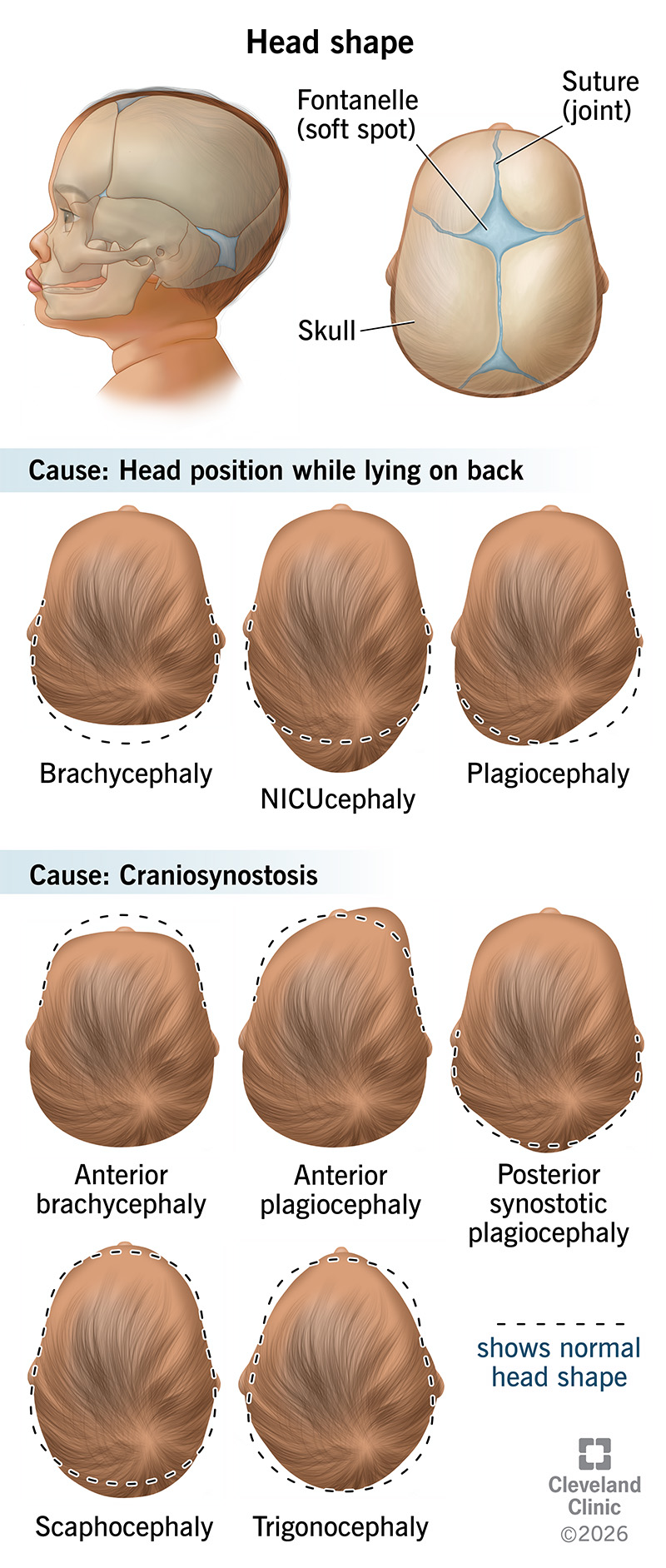
Image content: This image is available to view online.
View image online (https://my.clevelandclinic.org/-/scassets/images/org/health/articles/head-shapes.jpg)
There isn’t a one-size-fits-all head shape. It’s likely your newborn’s head won’t be flawless at birth. That’s because it has several soft spots (fontanelles). Don’t panic — they’re supposed to be there.
Advertisement
Cleveland Clinic is a non-profit academic medical center. Advertising on our site helps support our mission. We do not endorse non-Cleveland Clinic products or services. Policy
Fontanelles are normal gaps in your baby’s skull. They remain open so your baby can squeeze through the birth canal. They also let your infant’s brain grow quickly over the next year. The biggest fontanelle will typically close up within 18 months to two years.
After a while, your baby’s head shape should start to round out and appear even. Viewed from the top, their head may look oval, like an egg. Your infant’s ears will likely come to the same height and width from the front and back of their head. Their head and forehead may be even, and their face should be nearly even overall.
But if your newborn’s head shape more closely resembles a cone than a ball, try not to worry. There’s a wide variety of “normal” head shapes. The shape of your baby’s head at birth depends on several factors, including:
If your newborn doesn’t come out with the round head you were picturing, talk to the pediatrician in the hospital about your concerns. Slightly misshapen heads are very common right after birth. The newborn nursery pediatrician will quickly address any cause for concern.
Advertisement
Throughout the next few weeks, your baby’s skull bones will likely round out.
If labor or delivery affected your newborn’s head shape, it should correct itself within the first two months or so. As the bruising and swelling go down, your baby’s skull bones will shift back into place. But talk to your baby’s pediatrician about any concerns you have.
Your baby could’ve developed a preference due to their position in your uterus, or neck tightness. They may need some help gently molding their skull bones into place. Their provider may suggest physical therapy or helmet therapy. Or they may suggest both if physical therapy alone isn’t successful.
Within the first six months of your infant’s life, their head shape may shift once more. But again, it’s normal. One study reported that 20% to 50% of 6-month-old infants developed a certain type of head shape — plagiocephaly.
Plagiocephaly, or flat head syndrome, can develop when your baby spends time on their back. Sleeping on their back is safest because it reduces the risk of SIDS. But it can cause some head flatness. Your baby’s provider can usually help correct this with stretches, positioning or physical therapy.
Your baby’s head shape will also naturally improve as they grow and spend less time lying down.
Advertisement
There are three types of plagiocephaly:
Rarely, a serious health condition can be the cause of an abnormal head shape. Some infants are born with a skull deformity called craniosynostosis. It happens when the joints (skull sutures) between your baby’s skull bones fuse too early. This can prevent your baby’s brain from growing. There are several types:
Advertisement
Children with a condition called syndromic craniosynostosis have face, arm and leg deformities as well as different head shapes. The condition can affect the placement and shape of your baby’s eyes and the development of their jaw. It can happen as a symptom of several genetic disorders, including:
Advertisement
It’s completely normal for newborns to have oddly shaped heads at birth. Many babies are born with a cone-shaped or lopsided head, and it can take several weeks for things to round out. Then, their head shape may shift again, often from lying in the same position for too long.
Some baby head shapes can signal an underlying issue, but this is rare. Most quirks resolve on their own. Don’t hesitate to talk to your baby’s pediatrician if you have any concerns.
Advertisement



Sign up for our Health Essentials emails for expert guidance on nutrition, fitness, sleep, skin care and more.
Learn more about the Health Library and our editorial process.
Cleveland Clinic’s health articles are based on evidence-backed information and review by medical professionals to ensure accuracy, reliability and up-to-date clinical standards.
Cleveland Clinic’s health articles are based on evidence-backed information and review by medical professionals to ensure accuracy, reliability and up-to-date clinical standards.
As your child grows, you need healthcare providers by your side to guide you through each step. Cleveland Clinic Children’s is there with care you can trust.
