



If you have rectal bleeding, ongoing digestive symptoms or need colorectal cancer screening, your provider may recommend a flexible sigmoidoscopy. This fast test examines your rectum and the lower part of your colon using a thin, flexible tube with a camera. Most people stay awake during the procedure and return to normal activities the same day.
Advertisement
Cleveland Clinic is a non-profit academic medical center. Advertising on our site helps support our mission. We do not endorse non-Cleveland Clinic products or services. Policy
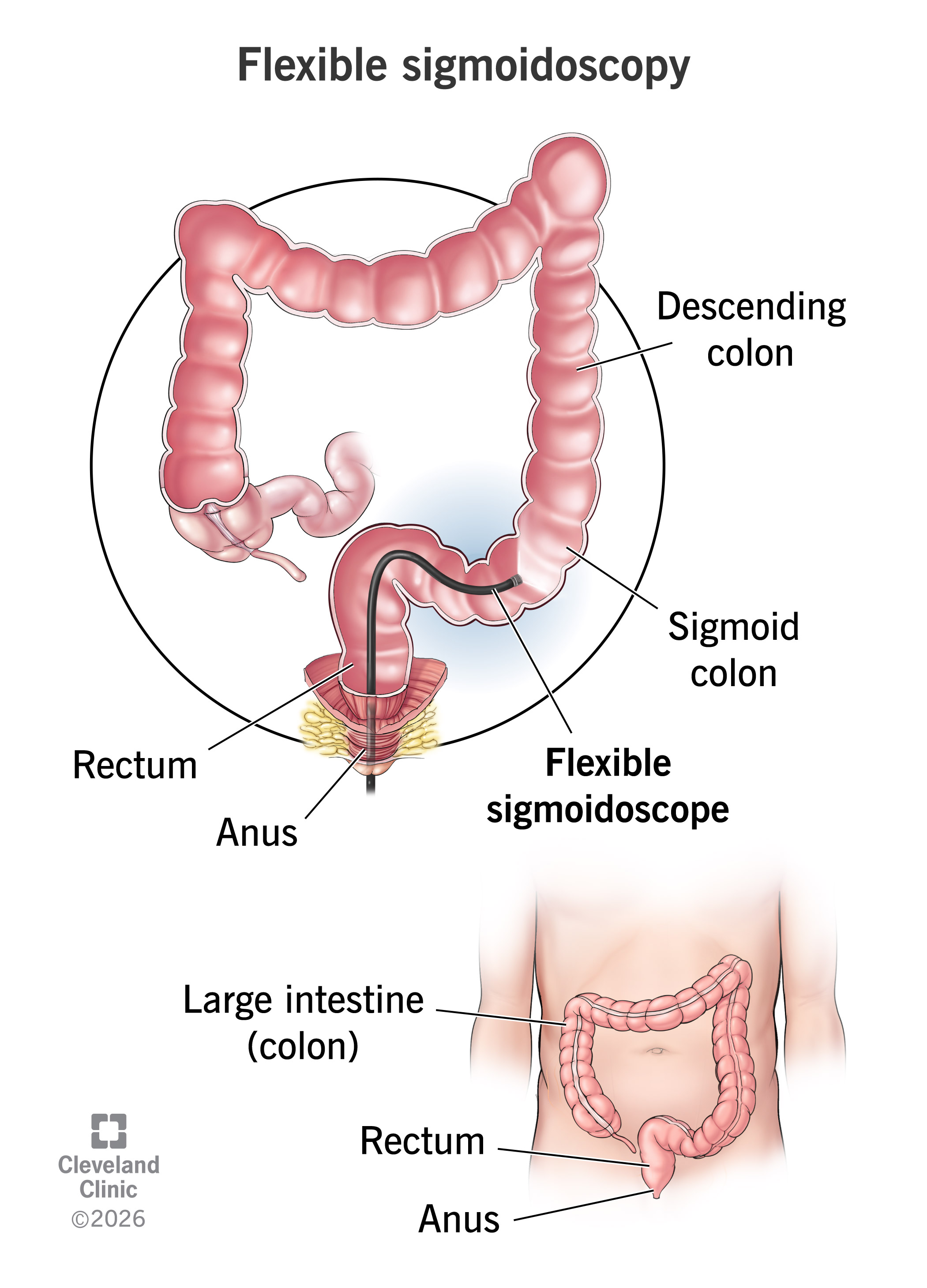
Image content: This image is available to view online.
View image online (https://my.clevelandclinic.org/-/scassets/images/org/health/articles/4953-flexible-sigmoidoscopy.jpg)
A flexible sigmoidoscopy is a test your healthcare provider may use to examine your rectum and the lower third of your large intestine (colon). This includes your sigmoid colon and descending colon.
Advertisement
Cleveland Clinic is a non-profit academic medical center. Advertising on our site helps support our mission. We do not endorse non-Cleveland Clinic products or services. Policy
During the test, your provider uses a thin, flexible tube with a light and camera on the end (a sigmoidoscope). The scope allows your provider to clearly see the lining of your colon. It sends images to a video monitor so your provider can look for growths, inflammation or signs of cancer.
Flexible sigmoidoscopy is shorter and examines less of your colon than a colonoscopy. Healthcare providers commonly use it to check on digestive symptoms and sometimes to screen for colon cancer.
Your provider may do a flexible sigmoidoscopy to:
Proper preparation helps your healthcare provider clearly see your colon lining. You’ll need to prep your bowels. And you may need to adjust your medications.
To prepare for a sigmoidoscopy, you’ll need to clean out the lower part of your colon. Preparations may involve:
Advertisement
Follow your provider’s instructions carefully. Call them if you have questions about how to prepare.
Tell your provider about all medications you take. You may need to:
Most blood pressure, heart, lung and seizure medications are safe to continue.
A flexible sigmoidoscopy usually takes place in a clinic or endoscopy center. Before the test, a nurse will review your medical history. Your provider will explain the procedure and ask you to sign a consent form.
The procedure is short, and discomfort is usually mild. So, you usually won’t need sedation. Most people remain awake during the test.
During the test, you’ll lie on your left side with your knees bent. This is the standard sigmoidoscopy position. Your provider will:
You may feel mild cramping, pressure or the urge to pass gas. You won’t feel any pain, even if you’re getting a biopsy. That’s because the lining of your colon doesn’t sense pain.
A flexible sigmoidoscopy is fast. It typically takes five to 15 minutes.
Flexible sigmoidoscopy is generally safe. Serious complications are rare. Possible side effects of sigmoidoscopy include mild cramping, bloating and light bleeding.
Rare risks include:
Most bleeding is minor and stops on its own. Your provider can usually control the bleeding during the procedure.
Most people feel fine after a flexible sigmoidoscopy. You should be able to drive home immediately (if you didn’t get sedation). You can eat normally and go back to your usual activities. You may continue to pass gas for a short time as the air leaves your colon.
Your provider may discuss early findings with you right after the test.
If they did a biopsy, results usually take several days. Your provider will tell you how and when you’ll get them.
Results may show:
Advertisement
Some polyps can develop into cancer over time. If your provider finds polyps or signs of cancer, they may recommend a colonoscopy to check the rest of your colon.
It depends on what your provider found during the procedure.
Your provider may recommend:
Your provider will explain what your results mean and guide you through the next steps.
Call your provider right away if you have:
These symptoms are uncommon after this procedure. But they need immediate medical attention.
A flexible sigmoidoscopy uses a thin, bendable tube. It lets your provider examine your rectum and lower colon more comfortably and completely.
A rigid sigmoidoscopy uses a shorter, straight tube. It examines only your rectum. Providers use it less commonly today.
Flexible sigmoidoscopy provides a better view of your sigmoid colon. It’s the preferred method in most cases.
It’s normal to feel uneasy about tests that involve your anus and rectum. A flexible sigmoidoscopy is a quick way for your provider to get important answers about symptoms like bleeding or belly pain. In many cases, it can even help your provider find signs of cancer and remove polyps early.
Advertisement
If your provider recommends this test, it’s because they want to protect your health and give you clear next steps. Don’t hesitate to ask questions and share any concerns along the way.
Advertisement



Sign up for our Health Essentials emails for expert guidance on nutrition, fitness, sleep, skin care and more.
Learn more about the Health Library and our editorial process.
Cleveland Clinic’s health articles are based on evidence-backed information and review by medical professionals to ensure accuracy, reliability and up-to-date clinical standards.
Cleveland Clinic’s health articles are based on evidence-backed information and review by medical professionals to ensure accuracy, reliability and up-to-date clinical standards.
A colonoscopy or other screening is an important test for colon cancer. The team at Cleveland Clinic can give you peace of mind and expert care when you need it.
