



Heart rate variability (HRV) is the slight change in the amount of time between your heartbeats. You can detect these changes with a smartwatch, but an EKG is more accurate. HRV can indicate current or future health problems, including heart conditions and mental health issues, like anxiety and depression.
Advertisement
Cleveland Clinic is a non-profit academic medical center. Advertising on our site helps support our mission. We do not endorse non-Cleveland Clinic products or services. Policy
Heart rate variability (HRV) is a slight change in the amount of time between your heartbeats. These variations are very small, adding or subtracting a fraction of a second between beats. Special devices can detect these differences, showing how well your heart adapts to changes around you.
Advertisement
Cleveland Clinic is a non-profit academic medical center. Advertising on our site helps support our mission. We do not endorse non-Cleveland Clinic products or services. Policy
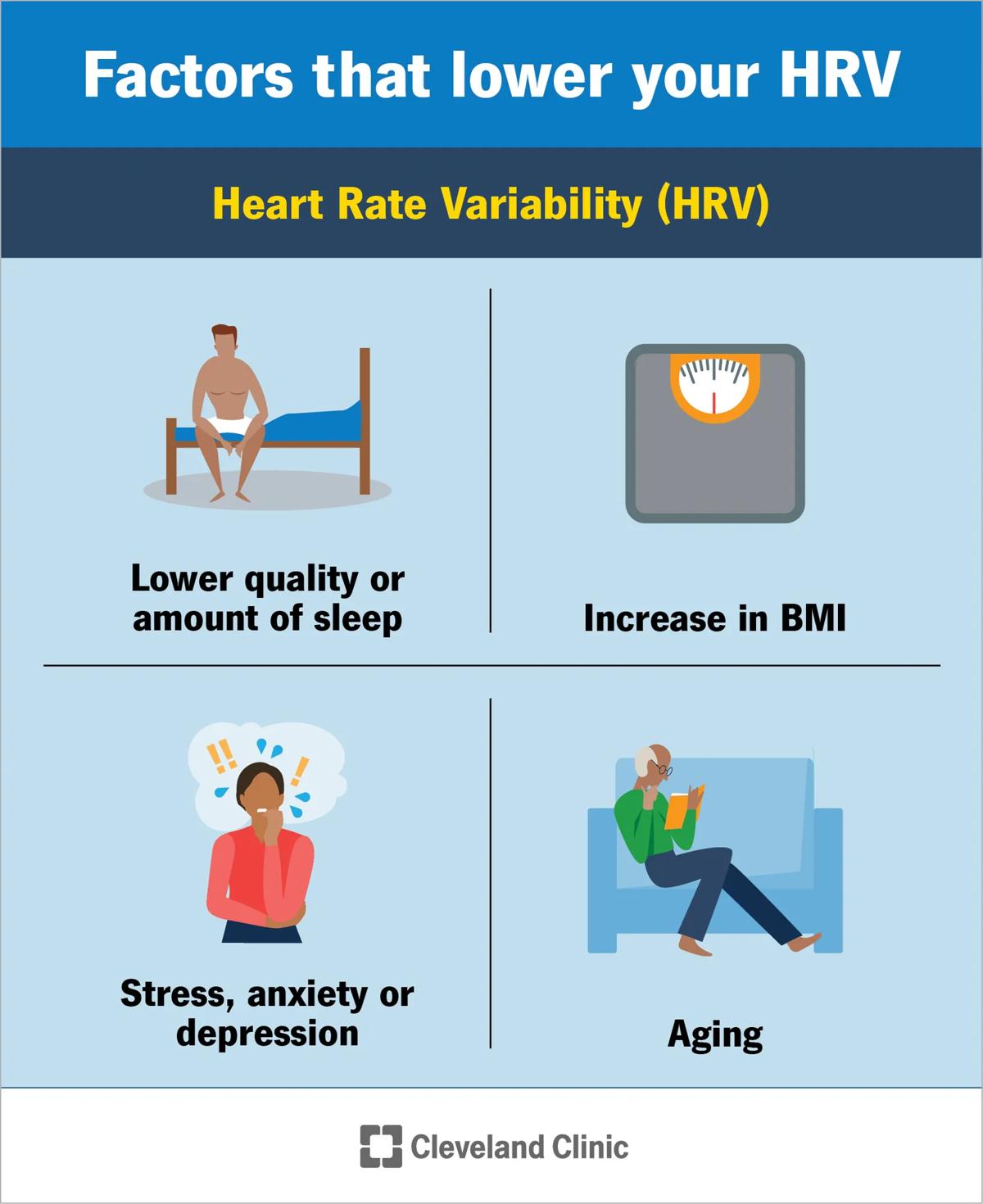
Image content: This image is available to view online.
View image online (https://assets.clevelandclinic.org/transform/a8965f41-d14e-40db-a11e-84e741466792/26-HVI-8910023-factors-that-lower-your-hrv)
Factors that lower your heart rate variability (HRV) include aging, stress, lack of sleep and an increase in BMI.
A high HRV is a sign that your body can adapt to changes easily. A low HRV can be a sign of health problems, including heart conditions and mental health issues, like anxiety and depression. Changes in your HRV can tell your healthcare provider if a chronic disease you have is getting better or worse. Comparing your current HRV with past ones can help with your prognosis.
Your HRV can tell you how well your autonomic nervous system is working. Your heart must react to changes in your life and surroundings. Your autonomic nervous system tells your heart when to speed up and work harder. This system is a part of your brain and a set of nerves that operate without you thinking of them. The system has two main parts: your sympathetic nervous system and your parasympathetic nervous system.
These nervous systems work like this:
Factors that can lower your HRV include:
Advertisement
Taking care of your physical and mental health can increase your HRV.
Your HRV reflects how well your body can adapt. If you have a high HRV, this usually means your body can adapt to many kinds of changes.
In general, low heart rate variability could be a sign of current or future health problems. This is because it shows your body is less resilient and struggles to handle changing situations.
A low HRV is also more common in people who have higher resting heart rates. That’s because when your heart is beating faster, there’s less time between beats, reducing the window for variability. This is often the case with conditions like:
The changes in your heart rate are very small, so it takes an HRV monitor to detect them. In a medical setting, an electrocardiogram (EKG) can correctly measure HRV. An EKG measures your heart’s electrical activity using sensors attached to your chest.
Healthcare providers can also send you home wearing a heart rate monitor that tracks heart rate variability nonstop for longer periods of time. It may monitor your heart rate variability for a few minutes or up to 24 hours. Longer monitoring times tend to give the best data.
Outside of a medical setting, athletes use a device attached to a band that wraps around their chest. Some look like a pulse oximeter (device that attaches to a finger and measures your pulse and blood oxygen level). But the athletes’ device is more sensitive and precise than a pulse oximeter.
Most wrist-worn fitness devices and trackers detect your heart rate through your skin. But they usually aren't sensitive enough to detect HRV accurately.
The preferred way to look at HRV for heart health uses a standard deviation of milliseconds (ms) between heartbeats over 24 hours. Standard deviation is how much your data goes outside of the average range.
A low result, where the standard deviation of time between heartbeats is below 50 ms, is unhealthy. Above 100 ms is healthy. A result from 50 to 100 ms signals “compromised” health.
But heart rate variability gets lower as you age, and HRV that’s normal in one person may not be normal for someone else. A healthcare provider is your best source for understanding your heart rate variability and what you should do about it.
There are a few different ways you can improve your heart rate variability. Some involve improving your physical condition. Others involve taking care of your mental health. Here are a few things you can do:
Advertisement
Biofeedback training is one method to help improve HRV. By controlling your breathing, you can improve your HRV. Biofeedback training can also help improve your stress and anxiety levels.
It’s easy to get caught up in popular fitness trends and compare yourself to others. But heart rate variability is really just about you. Numbers don’t tell the whole story. You know how you’re feeling from day to day. That number on your smartwatch will probably tell you what you already know about your stress level or sleep quality.
So, focus on taking care of your health instead of fixating on numbers. And talk to your healthcare provider about the best things you can do for your heart and your health as a whole.
Advertisement



Sign up for our Health Essentials emails for expert guidance on nutrition, fitness, sleep, skin care and more.
Learn more about the Health Library and our editorial process.
Cleveland Clinic’s health articles are based on evidence-backed information and review by medical professionals to ensure accuracy, reliability and up-to-date clinical standards.
Cleveland Clinic’s health articles are based on evidence-backed information and review by medical professionals to ensure accuracy, reliability and up-to-date clinical standards.
Cleveland Clinic’s primary care providers offer lifelong medical care. From sinus infections and high blood pressure to preventive screening, we’re here for you.
