


Course Offerings
We offer a range of professional development opportunities throughout the year, with a focus on mastering simulation best practices and facilitator training. For help, please contact us.
Simulation Facilitator Training Programs
In support of ongoing accreditation, the Simulation and Advanced Skills Center will begin tracking the completion status of simulation faculty development training for all educators and clinicians utilizing simulation resources.
Current and aspiring simulation educators will be required to complete the appropriate development pathway prior to scheduling courses through the Simulation and Advanced Skills Center.
There are two levels of programs available to support the developing simulation educator based on the type of simulation planned for their course:
Simulation Skills Facilitation Program
Courses that focus on the acquisition of technical skills via task-trainers or other modalities, but do not include full, scenario-based simulations require educators to be prepared via the Simulation Skills Facilitation Program. Guest clinical experts teaching a skills station as part of a larger course are included as part of the target audience for this program.
Simulation Facilitation and Debriefing Program
Courses with full, scenario-based simulations require educators to be prepared via the Simulation Facilitation and Debriefing Program. This includes stand-alone simulations and simulations that occur as part of a larger course where additional skill is needed to support learner outcomes. *This path includes live course requirements. Early registration is encouraged to avoid conflicts as dates are limited.
Prior completion of courses within these programs will be credited, but all educators using simulation should review the new program formats for courses that may have been added since their initial training.
Registration information:
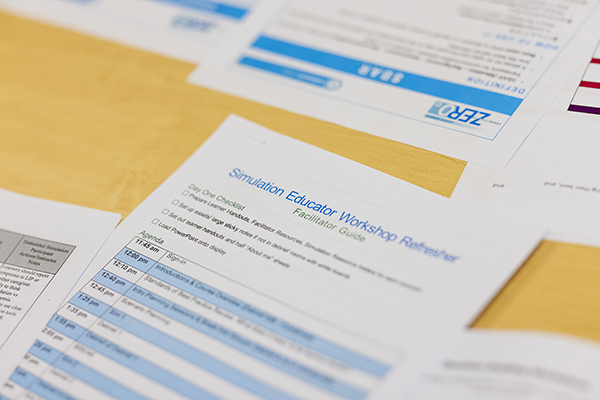
Simulation Educator Workshop (SEW) Refresher
Have you participated in the standard 2-day Simulation Educator Workshop and would like to refresh/maintain your facilitator and debriefing skills? This in person, 4-hour, interactive session includes:
- Review of debriefing standards and best practices
- Self-reflection & discussion
- Hands-on practice facilitating and debriefing High Reliability Organization (HRO) concepts with real-time feedback
- Live practice with pre-briefing and debriefing with structured feedback
*Please note, this course is only open to Cleveland Clinic employees.
Simulation Fellowships
The Simulation and Advanced Skills Center (SASC) at Cleveland Clinic sponsors a three-tiered simulation training program, which offers different opportunities and experiences based on the interests and goals of the applicant. These programs are the Simulation Research Fellowship, the Simulation Education Fellowship, and the Simulation Facilitator Elective. The overall mission of these programs is to develop leaders with vision, knowledge, and commitment to implement simulation-based training strategies with the aim to improve healthcare for patients at Cleveland Clinic.
- Simulation Research Fellowship: This program is a two-year, project-based, longitudinal experience focused on developing excellence in the areas of teaching, assessment, curriculum development, and simulation research.
- Simulation Education Fellowship: This program is a one-year, project-based, longitudinal experience focused on developing excellence in the areas of teaching, assessment, and curriculum development.
- Simulation Facilitator Elective: This program is a six-month commitment that provides basic training in the implementation of a formal simulation based curriculum. Mentees are accepted according to the availability of mentors, with variable start/end times. There will be no funding of this position by the Education Institute.
*Please note, this fellowship is only open to Cleveland Clinic employees.
Resources
The educational resources compiled below are intended to assist in the improvement of simulation courses.
Getting Started
Planning
Avoiding funny or generic names (e.g. Mr. Heart, Mr. Jones) increases the realism of your simulation and promotes learner buy-in. This simple random name generator can help you quickly name simulated patients during scenario design.
