



Photorefractive keratectomy (PRK) is a laser eye surgery similar to LASIK. Unlike LASIK, which involves opening a flap in your cornea, PRK removes your cornea so that it grows back naturally. That makes it a better laser eye surgery choice for some people who can’t undergo LASIK.
Advertisement
Cleveland Clinic is a non-profit academic medical center. Advertising on our site helps support our mission. We do not endorse non-Cleveland Clinic products or services. Policy
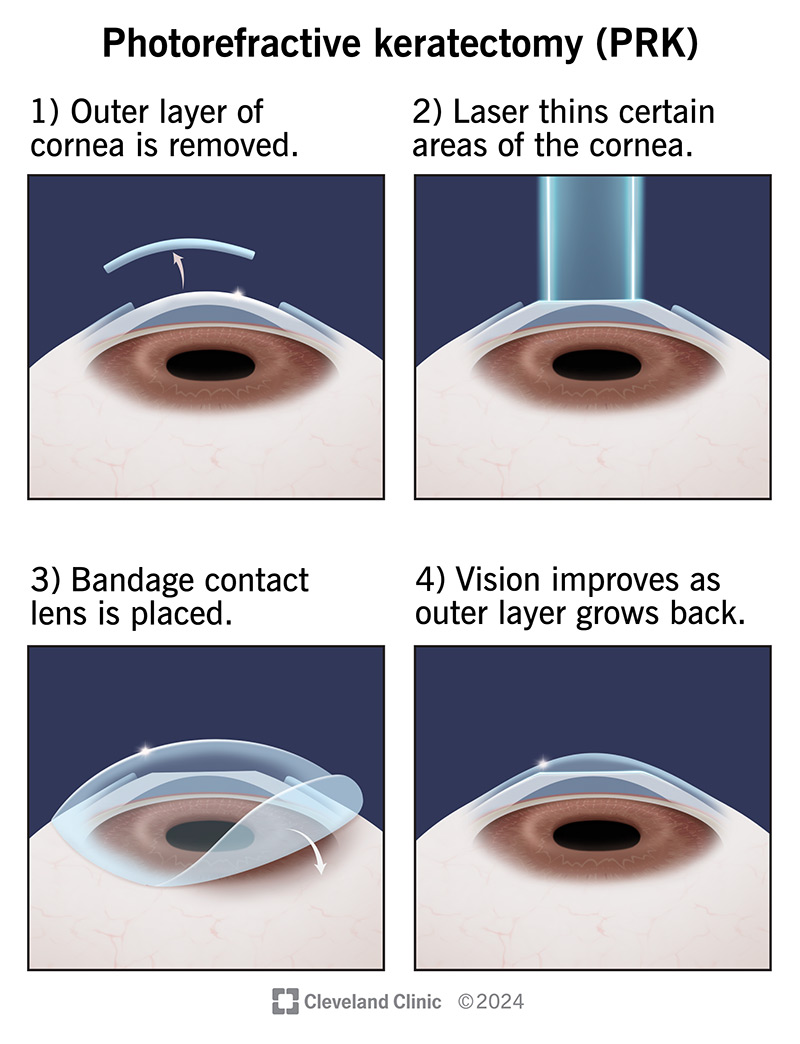
Image content: This image is available to view online.
View image online (https://my.clevelandclinic.org/-/scassets/images/org/health/articles/photorefractive-keratectomy)
Photorefractive keratectomy (PRK) is a laser surgery procedure to correct your eyesight. The laser makes small changes to the shape of your cornea, the clear, protective layer at the front of your eye. Reshaping your cornea affects how it bends light, which changes how you see.
Advertisement
Cleveland Clinic is a non-profit academic medical center. Advertising on our site helps support our mission. We do not endorse non-Cleveland Clinic products or services. Policy
PRK is a predecessor of laser-assisted in situ keratomileusis (LASIK). After the U.S. Food and Drug Administration (FDA) approved PRK in 1996, PRK was the preferred laser surgery for correcting vision. In 1999, the FDA approved LASIK, which has certain advantages that helped it become more popular than PRK. But PRK is still a useful and common treatment, and there are some situations where it does things LASIK can’t.
Your cornea is one of the most important parts of your eye when it comes to how your eye focuses light onto the retina inside. The cornea and lens refract (bend) light rays so they converge precisely on the retina. When light rays don’t converge at the right point, that’s called a refractive error.
When you wear corrective lenses (glasses or contacts), they bend light more than your eyes can on their own. That’s how corrective lenses help with refractive errors.
But sometimes, people want or need vision correction that’s stronger than what glasses or contacts can provide, or they can’t or would rather not wear corrective lenses. That’s where vision correction surgeries like PRK come in. It can reduce how much you rely on corrective lenses or eliminate your need for them altogether.
Advertisement
PRK can treat all four of the main types of refractive errors:
Many of the preparations for PRK are things your eye care specialist will help you through. They include:
Making sure you understand what to expect is important to being satisfied with the outcome. Your eye care specialist will want you to have realistic expectations because PRK isn’t a magic fix. They’ll talk to you about what to expect with PRK, making sure you understand that even if it doesn’t totally correct your sight, PRK should still improve it.
PRK is an outpatient procedure, which means you go home shortly after it’s over. The entire procedure takes between five and 15 minutes. You’ll be awake for this procedure and your eye care specialist will use numbing drops on your eyes so you won’t feel pain.
Once your eyes are numb, your eye care specialist will remove the epithelium, the outermost layer of your cornea. (It’ll grow back within several days.) They can do that with a laser, special tools or liquid solution. Feeling slight pressure on your eye surface is normal during this part, but it won’t hurt.
Once they remove the corneal epithelium, they’ll have you look toward a target light on the laser device. Having you look at a target makes for more precise shape changes, and most lasers help with this by tracking the position of the eye during the treatment.
Once you’re looking at the target light, they’ll begin using the laser. The beam is invisible, but you may hear a tapping or clicking sound from the device creating the beam. The beam ablates (removes) corneal tissue without heating it. Thinning specific areas of the cornea will change the shape of it after your epithelium grows back.
If you’re worried about keeping your eyes still during this part, communicate with your eye care specialist. They can stop the laser if you do have trouble keeping your eyes still. And many modern PRK lasers detect changes in your eye position and stop themselves if your eyes move too far. Smaller eye movements usually aren’t enough for the laser to cause negative effects.
Once the laser part of the procedure is over, your eye care specialist will add additional medicated drops to your eye (if necessary) and place a bandage contact lens on the eye. Bandage lenses protect your eye while the outer cornea layers regenerate.
Advertisement
After the procedure, your eye care specialist will provide or prescribe the following:
After you have everything from your provider, you can go home. Some things to keep in mind once you do go home include:
Advertisement
PRK has a successful history that goes back decades. That’s because:
LASIK is a more popular surgery because it has a faster recovery time and less pain. But PRK is better than LASIK for some people.
PRK may be the better option when:
Advertisement
But LASIK is more popular than PRK overall for a few reasons:
Because there are so many factors that play into these procedures, there’s no one procedure that’s better for everyone. Your eye care specialist is the best person to tell you which of these procedures will likely be best for you.
Some people shouldn’t undergo PRK because it’s less likely to help them, or it has higher risks of complications for them. The reasons why you might not be able to have PRK include:
After PRK, you might notice certain side effects or complications. These usually cause changes in how you see through the affected eye. They can include:
Some of these issues are minor and temporary, and may go away on their own. Others may need further treatment to resolve them. Your eye care specialist can tell you more about what to expect and what’s most likely to help.
Similar to LASIK, PRK may damage your eyes and make your vision worse. Fortunately, that’s extremely rare.
PRK recovery time happens in steps. The first step happens over the first several days after your surgery. During this stage, you wear a bandage contact lens while your cornea’s outer layer heals.
You shouldn’t notice any pain until the numbing medications wear off. That usually lasts for less than an hour after your PRK procedure. Plan to rest for the remainder of the day.
Acetaminophen (Tylenol®) or nonsteroidal anti-inflammatory drugs (NSAIDs) like ibuprofen (Advil® or Motrin®) or naproxen (Aleve®) may help with pain (but be sure to ask your provider first). Your provider may also prescribe pain medications for your recovery.
Discomfort and pain levels usually peak around Day 2 or 3. Most people can manage discomfort and pain with over-the-counter (OTC) medications. Other expected symptoms can include:
By Days 4 or 5, your cornea should’ve regrown enough to close over. You may feel more comfortable driving and be ready to stop using your bandage contact lens. But don’t do either until your provider tells you it's OK. You should notice improvements in your vision (and more are likely to happen in the coming days).
You might have a slight ridge or raised area at the center of your cornea after removal of your bandage contact lenses around Day 4 or 5. That’s normal, and it should smooth down and disappear within six weeks, which also explains why your vision keeps improving over that time. It happens because your corneas heal starting at the outer edge and work inward, and that can form a ridge when the healing areas converge at the center.
Over the next six weeks, you should see a noticeable improvement in your sight, especially within the first two weeks. Your pain or discomfort should go away after a few days.
You’ll need to keep taking some eye drop medications for one to four months after PRK. (For better odds of a good result, be sure to take them as directed, not just until you feel better.) You should avoid exerting yourself too much for at least a week (unless your specialist says otherwise).
Most people fully recover within six weeks or so. By six months after PRK, your eyes should be “stable.” Further eyesight changes after this aren’t likely (unless you undergo a follow-up PRK or another procedure to improve your sight further).
You can usually return to work or school around a week after PRK (maybe less). Your eye care specialist can tell you if it’s OK to return to your usual routine. They may still tell you to avoid certain activities for a while, though. Ask your eye care specialist about which activities you should avoid and for how long.
You should call your eye care specialist if you have any of the following:
If you decide you want to pursue PRK and your specialist clears you for it, they’ll talk to you about payment. Unlike many eye care procedures, insurance policies usually don’t cover laser vision correction surgery. You’ll likely have to pay the full cost out of pocket. Some optical/vision insurance carriers may still offer discounts with specialists who do PRK. You’ll still need to pay the entire amount, but the amount may be lower.
Once you complete all those steps, your eye care specialist or their staff will schedule a time and date for you to have the procedure. You’ll also want to arrange for someone to drive you to and from the procedure.
PRK may be a better option for some people who want laser vision surgery but have greater risks from LASIK. For more than 25 years, PRK has been a key laser correction procedure. Along the way, technological advances have improved it further, making it even safer and more effective.
If you’re unable to have LASIK but are still open to another laser vision surgery, PRK may be able to help you. While it’s not a magic fix, it has very high odds of improving your vision. Most importantly, don’t forget to be realistic about your expectations. PRK may not fix your vision completely, but if it improves your eyesight and lowers how much you rely on glasses or contacts, it can still bring big benefits to your life.



Sign up for our Health Essentials emails for expert guidance on nutrition, fitness, sleep, skin care and more.
Learn more about the Health Library and our editorial process.
Cleveland Clinic’s health articles are based on evidence-backed information and review by medical professionals to ensure accuracy, reliability and up-to-date clinical standards.
Cleveland Clinic’s health articles are based on evidence-backed information and review by medical professionals to ensure accuracy, reliability and up-to-date clinical standards.
Tired of wearing glasses or contacts? At Cleveland Clinic, we offer every laser vision correction option, including LASIK, PRK and SMILE.
