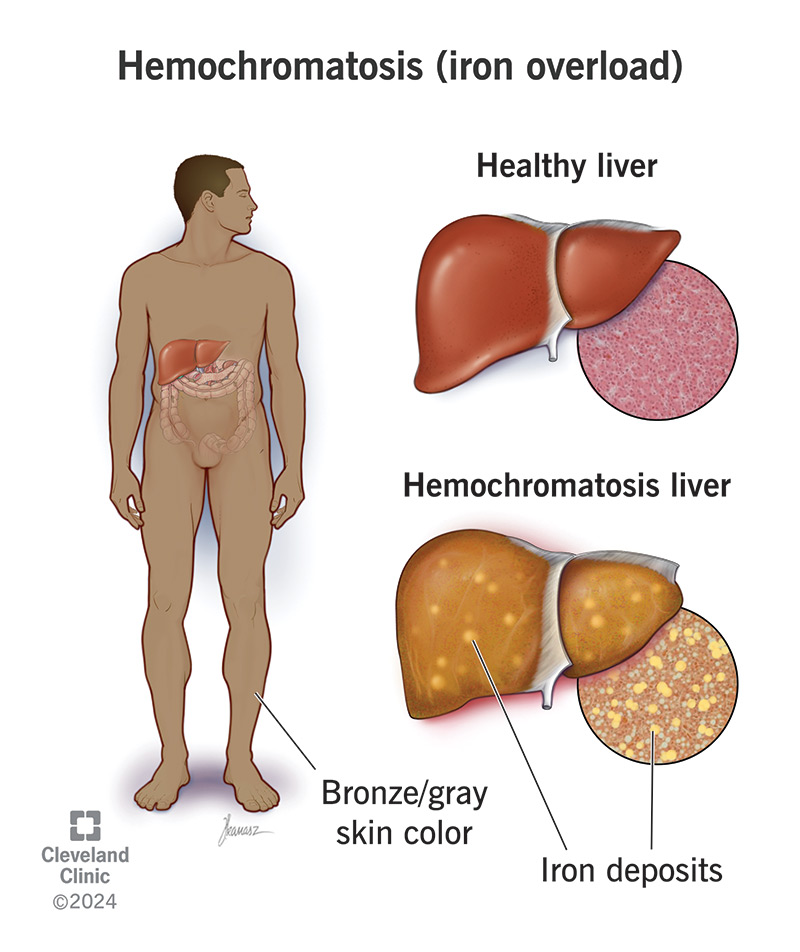
What is Hemochromatosis?
Hemochromatosis is a disease in which too much iron builds up in your body
(iron overload). Iron is a mineral found in many foods.
Too much iron is toxic to your body. It can poison your organs and cause
organ failure. In hemochromatosis, iron can build up in most of your body's
organs, but especially in the liver, heart, and pancreas.
Too much iron in the liver can cause an enlarged liver, liver failure, liver
cancer, or cirrhosis. Cirrhosis is scarring of the liver, which causes it to not
work properly.
Too much iron in the heart can cause arrhythmias, or irregular heartbeats,
and heart failure. Too much iron in the pancreas can lead to diabetes.
If hemochromatosis isn't treated, it may even cause death.
Overview
There are two types of hemochromatosis: primary and secondary. A defect in
the genes that control how much iron you absorb from food causes primary
hemochromatosis. Secondary hemochromatosis usually is the result of another
disease or condition that causes iron overload.
Most people who have primary hemochromatosis inherit it from their parents.
If you inherit two hemochromatosis genes—one from each parent—you're at risk for
iron overload and signs and symptoms of the disease. The two faulty genes cause
your body to absorb more iron than usual from the foods you eat.
Hemochromatosis is one of the most common genetic disorders in the United
States. About 1 million people in the United States have the disease.
Not everyone who has hemochromatosis has signs or symptoms of the disease.
Estimates of how many people develop signs and symptoms vary greatly. Some
estimates suggest that as many as half of all people who have the disease don't
have signs or symptoms.
The severity of hemochromatosis also varies from person to person. Some
people don't have complications, even with high amounts of iron in their bodies.
Others have severe complications or die from the disease.
Certain factors can affect how severe the disease is. For example, a high
intake of vitamin C can make hemochromatosis worse. This is because vitamin C
helps your body absorb iron from food.
Alcohol use can worsen liver damage and cirrhosis caused by hemochromatosis.
Conditions such as hepatitis also can further damage or weaken the liver.
Outlook
The outlook for people who have hemochromatosis largely depends on how much
organ damage they have at the time of diagnosis. Early diagnosis and treatment
of the disease are important.
Treatment may help prevent, delay, or sometimes reverse complications of the
disease. Treatment also may lead to better quality of life.
For people who are diagnosed and treated early, a normal lifespan is
possible. If left untreated, hemochromatosis can lead to severe organ damage and
even death.
Other names for Hemochromatosis
- Acquired hemochromatosis
- Classical hemochromatosis
- Genetic hemochromatosis
- Genetic iron poisoning
- Hereditary hemochromatosis
- Iron overload disease
- Primary hemochromatosis
- Secondary hemochromatosis
What causes Hemochromatosis?
There are two types of hemochromatosis: primary and secondary. Each type has
a different cause.
Primary Hemochromatosis
A defect in the genes that control how much iron you absorb from food causes
primary hemochromatosis. This form of the disease is sometimes called hereditary
or classical hemochromatosis. Primary hemochromatosis is the most common type of
the disease.
The genes usually involved in primary hemochromatosis are called HFE genes.
Faulty HFE genes cause the body to absorb too much iron. If you inherit two
copies of the faulty HFE gene (one from each parent), you're at risk for iron
overload and signs and symptoms of hemochromatosis.
If you inherit one faulty HFE gene and one normal HFE gene, you're a "hemochromatosis
carrier." Carriers usually don't develop the disease. However, they can pass the
faulty gene on to their children. Estimates suggest that about 1 in 10 people in
the United States are hemochromatosis carriers.
If two parents are carriers of the faulty HFE gene, then each of their
children has a 1 in 4 chance of inheriting two faulty HFE genes.
Although less common, other abnormal genes also can cause hemochromatosis.
Researchers continue to study what changes to normal genes may cause the
disease.
Secondary Hemochromatosis
This type of hemochromatosis usually is the result of another disease or
condition that causes iron overload. Examples of such diseases and conditions
include:
- Certain types of anemia, such as thalassemias and sideroblastic anemia
- Atransferrinemia and aceruloplasminemia—both are rare, inherited diseases
- Chronic liver diseases, such as chronic hepatitis C infection, alcoholic
liver disease, or nonalcoholic steatohepatitis
Other factors also can cause secondary hemochromatosis, including:
- Blood transfusions
- Oral iron pills or iron injections, with or without very high vitamin C
intake (vitamin C helps your body absorb iron)
- Long-term kidney dialysis
Who is at risk for Hemochromatosis?
Hemochromatosis is one of the most common genetic diseases in the United
States. About 1 million people in the United States it.
Hemochromatosis is most common in Caucasians of Northern European descent.
The disease is uncommon in African Americans, Hispanics, Asians, and American Indians.
Hemochromatosis is more common in men than in women. Older people are more
likely to develop the disease than younger people. In fact, signs and symptoms
usually don't occur in men until they're 40 to 60 years old.
In women, signs and symptoms usually don't occur until after the age of 50
(after menopause). Young children rarely develop hemochromatosis.
Inheriting two faulty HFE genes (one from each parent) is the major risk
factor for hemochromatosis. However, many people who have two copies of the
faulty gene don't develop signs or symptoms of the disease.
Alcoholism is another risk factor for hemochromatosis. A family history of
certain diseases and conditions also puts you at higher risk for hemochromatosis.
Examples of such diseases and conditions include heart attack, liver disease,
diabetes, arthritis, and erectile dysfunction (impotence).
What are the signs and symptoms of Hemochromatosis?
Hemochromatosis can affect many parts of the body and can cause various signs
and symptoms. Many of the signs and symptoms are similar to those of other
diseases. As many as half of the people who have hemochromatosis may not have
signs or symptoms.
Signs and symptoms of hemochromatosis usually don't occur until middle age.
Women are more likely to have general symptoms first, such as fatigue
(tiredness). In men, complications such as diabetes or cirrhosis (scarring of
the liver) often are the first sign of the disease.
Signs and symptoms also vary based on how severe the disease is. Common signs
and symptoms of hemochromatosis include joint pain, fatigue, general weakness,
weight loss, and abdominal pain.
Hemochromatosis complications
If hemochromatosis isn't found and treated early, iron builds up in your body
and can lead to:
- Liver disease, including an enlarged liver, liver failure, liver cancer,
or cirrhosis (scarring of the liver)
- Heart problems, including arrhythmias (irregular heartbeats) and heart failure
- Diabetes, especially in people who have a family history of diabetes
- Joint damage and pain, including arthritis
- Reproductive organ failure, such as impotence, shrinkage of the
testicles, and loss of sex drive in men, and absence of the menstrual cycle
and early menopause in women
- Changes in skin color that make the skin look gray or bronze
- Underactive pituitary and thyroid glands
- Damage to the adrenal glands
How is Hemochromatosis diagnosed?
Your doctor will diagnose hemochromatosis based on your medical and family
histories, a physical exam, and the results from tests and procedures.
The disease is sometimes found during the diagnosis of other diseases or
conditions such as arthritis, liver disease, diabetes, heart disease, and impotence.
Specialists involved
Family doctors or internal medicine specialists may diagnose and treat
hemochromatosis. Other doctors also may be involved in diagnosing and treating
the disease, including:
- A hematologist (blood disease specialist)
- A cardiologist (heart specialist)
- An endocrinologist (gland system specialist)
- A hepatologist (liver specialist)
- A gastroenterologist (digestive tract specialist)
- A rheumatologist (specialist in diseases of the joints and tissues)
Medical and family histories
To learn about your medical and family histories, your doctor may ask:
- About your signs and symptoms, including when they started and how
severe they are.
- Whether you take iron (pills or injections) with or without vitamin C
supplements (vitamin C helps your body absorb iron from food). If so, your
doctor may ask how much iron you take. This information can help him or her
diagnose secondary hemochromatosis.
- Whether other members of your family have hemochromatosis.
- Whether other members of your family have a history of medical problems
or diseases related to hemochromatosis.
Physical Exam
Your doctor will do a physical exam to check for signs and symptoms of
hemochromatosis. He or she will listen to your heart for irregular heartbeats
and check for arthritis, abnormal skin color, and an enlarged liver.
Diagnostic tests and procedures
Your doctor may recommend one or more tests or procedures to diagnose hemochromatosis.
Blood tests
In hemochromatosis, the amount of iron in your body may be too high even
though the level of iron in your blood is normal. As a result, doctors use
certain blood tests that give clues about how much iron is in your body.
During these tests, a small amount of blood is taken from your body. It's
usually drawn from a vein in your arm using a needle. The procedure usually is
quick and easy, although it may cause some short-term discomfort.
The blood tests you have may include transferrin saturation (TS), serum
ferritin level, and liver function tests.
Transferrin is a protein that carries iron in the blood. The TS test shows
how much iron the transferrin is carrying. This helps tell your doctor how much
iron is in your body.
Your doctor may test your serum ferritin level if your TS level is high. A
serum ferritin level test shows how much iron is stored in your body's organs. A
buildup of iron may suggest hemochromatosis.
You may have liver function tests to check for damage to your liver. Liver
damage may be a sign of hemochromatosis. If you've been diagnosed with
hemochromatosis, liver function tests may show how severe the disease is.
Blood tests alone can't diagnose hemochromatosis. Thus, your doctor may
recommend other tests as well.
Liver biopsy
During a liver biopsy, your doctor numbs an area near your liver and then
removes a small sample of liver tissue using a needle. The tissue is then
examined under a microscope.
A liver biopsy can show how much iron is in your liver. This procedure also
can diagnose liver damage (for example, scarring and cancer). Liver biopsies are
less common now than in the past.
Magnetic Resonance Imaging
Magnetic resonance imaging (MRI) is a safe test that uses radio waves,
magnets, and a computer to create pictures of your organs. An MRI may be done to
show the amount of iron in your liver.
Superconducting Quantum Interference Device
A superconducting quantum interference device (SQuID) is a machine that uses
very sensitive magnets to measure the amount of iron in your liver. It's
available at only a few medical centers.
Genetic testing
Genetic testing can show whether you have a faulty HFE gene or genes.
However, even if you do have two faulty HFE genes, the genetic test can't
predict whether you will develop the signs and symptoms of hemochromatosis.
Also, genetic testing may not detect other, less common faulty genes that
also can cause hemochromatosis.
There are two ways to do genetic testing. Cells can be collected from inside
your mouth using a cotton swab or a sample of blood can be drawn from a vein in
your arm and then tested.
People who have hemochromatosis or a family history of it and are planning to
have children may want to consider genetic testing and counseling. This will
help show whether one or both parents have faulty HFE genes. A genetic counselor
also can help figure out the likelihood of the parents passing the faulty genes
on to their children.
How is Hemochromatosis treated?
Treatments for hemochromatosis include therapeutic phlebotomy, iron chelation
therapy, dietary changes, and treatment for complications.
Goals of treatment
The goals of treating hemochromatosis include:
- Reducing the amount of iron in your body to normal levels
- Preventing or delaying organ damage from iron overload
- Treating complications of the disease
- Maintaining a normal amount of iron in your body for the rest of your
life
Therapeutic Phlebotomy
Therapeutic phlebotomy is a procedure that removes blood (and iron) from your
body. For this procedure, a needle is inserted into your vein, and your blood
flows through an airtight tube into a sterile container or bag.
The process is similar to donating blood and can be done at blood donation
centers, hospital donation centers, or a doctor's office.
In the first stage of treatment, about 1 pint of blood is removed once or
twice a week. After your iron levels return to normal, you may continue
phlebotomy treatments. However, you may need them less often—typically every 3 months.
As long as treatment continues, which is often for the rest of your life,
your doctor will order frequent blood tests to check your iron levels.
Iron Chelation Therapy
Iron chelation therapy uses medicine to remove excess iron from your body.
This treatment is a good option for people who can't have routine blood removal.
The medicine used in iron chelation therapy is either injected or taken
orally. Injected iron chelation therapy is done at a doctor's office. Oral iron
chelation therapy can be done at home.
Dietary changes
Your doctor may suggest that you change your diet if you have hemochromatosis.
You may be advised to:
- Avoid taking iron, including iron pills, iron injections, or
multivitamins that contain iron.
- Limit your intake of vitamin C. Vitamin C helps your body absorb iron
from food. Talk to your doctor about how much vitamin C is safe for you.
- Avoid uncooked fish and shellfish. Some fish and shellfish contain
bacteria that can cause infections in people who have chronic diseases, such
as hemochromatosis.
- Limit alcohol intake. Drinking alcohol increases the risk for liver
disease and can make liver disease worse.
Treatment for complications
Your doctor may prescribe other treatment as needed for complications such as
liver disease, heart problems, or diabetes.
How can Hemochromatosis be prevented?
You can't prevent primary, or inherited, hemochromatosis. However, not
everyone who inherits hemochromatosis genes develops symptoms or complications
of the disease. In those who do, treatments can keep the disease from getting worse.
Treatments include therapeutic phlebotomy, iron chelation therapy, dietary
changes, and other treatments.
People who have hemochromatosis or a family history of it and are planning to
have children may want to consider genetic testing and counseling. This will
help show whether one or both parents have faulty HFE genes. A genetic counselor
also can help figure out the likelihood of the parents passing the faulty genes
on to their children.
Living with Hemochromatosis
The outlook for people who have hemochromatosis largely depends on how much
organ damage has already occurred at the time of diagnosis. Early diagnosis and
treatment of the disorder are important.
Treatment may help prevent, delay, or sometimes reverse complications of the
disorder. Treatment also may lead to higher energy levels and better quality of
life. With early diagnosis and treatment, a normal lifespan is possible.
If organ damage has already occurred, treatment may prevent further damage
and improve life expectancy. However, treatment may not be able to reverse
existing damage.
If hemochromatosis isn't treated, it can lead to severe organ damage or even
death.
What to expect after treatment
People have different responses to treatment. Some people who have frequent
therapeutic phlebotomy may feel very tired. People who have advanced disease or
who are getting aggressive (very strong) treatment that weakens them may need
help with daily tasks and activities.
For the first 6 months to 3 years after diagnosis, you may need to have
therapeutic phlebotomy often. How long you will need this treatment depends on
how much extra iron is in your body.
After the initial treatment period, you may need ongoing treatment two to six
times a year. This will help prevent the iron from building up again.
Ongoing Care
If you have hemochromatosis, getting ongoing care is important. Ongoing care may include:
- Continuing therapeutic phlebotomy
- Taking medicines as prescribed
- Contacting your doctor right away about new or worsening symptoms, or
about possible reactions to phlebotomy
- Following up regularly with your doctor about test results, ongoing
treatments, and annual exams
- Using a diary or log to track the amount of iron in your body
If you need routine phlebotomy, you may have to change your usual work times
to schedule your treatments. You also may have to change your work schedule to
allow for periods of fatigue (tiredness) or recovery, especially if your
treatment weakens you.
Emotional issues
Having hemochromatosis may cause fear, anxiety, depression, and stress. It's
important to talk about how you feel with your health care team. Talking to a
professional counselor also can help. If you're feeling very depressed, your
health care team or counselor may prescribe medicines to make you feel better.
Joining a patient support group may help you adjust to living with
hemochromatosis. You can see how other people who have the same symptoms have
coped with them. Talk to your doctor about local support groups or check with an
area medical center.
Support from family and friends also can help relieve stress and anxiety. Let
your loved ones know how you feel and what they can do to help you.
Screening family members for Hemochromatosis
Parents, grandparents, brothers and sisters, and children (blood relatives)
of a person who has hemochromatosis may be at risk for the disease. Talk with
your doctor to see whether your relatives should have their iron levels checked.
Your doctor may recommend genetic testing to show whether family members are
at risk for the disease. If a relative already has been diagnosed with
hemochromatosis, a genetic test can show whether he or she has primary
(inherited) disease.
Key points
- Hemochromatosis is a disease in which too much iron builds up in your
body (iron overload).
- If the disease isn't detected and treated early, it can lead to serious
problems, including liver disease, heart disease, diabetes, arthritis,
impotence, abnormal menstrual cycles, pituitary and thyroid problems, and
changes in skin color. If hemochromatosis isn't treated, it may even cause
death.
- There are two types of hemochromatosis: primary and secondary. A defect
in the genes that control how much iron you absorb from food causes primary
hemochromatosis.
- Most people who have primary hemochromatosis inherit it from their
parents. If you inherit two hemochromatosis genes—one from each
parent—you're at risk for iron overload and signs and symptoms of the
disease.
- Secondary hemochromatosis usually is the result of another disease or
condition that causes iron overload, such as certain types of anemia.
- Hemochromatosis is one of the most common genetic disorders in the
United States. About 1 million people in the United States have it. The
disease is most common in Caucasians of Northern European descent. It's also
more common in men and older people.
- Hemochromatosis can affect many parts of the body and cause a number of
signs and symptoms. The signs and symptoms of the disease don't usually
appear until at least age 40 in men and age 50 in women. Common signs and
symptoms include joint pain, fatigue (tiredness), general weakness, weight
loss, and abdominal pain.
- Your doctor will diagnose hemochromatosis based on your medical and
family histories, a physical exam, and the results from tests and
procedures.
- Treatments for hemochromatosis include therapeutic phlebotomy, iron
chelation therapy, dietary changes, and treatment for complications.
- Your doctor may recommend frequent therapeutic phlebotomy at first to
get the amount of iron in your body back to normal. After your iron levels
return to normal, you may continue phlebotomy treatments, but get them less
often.
- You can't prevent inherited hemochromatosis. However, not everyone who
inherits hemochromatosis genes develops symptoms or complications of the
disease. If you do develop symptoms or complications, treatments can keep
the disease from getting worse.
- Family members (blood relatives) of people who have hemochromatosis
should consider having a doctor check their iron levels.
The outlook for people who have hemochromatosis largely depends on how much
organ damage has already occurred at the time of diagnosis. Early diagnosis and
treatment are important. Treatment may help prevent, delay, or reverse
complications. With early diagnosis and treatment, a normal lifespan is possible.
Source: The National Digestive
Diseases Information Clearinghouse (NDDIC) is a service of the National
Institute of Diabetes and Digestive and Kidney Diseases (NIDDK). The NIDDK is
part of the National Institutes of Health of the U.S. Department of Health and
Human Services.
Can't find the health information you’re looking for?
Ask a Health Educator, Live!
Know someone who could use this information?...send them this link.
This information is provided by the Cleveland Clinic and is not intended to replace the medical advice of your doctor or health care provider. Please consult your health care provider for advice about a specific medical condition. This document was last reviewed on: 2/27/2009...#5875