



Babies cry. A lot. It’s what they do. But if your baby cries nonstop for more than three hours a day at least three days a week, they may have colic. There’s often nothing you can do to calm a colicky baby. If your baby has the condition and you’re feeling overwhelmed, it’s important to reach out for help.
Advertisement
Cleveland Clinic is a non-profit academic medical center. Advertising on our site helps support our mission. We do not endorse non-Cleveland Clinic products or services. Policy
Colic means your otherwise healthy baby cries excessively for no clear reason. Often, there’s nothing you can do to settle your colicky baby. Healthcare providers define colic as intense crying:
Advertisement
Cleveland Clinic is a non-profit academic medical center. Advertising on our site helps support our mission. We do not endorse non-Cleveland Clinic products or services. Policy
All babies cry — it’s the way they communicate their needs. But you can’t soothe a baby with colic. They’ll continue to scream without any obvious cause. The crying usually starts suddenly at about the same time every day. This is often in the afternoon or evening hours. But when your baby isn’t crying, they act completely normal.
Colic in newborns is harmless and passes quickly. But the condition can be frustrating for parents. Managing an infant’s colic only adds to the stress and fatigue of new parenthood. The condition has been linked to postpartum depression and shaken baby syndrome. So, if your fussy baby has colic, it’s important to reach out for help if you need it.
Typically, babies get colic within the first few weeks after birth. It peaks between 4 and 6 weeks of age. Then, it usually ends rather abruptly when your baby is 3 to 4 months old.
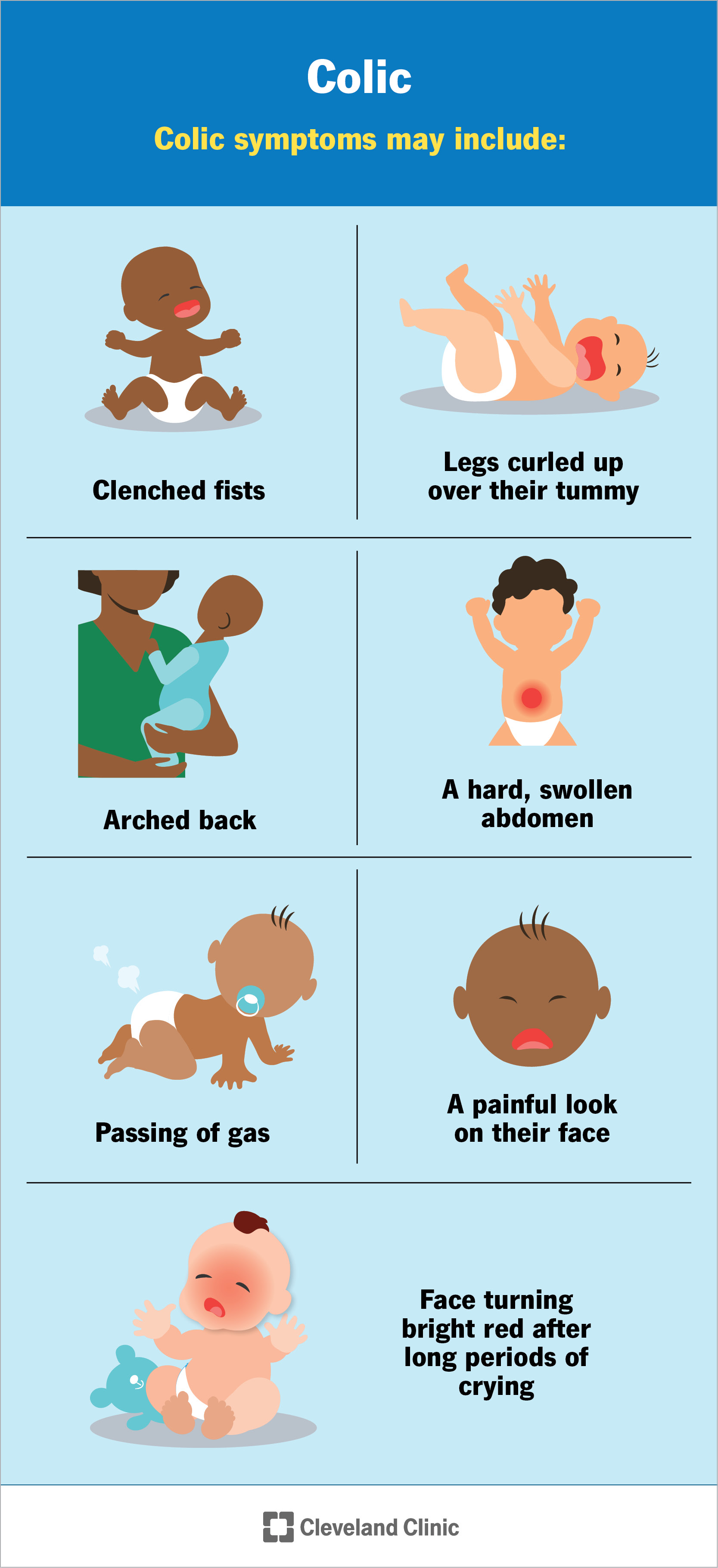
Image content: This image is available to view online.
View image online (https://my.clevelandclinic.org/-/scassets/images/org/health/articles/10823-colic)
Colicky infants are healthy babies. But they have repeated periods of crying — without an obvious reason — and you can’t comfort them. These crying episodes last for hours without stopping.
Signs of colic in babies can vary. Colicky babies usually get fussy at the end of the day. But the crying can happen at any time. It can be hard to comfort your baby during these stretches of time. There’s no link between these periods of fussiness and hunger or discomfort. Although your infant is fussy and cries, they continue to eat well and gain weight.
Advertisement
Symptoms of colic in an infant may include:
Researchers don’t know the exact reason babies get colic. But several factors may play a role.
Baby colic causes may include:
Newborn colic can take a toll on first-time and experienced parents alike. The overwhelming stress that the condition can place on caregivers can lead to postpartum depression and shaken baby syndrome.
No matter how impatient or angry you become, don’t shake your baby. Shaking an infant can cause blindness, brain damage or even death. Let your healthcare provider know if you’re having feelings of depression or trouble dealing with your emotions. They can recommend ways to help.
You can usually figure out your fussy infant has colic by the pattern of their symptoms. It’ll help if you keep a record of:
If you go to your baby’s pediatrician, they may do a physical exam. This is to rule out a physical condition as the cause of your baby’s fussiness. These conditions may include:
There’s no cure, but there are steps you can take to help ease colic in newborns. You may try the following baby colic treatments.
If you’re breastfeeding your baby, keep track of all the foods and drinks you consume in a food journal. You pass on everything you eat to your baby, and it can affect them. You may have to stop eating:
Ask your healthcare provider if there are any medications you should avoid.
If you’re feeding your baby formula, you may want to try a different brand of formula. Infants can be sensitive to certain proteins in formulas. Talk with your baby’s pediatrician about switching to a specific kind. You can also try feeding your baby smaller meals more often. But avoid feeding your baby too quickly or too much.
Advertisement
You may want to introduce a pacifier to your crying newborn. Some breastfed babies will actively refuse it. But it can provide instant relief for others. You could also try infant colic drops or a natural remedy like Colic Calm®. These colic medications for newborns can help relieve gas.
Other ways you can help your colicky baby include:
Call your baby’s healthcare provider if your baby stops gaining weight, shows dramatic changes in behavior or has any of the following symptoms:
Although a bout of colic can be frightening to watch — especially for first-time parents — it isn’t harmful to your baby’s health. Babies with the condition will eventually outgrow it. Typically, colic ends by the time your baby is 3 to 4 months old.
Advertisement
Thankfully, colic is a short-lived issue that doesn’t have any long-term effects on your baby. But that doesn’t make it any easier on you. It can be hard to look after a newborn who won’t stop crying. You may be feeling overwhelmed or frustrated. Your emotions are valid.
But if your baby has colic and your emotions are becoming too hard to handle, reach out to a trusted friend or family member. Ask them to watch over your baby while you take a break. Get out of the house. Clear your head. Give yourself time to calm down.
If you don’t have a trusted caregiver, place your baby in a safe place (like their crib) and leave the room. Your baby will be OK for a few minutes while you walk down the hall and take a breather. Remember, the crying won’t last forever.
When you hear the word “colic,” you may think of the kind infants get. But adults can get colic, too. Adult colic refers to pain in your intestinal or urinary system. Types of colic in adults include:
Advertisement
All babies cry, but if your baby is crying for hours on end, they may have colic. Researchers don’t know exactly why colic happens. But it has nothing to do with your parenting. It can be frustrating, especially for new parents trying to figure out how to take care of an infant. If you need help, reach out to a trusted friend or family member for a break. If you don’t have any trusted caregivers nearby, reach out to a healthcare provider. They can help you carefully manage this overwhelming bump in the road of parenthood.



Sign up for our Health Essentials emails for expert guidance on nutrition, fitness, sleep, skin care and more.
Learn more about the Health Library and our editorial process.
Cleveland Clinic’s health articles are based on evidence-backed information and review by medical professionals to ensure accuracy, reliability and up-to-date clinical standards.
Cleveland Clinic’s health articles are based on evidence-backed information and review by medical professionals to ensure accuracy, reliability and up-to-date clinical standards.
As your child grows, you need healthcare providers by your side to guide you through each step. Cleveland Clinic Children’s is there with care you can trust.
