



If you need knee surgery, arthroscopy can make the experience easier. Knee arthroscopy is a minimally invasive method for operating on your knee. It allows your surgeon to diagnose and fix many common injuries and conditions while only making small incisions. These heal much faster, so you can get back to activities sooner.
Advertisement
Cleveland Clinic is a non-profit academic medical center. Advertising on our site helps support our mission. We do not endorse non-Cleveland Clinic products or services. Policy
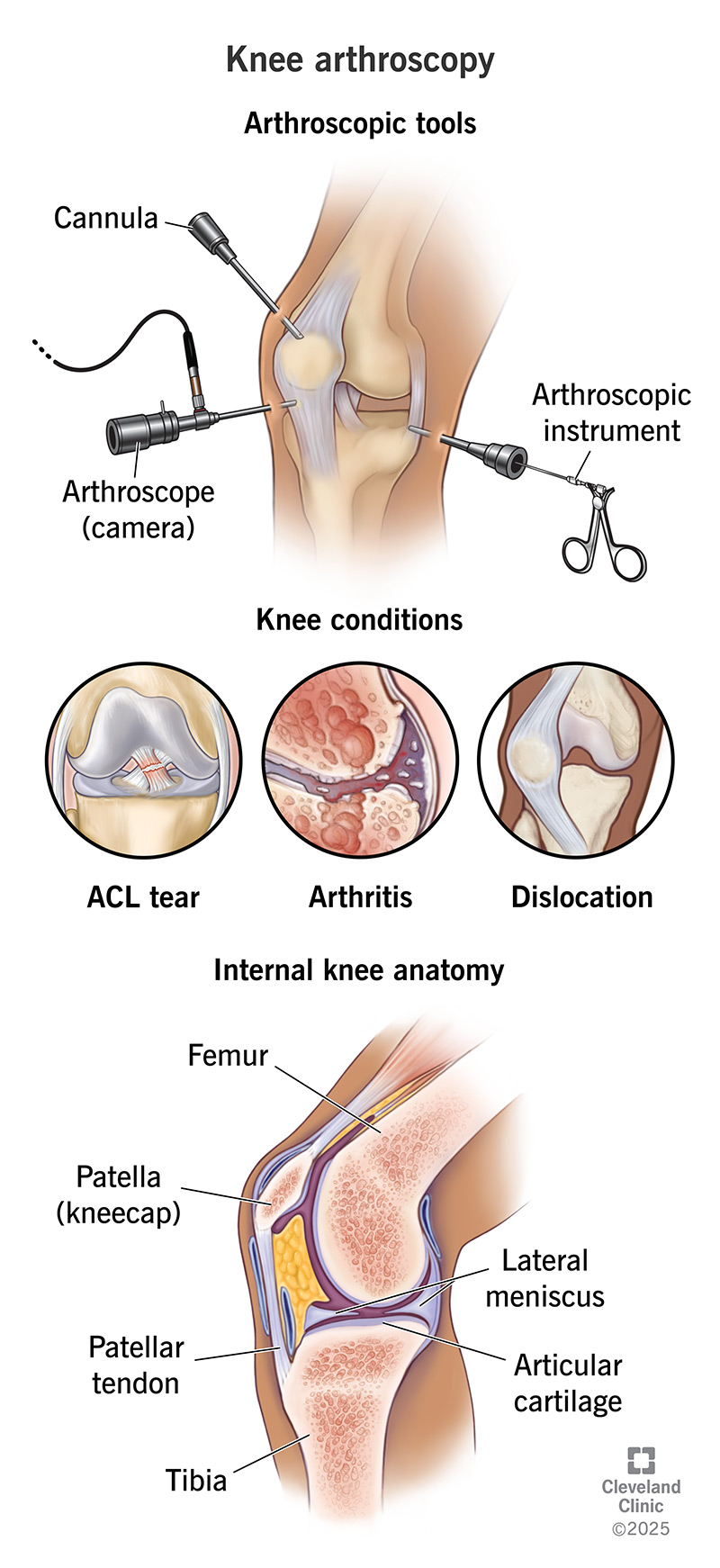
Image content: This image is available to view online.
View image online (https://my.clevelandclinic.org/-/scassets/images/org/health/articles/knee-arthroscopy)
Knee arthroscopy is minimally invasive surgery on your knee. That means your surgeon does everything through small incisions. They use a small scope, called an arthroscope, to look inside your knee joint and project images to a screen. They use the screen to operate on your knee through other small incisions.
Advertisement
Cleveland Clinic is a non-profit academic medical center. Advertising on our site helps support our mission. We do not endorse non-Cleveland Clinic products or services. Policy
Orthopedic surgeons use knee arthroscopy to diagnose and treat a wide range of knee injuries and conditions. The method allows them to easily identify and fix issues that might be causing you knee pain, while causing minimal trauma. The small cuts are easier to recover from than traditional knee surgery.
Some of the most common conditions knee arthroscopy treatments include:
Your healthcare team may instruct you to stop taking certain medications and to stop eating by a certain time leading up to your operation. You can choose what kind of anesthesia you want. You may have:
Knee scope surgery is usually an outpatient procedure, so you can plan to go home the same day. Since the anesthesia takes time to wear off, you’ll need to arrange for someone to drive you home.
During arthroscopic knee surgery, your surgical team will:
Advertisement
Most arthroscopy procedures take about an hour. You may spend another hour or two in recovery.
Arthroscopic knee surgery typically has fewer complications than open knee surgery. Still, with any surgery, there’s always a small risk of complications during and after. Some of these include:
One risk that’s more specific to knee surgery is that it can contribute to osteoarthritis of the knee. Osteoarthritis develops from cumulative wear and tear on your knee, and surgery adds to this. If you’re at risk of knee osteoarthritis, your doctor might hesitate to recommend elective knee surgery for you.
But in other situations, the benefits of knee arthroscopy may easily outweigh the risks. For diagnostic purposes, arthroscopy provides easy access and risks minimal damage. If you have a knee injury that won’t heal without surgery, knee arthroscopy will make the experience easier and the recovery faster.
After you go home, you’ll need to take it easy for a few weeks. You can expect some pain and swelling, which will get better after a few days. Depending on the procedure you had, you may have to wear a knee brace to keep your knee in the right position for healing. You may need to use crutches to walk.
Your healthcare team will explain how to take care of yourself at home, including:
After knee arthroscopy, most people are able to return to their usual activities within six to eight weeks. It might be a little longer before your knee is ready for high-impact activities, like sports or heavy labor. Being diligent with your physical therapy will help to prepare your knee to return to activity safely.
Your recovery time and outcome will also depend on the type of procedure you had and the damage you had to your knee. More severe injuries and surgeries may take longer to recover from. In some cases, you may not be able to return to high-impact activities. Your surgeon can tell you what to expect.
Advertisement
Call your provider if you have:
Having any kind of surgery can be nerve-wracking, but minimally invasive methods make it a little less so. Whether you have a serious injury that needs repair, or you have chronic, unexplained knee pain that needs an intervention, knee arthroscopy offers a relatively simple, safe and effective solution.
Advertisement



Sign up for our Health Essentials emails for expert guidance on nutrition, fitness, sleep, skin care and more.
Learn more about the Health Library and our editorial process.
Cleveland Clinic’s health articles are based on evidence-backed information and review by medical professionals to ensure accuracy, reliability and up-to-date clinical standards.
Cleveland Clinic’s health articles are based on evidence-backed information and review by medical professionals to ensure accuracy, reliability and up-to-date clinical standards.
Have knee pain? Cleveland Clinic’s knee surgery team offers minimally invasive options and pain management to get you back on your feet.
