



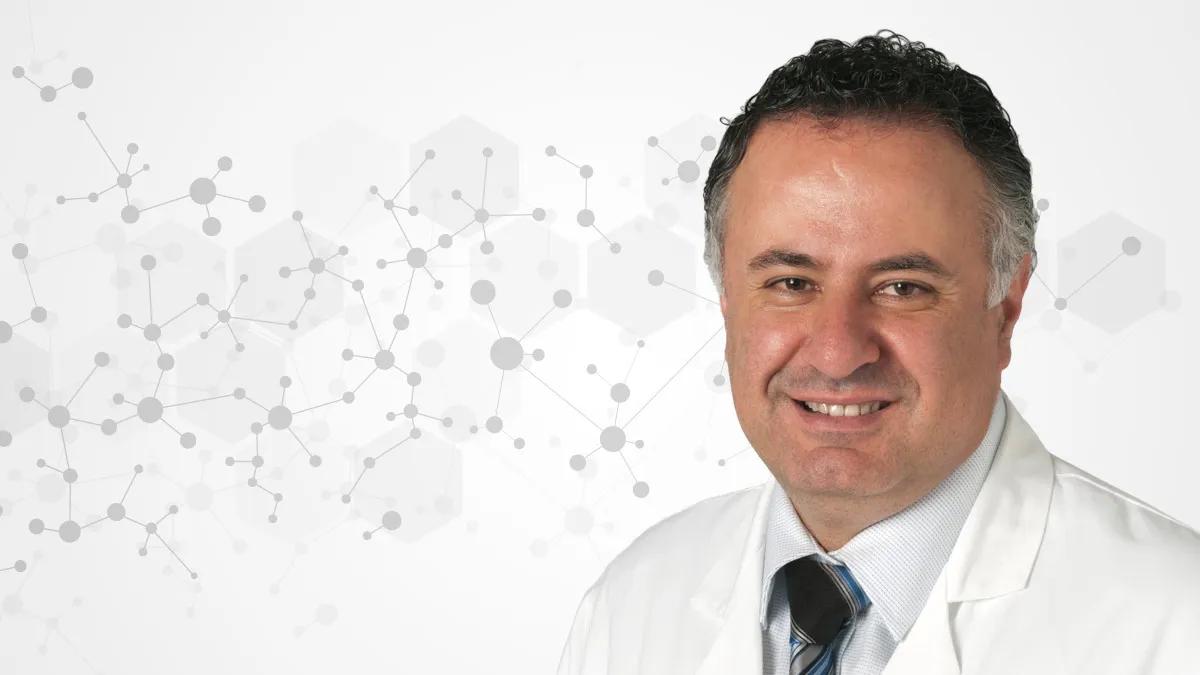
Transforming Epilepsy Diagnosis and Treatment Through AI-Enabled Infrastructure
Imad Najm, MD, discusses how AI-enabled infrastructure and advanced EEG analysis are transforming epilepsy diagnosis.
Advertisement
Cleveland Clinic is a non-profit academic medical center. Advertising on our site helps support our mission. We do not endorse non-Cleveland Clinic products or services. Policy
Recent Episodes
Advancing Recovery Through Early Mobilization in Neuro Care
Adam Barron, MD, and Natalie Lilly, PT, DPT, explore the evolving evidence behind early mobilization in neurocritical care.
Learnings of having Embedded Psychiatrists in Neurological Clinics
Drew Cumming, MD, reviews the impact of embedded psychiatry in neurology and the benefits of integrating behavioral health expertise into th…
Behavioral Health Protocols for Suicidal Ideation
Brianne Markley, PhD, explains how screening tools, risk assessment and safety planning can help clinicians recognize and respond to suicida…
Video content: This video is available to watch online.
View video online (https://cdnapisec.kaltura.com/p/2207941/sp/220794100/playManifest/entryId/1_p6twzivk/flavorId/1_5f3sgelj/format/url/protocol/https/a.mp4)
Transcript
Neuro Pathways Podcast Series
Advertisement
Cleveland Clinic is a non-profit academic medical center. Advertising on our site helps support our mission. We do not endorse non-Cleveland Clinic products or services. Policy
Release Date: September 1, 2026
Expiration Date: August 31, 2027
Estimated Time of Completion: 30 minutes
Transforming Epilepsy Diagnosis and Treatment Through AI-Enabled Infrastructure
Imad Najm, MD
Description
Each podcast in the Neurological Institute series provides a brief, review of management strategies related to the topic.
Learning Objectives
- Review up to date and clinically pertinent topics related to neurological disease
- Discuss advances in the field of neurological diseases
- Describe options for the treatment and care of various neurological disease
Target Audience
Physicians and Advanced Practice providers in Family Practice, Internal Medicine & Subspecialties, Neurology, Nursing, Pediatrics, Psychology/Psychiatry, Radiology as well as Professors, Researchers, and Students.
Accreditation
In support of improving patient care, Cleveland Clinic Center for Continuing Education is jointly accredited by the Accreditation Council for Continuing Medical Education (ACCME), the Accreditation Council for Pharmacy Education (ACPE), and the American Nurses Credentialing Center (ANCC), to provide continuing education for the healthcare team.
CREDIT DESIGNATION
- American Medical Association (AMA)
Cleveland Clinic Center for Continuing Education designates this enduring material for a maximum of 0.50 AMA PRA Category 1 Credits™. Physicians should claim only the credit commensurate with the extent of their participation in the activity.
Participants claiming CME credit from this activity may submit the credit hours to the American Osteopathic Association for Category 2 credit. - American Nurses Credentialing Center (ANCC)
Cleveland Clinic Center for Continuing Education designates this enduring material for a maximum of 0.50 ANCC contact hours. - Certificate of Participation
A certificate of participation will be provided to other health care professionals for requesting credits in accordance with their professional boards and/or associations. - American Board of Surgery (ABS)
Successful completion of this CME activity enables the learner to earn credit toward the CME requirements of the American Board of Surgery’s Continuous Certification program. It is the CME activity provider's responsibility to submit learner completion information to ACCME for the purpose of granting ABS credit.
Advertisement
Credit will be reported within 30 days of claiming credit.
Podcast Series Director
Andreas Alexopoulos, MD, MPH
Epilepsy Center
Additional Planner/Reviewer
Ari Newman, BSN
Faculty
Imad Najm, MD
Epilepsy Center
Host
Glen Stevens, DO, PhD
Cleveland Clinic Brain Tumor and Neuro-Oncology Center
Agenda
Transforming Epilepsy Diagnosis and Treatment Through AI-Enabled Infrastructure
Imad Najm, MD
Disclosures
In accordance with the Standards for Integrity and Independence issued by the Accreditation Council for Continuing Medical Education (ACCME), The Cleveland Clinic Center for Continuing Education mitigates all relevant conflicts of interest to ensure CME activities are free of commercial bias.
The following faculty have indicated that they may have a relationship, which in the context of their presentation(s), could be perceived as a potential conflict of interest:
Imad Najm, MD
| Company | Relationship |
|---|---|
| SK Life Science Inc | Teaching and Speaking, Advisor or review panel participant |
| Company | |
| SK Life Science Inc | |
| Relationship | |
| Teaching and Speaking, Advisor or review panel participant |
Glen Stevens, DO, PhD
| Company | Relationship |
|---|---|
| DynaMed | Consulting |
| Company | |
| DynaMed | |
| Relationship | |
| Consulting |
All other individuals have indicated no relationship which, in the context of their involvement, could be perceived as a potential conflict of interest.
CME Disclaimer
The information in this educational activity is provided for general medical education purposes only and is not meant to substitute for the independent medical judgment of a physician relative to diagnostic and treatment options of a specific patient's medical condition. The viewpoints expressed in this CME activity are those of the authors/faculty. They do not represent an endorsement by The Cleveland Clinic Foundation. In no event will The Cleveland Clinic Foundation be liable for any decision made or action taken in reliance upon the information provided through this CME activity.
HOW TO OBTAIN AMA PRA Category 1 Credits™, ANCC Contact Hours, OR CERTIFICATE OF PARTICIPATION:
Go to: Neuro Pathways Podcast September 1, 2026 to log into myCME and begin the activity evaluation and print your certificate If you need assistance, contact the CME office at myCME@ccf.org.
Copyright ©2026 The Cleveland Clinic Foundation. All Rights Reserved.
Introduction:
Neuro Pathways, a Cleveland Clinic podcast exploring the latest research discoveries and clinical advances in the fields of neurology, neurosurgery, neurorehab, and psychiatry.
Dr. Glen Stevens, DO, PhD:
Epilepsy care is entering a new era where artificial intelligence and advanced data infrastructure are helping clinicians analyze complex information faster, improve diagnostic precision, and support more personalized treatment decisions.
In this episode of Neuro Pathways, we discuss how AI-ready infrastructure, data integration, and clinical expertise are coming together to shape the future of epilepsy care. I'm your host, Glen Stevens, neurologist, neuro-oncologist in Cleveland Clinic's Neurological Institute. And joining me today is Dr. Imad Najm. Dr. Najm is director of Cleveland Clinic's Epilepsy Center at the Cleveland Clinic Neurological Institute. Imad, welcome to Neuro Pathways.
Advertisement
Dr. Imad Najm, MD:
Thank you, Glen. Happy to be here.
Dr. Glen Stevens, DO, PhD:
So we were just discussing earlier that we've known each other for 34 years, hard to believe. But for those that don't know you out there, tell us a little bit about yourself, why you came to Cleveland, and what you do on a regular basis.
Dr. Imad Najm, MD:
Yes. I came to Cleveland back in 1992, and I came to do my neurology training. After that, I joined the Cleveland Clinic Epilepsy Center Fellowship program, and I did my fellowship in clinical neurophysiology and epilepsy. After finishing this, I've been on the staff of the Cleveland Clinic Epilepsy Center.
Dr. Glen Stevens, DO, PhD:
Well, we're happy to have you today. I know you've been on the podcast before, and you're always provide so much information. It's great to have you.
So, I'm a little bit of a history buff. I love reading history, those types of things. And I was recently, just last week, don't ask me exactly why, but I was reading about the Kennedy assassination. Within that, as you know, Jack Ruby was reported to have killed Oswald, who's thought to have assassinated Kennedy. And for those young individuals out there, you should really probably YouTube and have a look at it because it's fascinating that in the basement of the police headquarters, they have actual... It went out live on TV around the country, Oswald being escorted by the police, and you can see Jack Ruby actually shoot Oswald. From your side of things where this is interesting is that the defense that was brought up was that he had psychogenic seizures or, as we would call it today, temporal lobe seizures, or you'd probably call it something else, but temporal lobe epilepsy. And then he was sort of in a fugue state, he was having automatisms, purposeless movements, and he shot Oswald because of this seizure that he was having.
Advertisement
And their data for that, which would be interesting because of the AI stuff that you're doing, and I don't know if it's long enough that you could do it, but they provide a copy of the EEG, a segment of the EEG that was done. And of course, when you and I trained, everything was paper, and we can get to that as well as we move on here. But you can see on one of the recordings, what they're saying is some abnormal activity in the temporal lobe lead where, in an EPIC, you can sort of see these six picket type things or spikes or whatever they wanted to call them at that period of time. So the EEG expert at the time in the mid 1960s came on and said, "This is temporal lobe epilepsy."
And then the other side brought in Foster. Foster was one of the four horsemen of the American Academy of Neurology, so he was a founder of the American Academy of... and he said, "This is just background noise. It's nothing. This is not epilepsy." Because it was all on TV, you could watch it, and they said, "There was no automatization here. It was purposeful movement, and you couldn't do that kind of coordinated movement." So I guess before we get ahead of ourselves, could we put this through an AI and ask if it's real or if it's artifact?
Advertisement
Dr. Imad Najm, MD:
Wow. Actually, I'm very happy that you started with a historical encounter, so to say, because... To give you some background too, I'm sure our audience know that the EEG is much older than the '60s. So the EEG actually was developed by Hans Berger, who was a psychiatrist in 1924. And as a psychiatrist, he was interested in understanding potentially the way the brain and brain activity misbehave in patients who suffered from psychiatric disorders and did not take off as a tool for diagnosis of psychiatric conditions. But in the 1950s, back in France, they described for first time what we call psychomotor epilepsy. Psychomotor epilepsy, which later was called auto motor epilepsy or temporal lobe epilepsy, it does affect the temporal lobe, as you mentioned. And there are, on the EEG recordings, like for any type of epilepsy, some interictal spiking that will point vaguely to the temporal lobe, and there are some EEG seizure patterns that could be basically evolving in temporal lobe.
But one thing here, there are some what we call normal variants on the EEG. They look like psychomotor seizures, and sometime we call them psychomotor variants. This historical encounter that you mentioned, Glen, highlights the promise, the strength, but at the same time, the weakness of the EEG. It is very subjective. And that is something we are trying, and we have been trying, for many years to solve it. How did we solve it in the past? By experience. But experience comes and goes, and we have to start all over again, and so there is this uneven way for people to look at this EEG and interpret this EEG. And that's what you mentioned here.
Dr. Glen Stevens, DO, PhD:
Exactly. I thought it'd be a nice intro. One of the negative things that they said that came out of the trial, and who knows how long it lasted, but it associated violence with epilepsy, which as you can imagine is a very negative thing because then it stigmatizes epilepsy as people that are criminals, people that have something wrong with them. And it's probably been a little bit of a push up the hill since the '60s for some period of time to reeducate people and tell them that's not the case, so very unfortunate.
Dr. Imad Najm, MD:
No, it is absolutely correct here. It's unfortunate. But after seizures, mainly seizures affecting the temporal lobe, there is the postictal period, and it could be an acute psychosis style type of period where people will do things completely unconscious. And sometimes the behavior is so unconscious, a point that you cannot control, and a person who's affected by this cannot even recall.
Dr. Glen Stevens, DO, PhD:
So, let's look at the scope of the problem, and you've built an unbelievable program here, within our healthcare system, how many EEGs per day approximately are we doing?
Dr. Imad Najm, MD:
Yeah. Within the Cleveland Clinic health system, probably we do around between 100 and 200 EEG studies per day.
Dr. Glen Stevens, DO, PhD:
Amazing. And if it was me reading, it would take about 24 hours, but how long would it take an epileptologist to read an EEG?
Dr. Imad Najm, MD:
Well, it depends what EEG we're talking about. If we're talking about the outpatient EEG, these are the 23-minute type of EEG. We'll call them routine or short EEGs. It takes maybe 10 minutes to read it. Now, the problem here we have, and it's since the late '90s and early 2000s, we've been doing more and more of the continuous 24-hour EEG mostly in the inpatient setting and mostly in the critical care setting. These EEGs, if you look at the 24-hour EEG, a very well-trained person takes them around two hours to go through these EEGs and to generate the first draft of the report.
Dr. Glen Stevens, DO, PhD:
So it doesn't take a math major to do the math and figure out pretty quickly that we need something to help the system, which I guess we'll get into the AI with. The other thing, of course, if we're still doing it on paper, could you imagine? I mean, you would need a forest every day just with the paper alone that would move through. So, when you look back on your experience caring for patients with epilepsy, which you've done for 30 years, what unmet need or challenge, and I guess we've sort of talked about a little bit, but led you to developing, we need to incorporate AI into epilepsy?
Dr. Imad Najm, MD:
Yeah. I mean, we have so many unmet needs in epilepsy, as it is probably for many of the diseases that we all have to deal with. And whenever we start to think about needs and how to address them, we look at low-hanging fruit. And if I think about something that potentially could be almost ready-made for the development of an AI model as a proof of concept that we can use data in order to improve our patient care, that will be the EEG. Because EEG, as we all know, and in particular since the late 1980s, has been digitized. In almost every program in the country or anywhere in the world who have been doing this for some time, they have thousands of hours of EEGs recorded over the years. And as one of the largest epilepsy programs in the country, we have been using actually digital EEG since 1988, and we have hundreds of thousands of EEG hours.
But more importantly, we have EEG hours on patients in whom we have all of their digital records, and for the most part that we know their diagnosis, we know their treatments, we know the outcome of these treatments. So any type of EEG or any type of model that we develop to read this EEG, beside detecting patterns, we can ascribe these patterns to a diagnosis and a diagnosis that is validated. And that's how we thought, if there is a good application to start with in epilepsy, it is the EEG.
Dr. Glen Stevens, DO, PhD:
Yeah, it makes sense, doesn't it? And as you mentioned, there's lots of challenges. What are some of the challenges that you're hoping EEG will help you with other than just helping with the workload itself?
Dr. Imad Najm, MD:
Well, the most important thing after the workload is to make sure we have an objective reading of the file. As you mentioned in your historical encounter that you shared here, an EEG can be read in two different way by two experts. We want to eliminate this, and we can.
Dr. Glen Stevens, DO, PhD:
So you mentioned data sets that you have readily accessible, the data that you have from back in the '80s, or hard to get to or it's digitized, it's ready to go for AI?
Dr. Imad Najm, MD:
It is digitized. I think, without going too much into technical details, we can transform some digital data to a more uniform format, could be an open-source international format or a international format that could be used to develop an AI model to read these EEGs for us.
Dr. Glen Stevens, DO, PhD:
And is this something that we're doing here, or are we doing it in collaboration with other institutions, or other institutions are doing their own thing?
Dr. Imad Najm, MD:
At this point, there are multiple institutions, multiple institutions with startup companies, with big companies. They've been working or toying with the developing some AI models to read the EEGs. For us, we've been developing this with a startup group that we are the experts. We are one of the bigger centers to supply the digitized EEG recordings and to put the EEG recordings and interpretations in the context of validated from the outcomes and the diagnosis that we have for these patients.
Dr. Glen Stevens, DO, PhD:
How long have you been doing this?
Dr. Imad Najm, MD:
We've been actually working on this for close to two years now.
Dr. Glen Stevens, DO, PhD:
Okay. All right. And are we currently using some form of AI in our EEGs for reporting, for data collection, for interpretation?
Dr. Imad Najm, MD:
Not yet. We are in the final stages now before getting the FDA approval for the model. And we hope that by the end of the third quarter, early fourth quarter 2026, we'll be able to start to use the AI at a small scale within our operation. And then once we move to our new Neurological Institute hospital and building, we will have at least one part of our central monitoring unit that is equipped by an AI model for a live analysis of EEGs recording in anywhere in the inpatient hospital setting outside the epilepsy monitoring units, such as the intensive care units, neurological intensive care units, medical intensive care units, and at any of our locations within the Cleveland Clinic health system.
Dr. Glen Stevens, DO, PhD:
Well, that's excellent. And that was going to be a question I was going to ask you later in terms of the new building I would integrate, and of course you would forethink on that and decide and know where things are going from.
Dr. Imad Najm, MD:
Yeah, absolutely, because that is a first step. The second step, we hope we can implement, which is doing a live analysis of the EEG or post-process of the EEG for detection of seizures and abnormal activities for patients in our epilepsy monitoring units come as a second step.
Dr. Glen Stevens, DO, PhD:
So are there aspects of AI-related EEG that you feel will be good to go for just it's an automatic thing, it will just read it and give you something versus things that clearly, as a physician, you need to look at, you need to assist with interpretation?
Dr. Imad Najm, MD:
Yeah, you know the AI model is as good as the data that is used to develop it, to validate it, and to make it as a learning model on the long term. So at this point, we are training our model to read this EEG and identify abnormalities and to assign these abnormalities to some labels that, as experts, we agreed upon. The AI currently, our AI model, is not trained to is to interpret the EEG in a context of the patient's condition. And this is where it's much higher level, this is where the physicians, the providers, they need to have their final way.
Because if we think about EEG reading and an EEG, we're going to interpret EEG studies, there are three levels. There is the description part of it, of the EEG. Say I'm seeing an activity that is sharp for a duration of 100 millisecond, for example, followed by slowing, which we may call it, "This is sharp wave." And then at the same time, we look at if there are seizures, we can talk, "We are seeing an evolving pattern, X, Y, Z." This is a description. The second part of it is classification, which is basically assign a label, pathological or normal variant label, to these activities. In a classification format, we see a slow in the left temporal region, for example, or seizures. And then the third part, which our model is not trained for, which is to tell us about the type of epilepsy and the context in which what is the possible cause, and certainly it's not trained to give us any information or any recommendation about treatment or outcomes.
Dr. Glen Stevens, DO, PhD:
Yet.
Dr. Imad Najm, MD:
Yet, exactly.
Dr. Glen Stevens, DO, PhD:
As it goes. And I think it's obvious, as you just mentioned, that it being able to pick up subtle seizures, being able to pick up normal variants will be, again, as good as the data that it gets into. But as you could imagine, its ability in microseconds to go through large volumes of data versus you going through a screen for a couple of hours, you can imagine how it could be immensely helpful or at least would tag the areas that you should look at and say, "Hey, these are the 10 areas that you need to look at a little bit closer," and just improve our diagnostic skills and treatment, and who do we really treat, who don't we treat, all those types of things. Very exciting.
Dr. Imad Najm, MD:
Yeah, it is exciting because we are training the model to show us a visual, so what we call a dashboard. For each study, we are feeding into it the model and show us in a graphic format the various activities that the model identified as of interest. And for us, we can go and click on each one of these points if we want to. Let's say a person had 10 seizures over the last 24 hours. There is a graph where it shows, at 12:01, there was a seizure. We can click on that asterisk there, and it takes us to the EEG where immediately we say, "Yes, we agree," or, "We don't agree with it." So that will help us immensely because it will shave off... Instead of two hours to read a 24-hour study, it may cost 5, 10, 15, 20 minutes.
Dr. Glen Stevens, DO, PhD:
My understanding is that your interest is to have vendor-agnostic and modality-agnostic AI. Explain what you mean by that or what your hope is and what's the reality of that happening.
Dr. Imad Najm, MD:
Yeah, it is... I mean, vendor agnostic, some of us in the field, we have a specific vendor that will buy from a machine to record the EEG and show us their recording. There are multiple vendors in United States, for example. Now, the modality agnostic means instead of only EEG, we can think here about feeding the same model, which we will, feeding MRI, for example. MRIs, they have multiple vendors, but they have, for example, one single format. DICOM is an example of these things.
So with these models here we can feed into the same model after we transform the digital EEG and digital MRI, PET scan, genetic results, for example, into a one single language. And that is how we are building our data platform that will be taken information from everywhere, linked to one single number, which is medical record number, and will be timestamped as we collect this information. All of it is one single format, whatever it's coming from, whatever modality it is, that will be used later on to develop appropriate models for the diagnosis, for the prediction of the disease evolution, for example, to the recommendation for treatment and prediction of outcomes.
Dr. Glen Stevens, DO, PhD:
And is it difficult with different vendors, or the modeling not a problem?
Dr. Imad Najm, MD:
No, basically, because once we have the data, whatever vendor it is, we can transform this data into an international format.
Dr. Glen Stevens, DO, PhD:
If I go back to my montages, there's a lot of different montages, does the montage make a big difference with this, or when you're collecting the data, will it look at a double banana or some other type of montage and it will understand what it is and look at what you need to look at? Tell me a little bit about montages and AI.
Dr. Imad Najm, MD:
The montages are not any more as important as 5, 10, 15, 20 years ago where we need to have a particular page in a certain montage to look for a particular activity in one single area of the brain. Here, it is agnostic to the montages. We have data on each electrode, and it will basically create multiple montages or configuration from the basic digital data that it's fed into.
Dr. Glen Stevens, DO, PhD:
And I assume that your hope down the road is that this can be in real time, that you'll be able to use it in real time to help treat patients, that it will have some predictive quality or prognostic quality, that, hey, when we see this type of pattern, it tends to be more a medication resistant epilepsy. Are we going to get to that point? I mean, I'd like to believe we would, but you tell me, is this not that far away?
Dr. Imad Najm, MD:
I don't think it is that far away. I think it's very important, those of us who have started to learn a little bit about AI, I'm just learned a little bit about AI over the last two, three years, know that an AI model is as good as the data that is fed into it for the development of that model, for the training of the model, and for the validation of this problem. So our major role as clinicians, as medical professionals, as scientists in the medical field is to make sure we clean the data to the extent we can, to make sure that we try to validate every clinical detail that we can before we feed it into any AI model. Because I can use this word, junk in, junk out. We need to have quality in, and we'll have a much higher quality out.
Dr. Glen Stevens, DO, PhD:
You already mentioned MRI. Are we currently putting in MRI data, PET data, SPECT data into the AI models or not yet?
Dr. Imad Najm, MD:
Not yet. Not yet. First phase is EEG for the non-epilepsy units. Second one, it will be EEG for the EMU and epilepsy monitoring areas. Third one is videos, videos for the EEG, the whole semiology. Semiology, it is in the field of, as we know, epilepsy surgery. It is of utmost important if a person has a seizure, let's start with a index finger movement and that they basically grimaced in that same time. We want the AI model to notice both of these details and put them in context, "How did we localize that epilepsy, and where is it coming from?" for example, "And what network in the brain is involved?" So that will be even more exciting for us.
Dr. Glen Stevens, DO, PhD:
I mean, I think it would be fascinating to go to your epilepsy patient management cases five years from now and see what it looks like because it's going to look so different in the data and... maybe even shorter than that. But the data and the information that's there, I mean, it's really quite astounding.
Dr. Imad Najm, MD:
That's what we hope for. We hope for that our patient management will be faster. As I mentioned, I think our role as physicians is going to be actually more exciting. Because instead of taking care of small details that are important, but they are time-consuming, we'll look at the almost final product and try to make sense of it. All of us will be starting to work at the top of our license. Every professional in medical field, the goal should be to elevate our daily work to be 100% on top of our license.
Dr. Glen Stevens, DO, PhD:
Excellent. And just reiterate for me, in the new Neurological Institute building, how are we going to incorporate the AI there?
Dr. Imad Najm, MD:
Well, simply by considering the fact that this Neurological Institute building is so modern and so well connected, the connectivity here give us the infrastructure to build on and to optimize the benefit or the yield of any AI model we have.
Dr. Glen Stevens, DO, PhD:
So where do you think we're going to be in five years?
Dr. Imad Najm, MD:
In five years, I think we kind of talked about it a little bit, we are going to be seeing the patient, and at the moment we're seeing the patient, much of the information had been acquired, has been read, interpreted, and put in context, and our interaction with the patient would be not taking so much time to go for getting so much details and then doing it at multiple steps. For example, we'll do a study today or two studies or three studies. We look at them asynchronously, and then we interpret them. We'll input this data in our record. Then we'll get the patient back. We'll look at them, say, "Well, we think this is what's happening. Oh, but we need to do this study or that study." I see it in five years from now.
When we have the initial information about a patient to have a plan about every study that we're going to need, these studies will be done, will be fed into an interactive AI model platform, model for each modality and model that put all of these modalities together, and then generate a report that will be available for the physician to make sure that they check it and then put it in context of the patient condition and relay this information to the patient. Not only information about what we think is going on, we have a higher certainty about diagnosis, we have higher certainty about type of treatment, but as important, we'll give the patient prediction about their outcomes and what's available out there. If treatment A doesn't work, what about B, C, and D?
Dr. Glen Stevens, DO, PhD:
Imad, it's unbelievable. Our time is just about up, so a couple things. One is, do you think epilepsy monitoring unit length of stay will change with AI?
Dr. Imad Najm, MD:
I think it will potentially change by simply optimizing the yield of the EEG. We think, in our current models, we are reading every second of it, but we are all human. And so if we eliminate the uncertainty, which is, "Is it a seizure? It's not a seizure?" for example, we eliminate the lack of attention to small details, the yield of the study will be higher and faster.
Dr. Glen Stevens, DO, PhD:
Anything that we haven't discussed you think is important?
Dr. Imad Najm, MD:
I try to remind myself with, Glen, is anytime I think about AI, I try to think about two things. What do I want to achieve? And do I have the clean, validated data that I need? If I have these two sorted out, developing a model will be fun, and more importantly, it will be very helpful, and it will make a difference in the way we treat our patients.
Dr. Glen Stevens, DO, PhD:
Well, Imad, you have exceeded my expectations throughout your career. I've loved watching you grow throughout your career and all the great things that you're doing, this and brain health study that you're doing as well. I mean, you're doing a lot of cutting-edge things that are really going to make a difference in people's lives in the future and appreciate everything you do and your continued success.
Dr. Imad Najm, MD:
Thank you, Glen.
Conclusion:
This concludes this episode of Neuro Pathways, and you can find additional podcast episodes on our website, clevelandclinic.org/neuropodcast or subscribe to a podcast on iTunes, Google Play, Spotify, or wherever you get your podcasts. And for further learning, you can access real-time updates from experts in Cleveland Clinic's Neurological Institute on our Consult QD website. That's consultqd.clevelandclinic.org/neuro, or follow the Cleveland Clinic Neurological Institute on LinkedIn. And thank you for listening.
Closing:
This concludes this episode of Neuro Pathways. You can find additional podcast episodes on our website, clevelandclinic.org/neuropodcast, or subscribe to the podcast on iTunes, Google Play, Spotify, or wherever you get your podcasts. And don't forget, you can access real-time updates from experts in Cleveland Clinic's Neurological Institute on our Consult QD website. That's consultqd.clevelandclinic.org/neuro, or follow us on Twitter @CleClinicMD , all one word. And thank you for listening.
Recent Episodes
Advancing Recovery Through Early Mobilization in Neuro Care
Adam Barron, MD, and Natalie Lilly, PT, DPT, explore the evolving evidence behind early mobilization in neurocritical care.
Learnings of having Embedded Psychiatrists in Neurological Clinics
Drew Cumming, MD, reviews the impact of embedded psychiatry in neurology and the benefits of integrating behavioral health expertise into th…
Behavioral Health Protocols for Suicidal Ideation
Brianne Markley, PhD, explains how screening tools, risk assessment and safety planning can help clinicians recognize and respond to suicida…
Never miss a moment - subscribe now.
Listen to the Health Essentials Podcast on your favorite streaming platform.
Other Podcasts You May Love
Beyond Leadership
Hosts Jim Pae and Elizabeth Pugel escort you through a network of thought leaders, sharing world-cla…
Beyond the Pages: CCJM Podcast
Beyond the Pages: CCJM Podcast takes the listener more in-depth into Cleveland Clinic Journal of Med…
Butts & Guts
A Cleveland Clinic podcast exploring your digestive and surgical health from end to end. You’ll lear…
Cancer Advances
A Cleveland Clinic podcast for medical professionals exploring the latest innovative research and cl…