



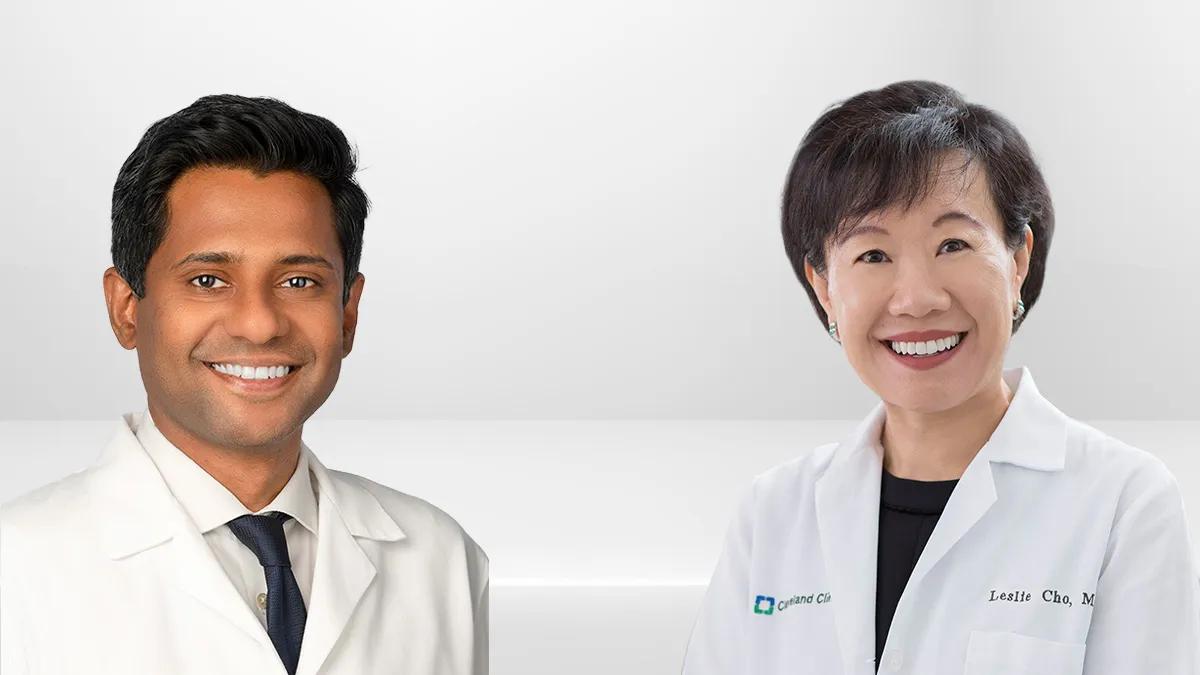
Understanding New Cholesterol Guidelines for Better Heart Health
Ashish Sarraju, MD, and Leslie Cho, MD, discuss the latest cholesterol guidelines and why understanding lifetime risk is key to preventing heart disease and stroke. They explain early testing, lifestyle changes and personalized care to help people take control of their heart health over time.
Advertisement
Cleveland Clinic is a non-profit academic medical center. Advertising on our site helps support our mission. We do not endorse non-Cleveland Clinic products or services. Policy
Recent Episodes
Aspirin for Prevention: Latest Recommendations
Luke Laffin, MD, and Vikas Sunder, MD, discuss the latest recommendations for using low-dose aspirin to help prevent heart disease, includin…
Choosing the Right Treatment for Blocked Coronary Arteries
Faisal Bakaeen, MD, and Grant Reed, MD, explain what blocked coronary arteries mean and the risk factors that can lead to coronary artery di…
Robotic Lung Transplantation Explained
Kenneth McCurry, MD, and Gregory Jones, MD, discuss who may need a lung transplant, how patients are evaluated and how transplantation can i…
Video content: This video is available to watch online.
View video online (https://cdnapisec.kaltura.com/p/2207941/sp/220794100/playManifest/entryId/1_h7e7m97x/flavorId/1_5f3sgelj/format/url/protocol/https/a.mp4)
Transcript
Announcer:
Advertisement
Cleveland Clinic is a non-profit academic medical center. Advertising on our site helps support our mission. We do not endorse non-Cleveland Clinic products or services. Policy
Welcome to Love Your Heart, brought to you by Cleveland Clinic's Sydell and Arnold Miller Family Heart, Vascular & Thoracic Institute. This podcast will explore disease prevention, testing, medical and surgical treatments, new innovations and more. Enjoy.
Dr. Ashish Sarraju:
Thank you, everybody, for joining us. My name is Ashish Sarraju. I'm a preventive cardiologist in the section of Preventive Cardiology and Rehabilitation at the Cleveland Clinic main campus in Cleveland, Ohio. I am the Director of Research for Preventive Cardiology and the Director of the Center for Inherited Lipid Disorders here at the Cleveland Clinic. We are lucky today to be joined by Dr. Leslie Cho. Dr. Cho, please introduce yourself.
Dr. Leslie Cho:
Thank you. My name is Leslie Cho. I'm the Vice Chair for the Heart, Vascular & Thoracic Institute here and the Section Head for Preventive Cardiology and a colleague of Dr. Sarraju.
Dr. Ashish Sarraju:
Thank you very much for joining us today for this podcast, Dr. Cho. We're here to talk about something that is the latest and greatest in preventive cardiology. That is the 2026 ACC/AHA guideline for the management of cholesterol, on which you were a co-author. Congratulations.
Advertisement
Dr. Leslie Cho:
Thank you. Thank you.
Dr. Ashish Sarraju:
A very prestigious achievement and a great contribution to the field, of course. Maybe let me start off with a very simple question. Why do we have guidelines on cholesterol? Why does it matter for heart health?
Dr. Leslie Cho:
One of the wonderful things we know is that cholesterol really is a causal risk factor. It causes heart attack, stroke, atherosclerotic heart disease. We have such a fast-changing field with science. We're so lucky to live in an era where we have this amazing understanding and breakthroughs. These guidelines really help clinicians and patients try to find the best therapy for them so they can live longer, have less heart attacks, less stroke.
Dr. Ashish Sarraju:
Well, all of that sounds really good to me. What is new about these guidelines? We've had guidelines in the past. The last edition was over 10 years ago. What's new? What's been updated? What do patients need to know?
Dr. Leslie Cho:
I think the number one message is that the guideline really focuses on the lifetime risk of having high cholesterol. The burden of having high cholesterol for a long time. Starting, not just treatment, we're not talking about starting everyone on statins, but really trying to identify your risk early so you can do something about it with diet and exercise and all of those things. That's one of the big changes.
The other change is that the goals are back. For a while we had this percentage. I had no idea what they meant. Nobody else knew what they meant, but now we actually have a number so clinicians and patients can target. Then I think the other really important thing is the emergence of lipoprotein(a) (Lp(a)), which we'll talk about, as well as apolipoprotein B (ApoB). Some of these markers have been around for a long time, but now we really know what they mean and how to modify risk.
Dr. Ashish Sarraju:
All right. You mentioned lifetime risk, right? So, how do these guidelines guide people on how to assess their lifetime risk? So how does somebody, let's say in their 30s with high cholesterol, know whether they should act on it?
Dr. Leslie Cho:
Yeah, great question. The number one thing is you have to check your cholesterol. Unfortunately, Americans don't get their cholesterol checked until they're in their 40s. For most women, it's after they hit menopause. I mean, that's like insanity, right?
That means that we've gone all these years without understanding what our risks are. Getting your cholesterol checked, we recommend that everybody at the age of 19 gets their cholesterol checked. But the American Pediatric Academy has been recommending that all children get their cholesterol checked between the ages of nine to 11. Again, not to start them on medicine, but to identify those genetic cholesterol defects and then to modify with diet and exercise. You get your cholesterol checked every five years. Then, when you hit age 30, use that PREVENT risk calculator.
Advertisement
Dr. Ashish Sarraju:
So there's a new risk calculator?
Dr. Leslie Cho:
There's a new risk calculator. Yeah.
Dr. Ashish Sarraju:
Okay. How is that different from the older risk calculators?
Dr. Leslie Cho:
So, it is a much more refined calculator. It uses kidney function. It's been validated, also. People think, "Oh my God, we have this new risk calculator. They're going to put more people on medicine." That is not the intent. This risk calculator actually puts less people on medication. It's much more refined. I think the new risk calculator really makes sense to use to understand the 10-year risk as well as the 30-year risk of developing ASCVD (Atherosclerotic cardiovascular disease).
Dr. Ashish Sarraju:
Which makes a lot of sense, because heart disease develops not in a year or two. Usually it takes decades. So, acting early requires a telescope into the future, kind of.
You mentioned again, lifestyle, medications. How do you think about the role of lifestyle or the role of medications? Is it both? Is it one first, then the other? Some patients don't like taking medications.
Dr. Leslie Cho:
Yes, yes. I am sympathetic to not wanting to be on medicine. Absolutely. The goal is for you not to have a heart attack or stroke. The goal is for you to have a high quality of life without vascular dementia and live your best life. How do we get there? If we get there with just diet and exercise, great. But for many of us, we need medication. Medications are not a substitute for diet and exercise. They're merely supplements for diet and exercise. Aren't we so lucky to live in an era where we can take medications? There were people who were dying to take these medicines who could never take them because they didn't live to see this era. I think there's a lot of misunderstanding about somehow these are moral failings to have high cholesterol. It's not a moral failing. It's aging. It's genetics. It's okay.
Advertisement
Dr. Ashish Sarraju:
Right, right. Yeah. You bring up a great point there for a lot of people, it's genetics. We have a section of genetics now. We have inherited liver disorder centers here. There are some patients in whom lifestyle is important, but not sufficient, as you correctly said.
Dr. Leslie Cho:
Exactly. I mean, I think we have this culture where we feel like, "Oh my gosh, I failed if I have to be on these medicines. I failed if I have hypertension." There's no failure. Okay, we get older. People didn't live this long in the olden times. It's okay.
Dr. Ashish Sarraju:
That's a great way of looking at it. Everyone starts off at different places, but the goal is the same. So, what someone needs to get to that goal may be different from what someone else needs to get to that goal. That's great. Can you share a final take-home message for our patients on what they need to take away from our conversation about the new guidelines and what they should ask their doctor about?
Dr. Leslie Cho:
So number one, please check your cholesterol. If you don't check it, you don't know. Get lipoprotein(a) measurement in the guidelines. Lipoprotein(a) is a genetic cholesterol problem that you get from your mom or your dad, or you could be a spontaneous mutation. Everyone should have their Lp(a) checked at least once in their lifetime because it increases the risk for heart attacks, stroke and calcific aortic stenosis. Ask your doctor to check your cholesterol, check Lp(a), and then once you know the results, actually do something. Knowing something and not doing anything, what is that? That's denial. If we know it, hopefully we'll be on top of it, and we'll treat it so that they can live until they're 90 or 95 or even 100 with that high quality of life that all of us want.
Advertisement
Dr. Ashish Sarraju:
That's a great question. One addendum to this final take-home message is let's say someone checks their cholesterol, and they want to start some lifestyle measures themselves before they see their doctor. What should their takeaway be from our conversation about what lifestyle measures would be best for them for cholesterol?
Dr. Leslie Cho:
Oh, we love the Mediterranean diet. A diet that is very heavy in plants and complex carbohydrates, really sort of minimizing that meat, limiting egg yolks and things like this. We also like exercise for 150 minutes a week. If you can't do it five days a week, then maybe even on the weekends doing 75 minutes. But having that active lifestyle is so critically important.
Dr. Ashish Sarraju:
Right. That's great. Well, I think that's a great place to end the podcast. Great information for all of us. Thanks again for joining. Thank you all for joining us on this podcast.
Announcer:
Thank you for listening to Love Your Heart. We hope you enjoyed the podcast. For more information or to schedule an appointment at Cleveland Clinic, please call 844.868.4339. That's 844.868.4339. We welcome your comments and feedback. Please contact us at heart@ccf.org. Like what you heard? Subscribe wherever you get your podcasts, or listen at clevelandclinic.org/loveyourheartpodcast.
Recent Episodes
Aspirin for Prevention: Latest Recommendations
Luke Laffin, MD, and Vikas Sunder, MD, discuss the latest recommendations for using low-dose aspirin to help prevent heart disease, includin…
Choosing the Right Treatment for Blocked Coronary Arteries
Faisal Bakaeen, MD, and Grant Reed, MD, explain what blocked coronary arteries mean and the risk factors that can lead to coronary artery di…
Robotic Lung Transplantation Explained
Kenneth McCurry, MD, and Gregory Jones, MD, discuss who may need a lung transplant, how patients are evaluated and how transplantation can i…
Never miss a moment - subscribe now.
Listen to the Health Essentials Podcast on your favorite streaming platform.
Other Podcasts You May Love
Beyond Leadership
Hosts Jim Pae and Elizabeth Pugel escort you through a network of thought leaders, sharing world-cla…
Beyond the Pages: CCJM Podcast
Beyond the Pages: CCJM Podcast takes the listener more in-depth into Cleveland Clinic Journal of Med…

Butts & Guts
A Cleveland Clinic podcast exploring your digestive and surgical health from end to end. You’ll lear…
Cancer Advances
A Cleveland Clinic podcast for medical professionals exploring the latest innovative research and cl…