



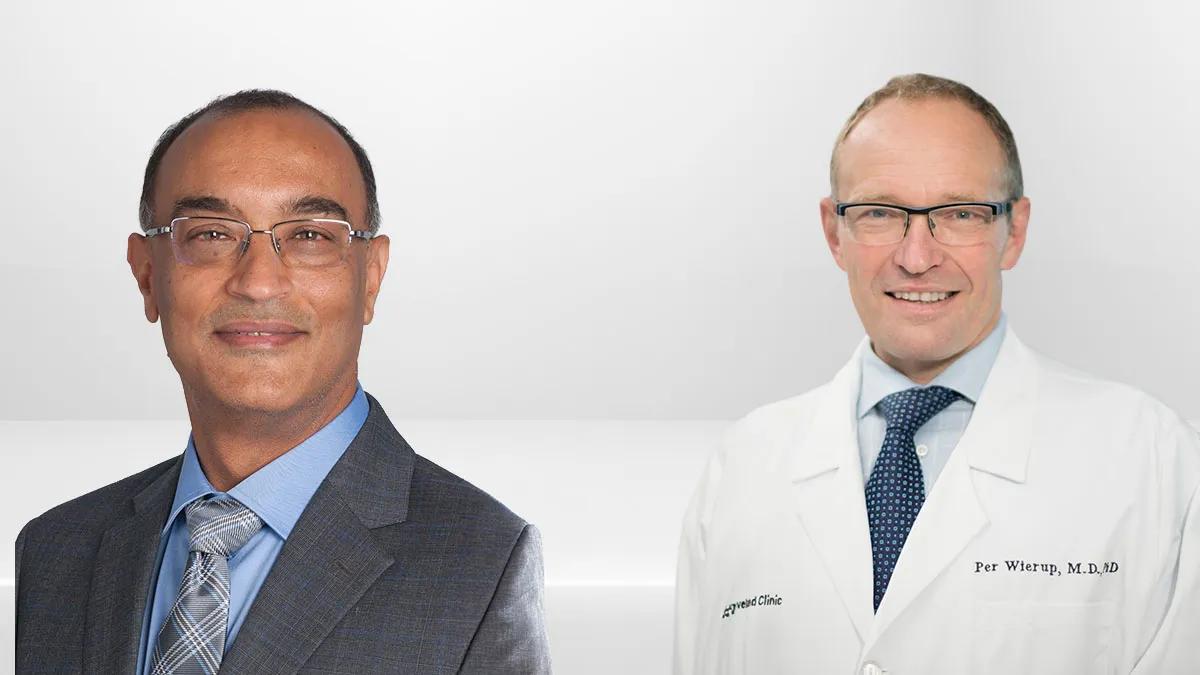
Management of Complex Aortic Valve Endocarditis
Milind Desai, MD, and Per Wierup, MD, discuss the evaluation and management of high-risk aortic valve endocarditis, including indications for urgent intervention and timing of surgery. They also review operative approaches to patients with heart failure, uncontrolled infection and embolic risk, highlighting the role of multidisciplinary expertise in complex endocarditis care Looking to refer a patient?
Please reach out to our Physician Referral team Mon. - Fri., 8 a.m. - 5 p.m. (ET) at 855.751.2469.
Advertisement
Cleveland Clinic is a non-profit academic medical center. Advertising on our site helps support our mission. We do not endorse non-Cleveland Clinic products or services. Policy
Recent Episodes
Lepodisiran and the Emerging Role of Oxidized Phospholipids in Lipoprotein(a) Risk
Luke Laffin, MD, speaks with Steven Nissen, MD, about findings from the ALPACA trial evaluating lepodisiran and its effects on oxidized phos…
Talking Tall Rounds®: Updates on Less Invasive Cardiac Surgery
In this excerpt from Tall Rounds®, Gianluca Torregrossa, MD, discusses minimally invasive and totally endoscopic coronary artery bypass graf…
CTX310 and the Future of Gene Editing for Lipid Disorders
Steven Nissen, MD, and Luke Laffin, MD, discuss one-year follow-up data for CTX310, a CRISPR-Cas9 gene-editing therapy targeting ANGPTL3 to…
Video content: This video is available to watch online.
View video online (https://cdnapisec.kaltura.com/p/2207941/sp/220794100/playManifest/entryId/1_ok7l4rrr/flavorId/1_5f3sgelj/format/url/protocol/https/a.mp4)
Transcript
Announcer:
Welcome to Cardiac Consult, brought to you by the Sydell and Arnold Miller Family Heart, Vascular & Thoracic Institute at Cleveland Clinic. This podcast will explore the latest innovations, medical and surgical treatments, diagnostic testing, research, technology and practice improvements.
Advertisement
Cleveland Clinic is a non-profit academic medical center. Advertising on our site helps support our mission. We do not endorse non-Cleveland Clinic products or services. Policy
Dr. Milind Desai:
Hello everybody. Thank you for joining this episode of Cardiac Consult. My name is Dr. Milind Desai and I'm vice chair for Heart, Vascular & Thoracic Institute at Cleveland Clinic. I'm a cardiologist and with me is Dr...
Dr. Per Wierup:
Per Wierup. I'm a heart surgeon at Cleveland Clinic.
Dr. Milind Desai:
Today, we are going to be discussing all things you need to know as it relates to high risk aortic valve endocarditis. Hope you find this session informational.
Dr. Per Wierup:
So Dr. Desai, how do you determine urgency in the cases involving heart failure, embolic risk or uncontrolled infection?
Dr. Milind Desai:
First and foremost, I'll say endocarditis, general rule of thumb is inpatient, at least the initial therapy and decision making is an inpatient problem. So most of these patients, if not all, we are going to be dealing, at the outset, as inpatients. Then when you look at these patients, you need to quickly assess who requires urgent, elevated care. Clearly, people who develop signs and symptoms of congestive heart failure, especially high risk aortic valve endocarditis, what happens is if these patients start to leak severely, regurgitate severely, the LV, the left ventricle, does not have time to compensate for it. So, their end diastolic pressure goes through the roof, and they end up in cardiogenic shock. So more often than not, these people will end up in the ICU. That clearly is a major emergency.
Advertisement
Uncontrolled infection. If the burden of vegetations is large and you are not able to clear their blood cultures despite aggressive treatment, that's another major red flag that we need to control source infection. The third thing obviously is if these patients have abscess formation and they are impinging upon the AV node and you are showing signs of prolonged PR interval increase or advanced degrees of AV block, that's another red flag which will make me run to your office.
The stroke is sort of a paradox. So if the vegetation is high and vegetation size is large, and in my clinical judgment, this person is at a higher risk of a stroke if it flicks off, then I'm running to your office. But once they've had a stroke, then it becomes this complicated situation where you don't want to go in early. Now you are stuck waiting until the neurologist clears you. Often, it can take up to six weeks of f. So that's why early and decisive decision making strategies make a lot of sense.
Okay, so I have determined it is DEFCON four, it is a major emergency, and I need for you to operate on this patient tomorrow or the next day. So you walk into the patient's room. What factors in your mindset influence early versus delayed surgical intervention?
Dr. Per Wierup:
I would say in general, and that I'm speaking for all my surgical colleagues here, we really want to operate on the patient yesterday, practically. We really want to get it going before they develop any more complications. That is our standard and go-to. However, if they have had a stroke and even worse, if they already have brain bleeding, then we have to hold off. Another factor is if we need to do a very extensive root surgery, homograft, and the patient has unfortunately been on blood thinners, we might have to wait out those to avoid excessive bleeding. But then we have to balance out the risk of waiting. Then we're looking at the size of vegetations. But in general, we want to operate as early as possible.
Dr. Milind Desai:
Sometimes, as the cardiologist waiting for you to take the patient for an operation, there are some on the ground logistic scenarios that also come in the way. Often, these patients, you guys will want to define their coronary anatomy, and some patients, especially elderly, we would have to get an invasive coronary angiogram, and that may delay things by a day or two. CT coronary angiography has gotten very good nowadays, such that it is very well diagnostic in a lot of cases. So that has helped.
Advertisement
The other holding pattern scenario I've seen is waiting for cerebral angiogram to rule out mycotic aneurysms. But if we all work together as a team and are aggressive in getting these logistics worked out, I fully agree with you that they need to be operated yesterday, especially with high risk features.
Now, another important thing for our medical professional audience is what operative strategies are most effective? It's a spectrum. This is where, I think, Cleveland Clinic shines. You can do a simple procedure when needed, or you can elevate it to the most complicated procedure if needed. We are very adept. So walk us through that.
Dr. Per Wierup:
That's actually a pretty logical three step module, I would say. All surgeons here are very experienced in doing valve repairs for both mitral, but also for aortic and tricuspid. The first step we always look in, if we get the patient early enough, can we do a valve repair, meaning preserving the patient's native valve and just make it work. Typically, if it's a localized infection, we remove that little part and reconstruct that part of the leaflet. That is our ideal to go to.
Most of the times, however, the valves are more chewed up like that. If the infection is staying just confined to the leaflets, then it's perfectly enough with a valve replacement. We generally use tissue valve because we want to avoid the blood anticoagulation, which can lead to brain bleeding complications down the road.
Advertisement
When the infection has spread outside the native valve into creating an abscess, and even if we have just a small abscess, then we practically always use a homograft. I would say that homograft is very, very efficient in terms of taking care of extensive destruction and very resistant to reinfection.
Dr. Milind Desai:
When do you think of a Commando operation?
Dr. Per Wierup:
Yeah, Commando in my hands, when I was younger, I did more of the Commando. Commando is when you have a double valve endocarditis for aorta and mitral, and you have an infection in the curtain between those two. When I was younger, I did a lot of those. Then you simply reconstruct. You open up in between the mitral and the aorta, and take away the infection. Then you reconstruct that with bovine pericardium. Then you place the mitral prosthesis and aortic prosthesis or a homograft. However, I've, over the years, learned to kind of avoid it a little bit because most of the times, it's not that destructive and you can do more local reconstruction of the area with very good long-term results.
Dr. Milind Desai:
What Dr. Wierup said is important. This is where a surgical team with the full spectrum of expertise comes into play, where it's not a one-size-fits-all. You have to tailor your approach to a given individual, given findings. As good as we can provide you with advanced imaging diagnoses going in, often the judgment comes from visualizing it intraoperatively. That's where experience matters.
Advertisement
I'm going to put you on the spot a little bit more and ask you. A lot of these patients nowadays have TAVRs. TAVRs are ubiquitous now, transcatheter AVRs. Unfortunately, many of these patients who had TAVRs because they were deemed inoperable or high risk, et cetera, now are coming back with TAVR infections. In fact, I saw one yesterday reading a CT scan. And we know that TAVR explant already is a high risk operation. TAVR explant in the setting of endocarditis is also not an interesting walk in the park. Do you want to tell us your thoughts about how you handle these people?
Dr. Per Wierup:
We are seeing an increasing number of TAVR explant, both because they need a new valve, but now with the focus on endocarditis, we really see many of those. Generally, it's tricky. What we do, we take out the TAVR first, and then we take out the rest of what's needed to be dealt with. If you're not used to that, it frequently ends up with a total root replacement. But I must say, having done really many, even though they're infected, it tends to stay in the TAVR valve. So I'll take out the TAVR, and then I'll take out the leaflet. But then it's uncommon that it creates a root abscess. It does happen, but it's not always necessary to do a homograft root replacement.
If you take your time, with experience, you can sneak out, and then eventually you just have the patient only need an aortic valve replacement. That is important because many of these with TAVRs, they're deemed inoperable because of their comorbidities. Just taking them to surgery is a challenge, not just technical, but to get them to survive and to get out of the ICU and get home. You have to do the surgery so it doesn't get too extensive, because even though it might look good in the OR, they will never make it out. So, not doing more than necessary, but absolutely do the necessary.
Dr. Milind Desai:
Look, yes, a modern world brings modern solutions, but modern solutions also now bring modern complications and new challenges to innovate. This is one such scenario, which is why I think having a group of people, multidisciplinary team members who understand the clinical context, the imaging context, the perioperative workup context, and then the operative and postoperative context is absolutely important. Which is why a high volume experienced large center like the Cleveland Clinic is where it shines. This is about a team sport and this is about a team sport in the most complicated of circumstances.
Thank you very much for this episode of Cardiac Consult, and we look forward to continuing these in the future.
Announcer:
Thank you for listening to Cardiac Consult. We hope you enjoyed the podcast. For more information or to refer a patient to Cleveland Clinic, please call 855.751.2469. That's 855.751.2469. We welcome your comments and feedback. Please contact us at heart@ccf.org. Like what you heard? Subscribe wherever you get your podcasts or listen at clevelandclinic.org/cardiacconsultpodcast.
Recent Episodes
Lepodisiran and the Emerging Role of Oxidized Phospholipids in Lipoprotein(a) Risk
Luke Laffin, MD, speaks with Steven Nissen, MD, about findings from the ALPACA trial evaluating lepodisiran and its effects on oxidized phos…
Talking Tall Rounds®: Updates on Less Invasive Cardiac Surgery
In this excerpt from Tall Rounds®, Gianluca Torregrossa, MD, discusses minimally invasive and totally endoscopic coronary artery bypass graf…
CTX310 and the Future of Gene Editing for Lipid Disorders
Steven Nissen, MD, and Luke Laffin, MD, discuss one-year follow-up data for CTX310, a CRISPR-Cas9 gene-editing therapy targeting ANGPTL3 to…
Other Podcasts You May Love
Beyond Leadership
Hosts Jim Pae and Elizabeth Pugel escort you through a network of thought leaders, sharing world-cla…
Beyond the Pages: CCJM Podcast
Beyond the Pages: CCJM Podcast takes the listener more in-depth into Cleveland Clinic Journal of Med…

Butts & Guts
A Cleveland Clinic podcast exploring your digestive and surgical health from end to end. You’ll lear…
Cancer Advances
A Cleveland Clinic podcast for medical professionals exploring the latest innovative research and cl…