



Expanding Coronary Revascularization With TECAB
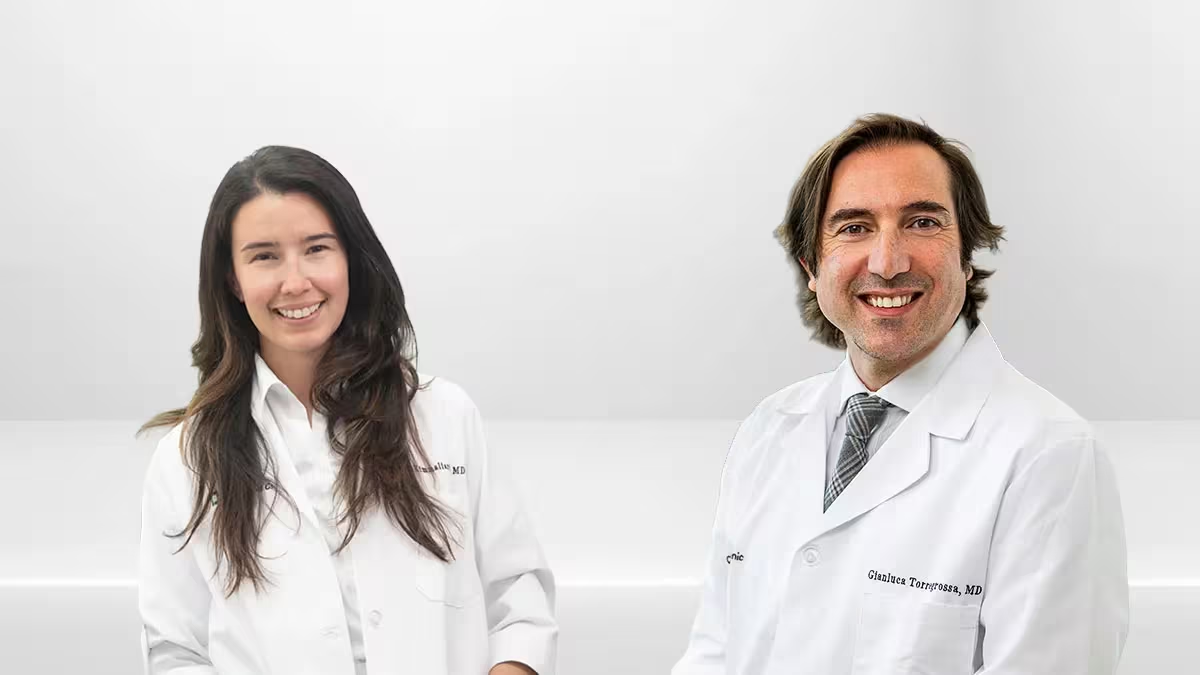
Donna Kimmaliardjuk, MD, and Gianluca Torregrossa, MD, discuss the expanding role of robotic coronary artery bypass grafting, including total endoscopic coronary artery bypass (TECAB). They explore how a tailored surgical approach can improve long-term patient outcomes.
Looking to refer a patient? Please reach out to our Physician Referral team Mon. - Fri., 8 a.m. - 5 p.m. (ET) at 855.751.2469.
Advertisement
Cleveland Clinic is a non-profit academic medical center. Advertising on our site helps support our mission. We do not endorse non-Cleveland Clinic products or services. Policy
Recent Episodes
Lepodisiran and the Emerging Role of Oxidized Phospholipids in Lipoprotein(a) Risk
Luke Laffin, MD, speaks with Steven Nissen, MD, about findings from the ALPACA trial evaluating lepodisiran and its effects on oxidized phos…
Talking Tall Rounds®: Updates on Less Invasive Cardiac Surgery
In this excerpt from Tall Rounds®, Gianluca Torregrossa, MD, discusses minimally invasive and totally endoscopic coronary artery bypass graf…
CTX310 and the Future of Gene Editing for Lipid Disorders
Steven Nissen, MD, and Luke Laffin, MD, discuss one-year follow-up data for CTX310, a CRISPR-Cas9 gene-editing therapy targeting ANGPTL3 to…
Video content: This video is available to watch online.
View video online (https://cdnapisec.kaltura.com/p/2207941/sp/220794100/playManifest/entryId/1_mnoig16v/flavorId/1_5f3sgelj/format/url/protocol/https/a.mp4)
Transcript
Announcer:
Welcome to Cardiac Consult, brought to you by the Sydell and Arnold Miller Family Heart, Vascular & Thoracic Institute at Cleveland Clinic. This podcast will explore the latest innovations, medical and surgical treatments, diagnostic testing, research, technology and practice improvements.
Advertisement
Cleveland Clinic is a non-profit academic medical center. Advertising on our site helps support our mission. We do not endorse non-Cleveland Clinic products or services. Policy
Dr. Gianluca Torregrossa:
Welcome to a new episode. Today, together with my colleague, Donna Kimmaliardjuk, we are going to discuss robotic coronary artery bypass grafting. What is it? What is new out there? What's the future? Donna, first of all, it's a pleasure to be here.
Dr. Donna Kimmaliardjuk:
Likewise.
Dr. Gianluca Torregrossa:
It's new here at Cleveland Clinic. It's a pleasure to work side by side with you and take care of this robotic coronary artery bypass grafting program. Tell me a little bit more. What is robotic CABG?
Dr. Donna Kimmaliardjuk:
We're so excited that you're here. As a fellow coronary enthusiast, I'm so excited to have a new member to our team. Thank you. That's what we're here to talk about: something that we're both excited about, robotic bypass surgery or bypass surgery in general, but of course robotic-assisted bypass surgery.
That's something that I've been doing the last year and a half, two years, these operations, minimally invasively to do currently or so far just exclusively single vessel bypass through a small incision between the ribs, so a mini anterior thoracotomy, as opposed to our traditional sternotomy. As I might've mentioned in previous sessions or with other physicians, I originally learned how to do this I call it the direct vision or “old-fashioned way” working through this little incision, taking the mammary artery off of the ribcage, through that small incision, and then sewing it by hand onto the LAD.
Advertisement
But now with the robot, it makes it so much more fun, so much easier, so much more accessible with such better visualization of that mammary artery. It's much less painful for the patient, because we're not spreading ribs or breaking ribs, and less painful for the surgeon. I can see. I'm not crunched in this little space, trying to see way up high in the chest.
Traditionally, as it's been here, we've used the robot to harvest the mammary artery off of the ribcage, but then I still perform a small, about five-centimeter incision and sew that bypass by hand. But now with you joining our team, we're going to be growing this program and introducing and including TECAB. Can you tell me a bit about TECAB and the difference between TECAB versus something like a robotic-assisted MIDCAB that I've been doing?
Dr. Gianluca Torregrossa:
So, exactly. I think that TECAB is part of the family of robotic coronary artery bypass grafting procedures that together we are capable of performing and offering to our patients. TECAB is the ultimate technical procedure, where we can perform not only the harvesting of one or two mammary arteries robotically, but also the sewing of this graft to the distal target, to the final conduit that needs the bypass, to the artery that supplies the heart, and is in need of new oxygen, directly with the robot itself. The advantages of using these robotic techniques are mostly two. Number one, we avoid any skin incision or large skin incision in the chest of the patient; so, less pain for the patients, even faster recovery than a robotic MIDCAB.
Dr. Donna Kimmaliardjuk:
Because it's just those keyhole incisions, right, when you do everything with the robot.
Dr. Gianluca Torregrossa:
Correct. Three small incisions, less than a centimeter on the left side of the chest. From there we can perform the entire robotic. But second and most importantly it’s not only cosmesis, it's not only pain, but it's also the opportunity to increase the number of grafts to perform more than one bypass, offering more opportunities for more patients to have the opportunity to receive a robotic coronary artery bypass grafting. The incision in the front is an excellent operation that we still perform. We will still perform it in selected cases, but mostly it's dedicated for one vessel. The most important artery of our heart is what we call LAD, left anterior descending artery.
Dr. Donna Kimmaliardjuk:
Or infamously known colloquially as the widowmaker.
Dr. Gianluca Torregrossa:
Correct. A tube that is able to supply almost 60% of the muscle of your own heart. But now with TECAB, we can expand an indication, going even to the lateral wall, to the ramus intermedius, to other targets, enhancing the possibility for more patients to receive robotic coronary artery bypass grafting.
Donna, tell me a little bit, how does robotic coronary sit in the spectrum of the procedures that we can offer?
Advertisement
Dr. Donna Kimmaliardjuk:
That's a great question because I was going to bring that up to you, too. Of course, nobody ever wants a sternotomy. No patient is ever looking forward to that, saying, “give me that”. It's very rare. Of course, everyone would want a less invasive incision, but there is still a role, I think, for a sternotomy approach.
Dr. Gianluca Torregrossa:
Absolutely.
Dr. Donna Kimmaliardjuk:
Now with TECAB and robotic-assisted MIDCAB, we complement that sternotomy approach and really now offer the whole spectrum of bypass surgery that can be done. Whether it be a patient with a very weak heart that needs bypasses to improve blood flow, improve its strength, and we have to do multiple bypasses all around the heart, sometimes with the assistance of little pump devices to either, again, sternotomy, but beating heart or beating heart where we don't use the heart lung machine. That's also something we both specialize in for patients who are a little high risk to put on a heart lung machine. We can do it without that, using multiple arteries to bypass multiple targets.
So, it's also something we're very passionate about and are big advocates for using multiple arteries as much as possible in patients, to then less invasive MIDCAB and including along with that, a hybrid approach. If you see online, there's a lot of discussion around doing one or two bypasses, and then also doing one or maybe two stents for other blockages. That's something we offer here as well, to then totally endoscopic, even smaller than my five-centimeter cut, just doing all little keyhole cuts to do those bypasses.
Advertisement
Not every patient, I don't think, will always be a candidate for a totally robotic approach or a minimally invasive approach. But it is something that's part of the repertoire here that we can really evaluate every patient for, whether it be sternotomy on pump, or on pump beating, or off pump to completely endoscopic.
Dr. Gianluca Torregrossa:
Completely agree. I think a lot of attention is on which patients are ideal for this type of procedure. I think that a lot of patients who are currently receiving a sternotomy bypass grafting are done with one mammary and one vein. Every year, more than 300,000 patients receive coronary artery bypass grafting in the United States of America. Unfortunately, what we call multi-arterial bypass grafting, meaning bypass with more than one artery, account for only 10%, 12% of these 300,000. A large majority of patients are still treated with one single arterial conduit and one or two veins that come from the leg.
Some of these patients could receive one or two bypasses done with arteries, the best artery in our body. Arteries that have been made by mother nature to really perform very well in the heart as bypass, the two mammary arteries, and perform this bypass totally robotic. Only an experienced surgeon that has the ability to perform the entire repertoire of procedures is capable of selecting this patient and tailoring the procedure around the anatomy of the specific patient.
Advertisement
Dr. Donna Kimmaliardjuk:
I absolutely agree. As someone who performs TECAB, what are some characteristics that you look for in someone to be a good candidate or maybe not a good candidate for TECAB?
Dr. Gianluca Torregrossa:
I will say that generally a good candidate for bypass graft, for total endoscopic bypass grafting, is a patient who has had, for example multiple arterial disease, so more than one artery. But the amount or the extent of this coronary artery disease is focal, is good, but is not so overextended. I'm, for example, treating a complex LAD diagonal lesion with a mammary artery, but there is a focal lesion in the right coronary artery that can be treated with a stent or can be left alone for medical therapy. Or there is complex left main disease, where we can use two mammary arteries to bypass the front and the lateral graft completely robotically. Or again, patients who have had multiple stenting and keep going back with what we call in-stent restenosis, the phenomenon for which the stent keeps redeveloping the same disease that originally brought the patients to receive that metal stent.
And at that point, there is an alternative to an open heart surgery that is totally robotic opportunity. A lot of different patients can benefit from total endoscopic coronary artery bypass grafting. Really, the anatomy depends on a careful evaluation. In our, in my current experience, almost 40% of my total volume of coronary artery bypass grafting is done robotic. I still perform 50% to 60% of open heart surgery. I'm looking forward to being here, being at Cleveland Clinic, working closely with you and with a team, so we can expand at 40% in the next year to get to 60%, 70% of totally robotic procedures, and decrease the amount of patients that still needs an open heart surgery.
Dr. Donna Kimmaliardjuk:
Our thought and my thought has always been, if you have a patient or if you, a patient yourself, are thinking about bypass surgery, reach out to us because we can really review all your tests, meet with you and see if you are a candidate. Because sometimes if folks don't know about it, they're offered sternotomy, one mammary, two veins, that's it. But without maybe knowing of other options, they don't know that there could be something else.
I don't think there's any definitive hard stop of, you're absolutely not a candidate because of X, Y, or Z. It's something that we really want to evaluate and discuss. And maybe if we can't offer robotically, maybe at least beating heart or multiple arterial grafting, which are very important for outcomes and longevity.
Dr. Gianluca Torregrossa:
I completely agree. I think that one of the cultural shifts that needs to happen among patients, but also among referring cardiologists, is treating coronary artery bypass grafting as a subspecialty. It's something that requires dedicated surgeons. We have seen as a surgeon, we see every day patients with valvular heart disease traveling around the world to come to Cleveland Clinic to receive a robotic mitral valve or an advanced aortic surgery by excellent surgeons.
Yet, among patients with coronary artery disease, there is still this stigma. There is still this convention, both from the patients and the cardiologist, that every local cardiac surgical program can perform a coronary artery bypass grafting, not understanding that the type of surgery that that patient receives at that specific moment is going to impact his 10-year survival. His chances to see his niece and nephew or his grandchildren, going through that college graduation, so much more than any other choices they make in their own life.
I think that this is exactly the moment in which you should take a step back. Don't just jump in and agree to have surgery locally. Look for the best expert, for the best team that can offer a different type of procedure tailored around your needs, tailored around your anatomy, knowing the entire spectrum of procedures from robotic to off-pump, to on-pump, to hybrid.
Patients with very low ejection fraction, we can treat them robotically. We can treat them with open heart surgery. We have different tools. I think it's very important that both cardiologists and patients themself advocate for a better type of procedure. Not stopping at the first pit stop, at the first hospital locally to receive their surgery, but understanding that the quality of the procedure that they can receive is completely different in a center like Cleveland Clinic.
Dr. Donna Kimmaliardjuk:
Yes. The analogy I sometimes use when I talk to patients is like, well, everyone can sing. I can sing, but there's a very big difference in me singing versus someone like Celine Dion or an opera singer or a professional singer. That's the analogy I use. We can all do certain operations, but I think there's difference in your area of expertise and your passion. I think bypass surgery is absolutely the same.
Dr. Gianluca Torregrossa:
I completely agree. I think these unique opportunities now with our collaboration to have two surgeons both trained in robotic and fully trained in every aspect of coronary artery bypass grafting gives us an opportunity. Very few centers around the world, probably none of the centers around the world, have two surgeons capable of performing a total endoscopic coronary artery bypass grafting. Most importantly, within a context of advanced robotic cardiac procedures performed here at Cleveland Clinic, this gives an extra safety layer for patients, knowing that what we are performing here is advanced, at the forefront of coronary revascularization, but with outcomes that are superior to anybody else in this country.
Dr. Donna Kimmaliardjuk:
Exactly. Not to sound too braggy, but I agree.
Dr. Gianluca Torregrossa:
I completely agree. I think that the collaboration is something that will be very important and we’ll be offering better safety outcomes for our patients.
Among the different procedures, and we were discussing procedures, what type of procedures a coronary expert can perform. Well, we were saying we can perform open heart surgery and robotic coronary artery bypass grafting. Give me a little bit of an overview, Donna, of the open heart surgery. We still, both of us, perform a lot of bypasses through a front access. Certain anatomies still need it. What are the different techniques from the front access that are available? What are the different options for a patient?
Dr. Donna Kimmaliardjuk:
Great question. Lots of options. When I talk with patients or trainees, I get so excited because there truly are so many options with bypass surgery. You really can tailor it to the patient and to their anatomy.
So, whether it be our traditional “put someone on a heart lung machine, stop their heart, do the bypasses” versus something that we do a lot of where we still go through the breast bone, but we do not hook someone up to the heart lung machine. So, it’s beating heart or off-pump, and oftentimes without manipulating the blood vessel that comes out of the heart at all.
So, that again decreases the risk of stroke in many patients. Whereas, too, sometimes if patients need something like an Impella or a temporary mechanical circulatory support device, we can also use that in patients that we might be performing bypass on if their heart is very weak, in addition to then the robotic and the minimally invasive approaches.
Then, when you talk about open sternotomy, I always think about conduit. How do we actually do the bypass? So, we've talked about that there's the very traditional using one artery from the ribcage, the mammary artery, and then some veins from our leg, which is done in nearly 90% of cases in the country.
But again, we and a lot of our colleagues here really specialize and are passionate about and focus on using multiple arteries from the body, and using those for bypasses, trying to minimize the amount of vein that we use. Now, I admit, absolutely sometimes I still have to use vein, but we try to use not just the artery from the left side of the ribcage, but use the artery from the right side of the ribcage. Sometimes we can use arteries from the left or the right arm or both.
Why that's important is that we see that these arteries tend to last longer compared to veins. So, it's not just sometimes the approach; it's what are you using for the body? And that's what I often tell patients if we're talking about on versus off pump. Sometimes it's, in all honesty, not a big difference for a certain patient if they're on pump or off. But I say sometimes it's much more important if you get multiple arteries versus only just one.
Dr. Gianluca Torregrossa:
Absolutely. But I think that the off pump component becomes very important for a subset of patients, patients that are very vasculopath, patients that have an aorta that doesn't want to be manipulated, meaning with calcification in the aorta with a higher risk of stroke. For those patients, really the opportunity of doing what you were referring to, as no aortic touch technique, where we use the two mammary arteries as the inflow, as the supply for all of the bypasses done in your heart. Avoiding any manipulation of the aorta becomes imperative to ensure proper, excellent outcomes.
In the robotic spectrum, we discuss MIDCAB and TECAB. Overall, it means three small incisions on the left side of the chest. We connect the patient to a special machine that we call a robotic platform. It has one camera and two arms. We sit at a console that is inside the same room where the patient is asleep and connected to this machine. Using this console, we can manipulate the robot with the console, the robotic arms, and the robotic camera inside the chest of the patient. By seeing with the camera and with these very fine instruments inside the chest, we take one or two mammary arteries.
While the heart is still beating, without stopping the heart, we can make the connection with a very, very fine suture that is almost nine parts of a millimeter and connect them to the front of the lateral artery of the heart. By doing that, we are capable of minimizing any type of injury, minimizing any type of invasiveness because it's only done with three small incisions. Also, enhancing our opportunity to see very well this small target and small conduit that are just a few millimeters in size, but can be seen in an excellent view with the focus and the zoom of the robotic platform. This is what robotic bypass entails. These are the techniques of robotic bypass.
Dr. Donna Kimmaliardjuk:
I think hopefully we've highlighted that we really do offer the whole spectrum of bypass surgery here and really feel that we are a center of excellence. We are really passionate about surgery, but we have some other excellent surgeons as well. They're all excellent, but it's not just us in terms of multiple arterial grafting and off pump, but we really can evaluate everyone from sternotomy to minimally invasive.
Dr. Gianluca Torregrossa:
Correct. Again, this goes back to what we said before. The choice of where you are going to receive a coronary artery bypass grafting surgery is a very important choice. Sometimes it scares patients and their family to know that they have some blockages inside the artery that supplies the heart. Sometimes this makes you rush through a very quick decision to just be in your local hospital. Yet, the opportunity to take your time for a second opinion, for a center of excellence to identify if or which type of surgery you should receive, and which type of conduit, and which type of approach, becomes the most important choice you're making for medium- and long-term outcomes and how you are going to live the type of life.
Going back and forth from the hospital, because your heart is very weak 10 years from the surgery? Or with an excellent bypass performed with multiple arteries that will stay open throughout the rest of your life? This is an important choice that you make at the time of signing a surgical consent.
Thank you so much. It was a pleasure being here and discussing.
Dr. Donna Kimmaliardjuk:
Yes. Likewise.
Dr. Gianluca Torregrossa:
And we are looking forward to evaluating more patients together.
Announcer:
Thank you for listening to Cardiac Consult. We hope you enjoyed the podcast. For more information or to refer a patient to Cleveland Clinic, please call 855.751.2469. That's 855.751.2469. We welcome your comments and feedback. Please contact us at heart@ccf.org. Like what you heard? Subscribe wherever you get your podcasts or listen at clevelandclinic.org/cardiacconsultpodcast.
Recent Episodes
Lepodisiran and the Emerging Role of Oxidized Phospholipids in Lipoprotein(a) Risk
Luke Laffin, MD, speaks with Steven Nissen, MD, about findings from the ALPACA trial evaluating lepodisiran and its effects on oxidized phos…
Talking Tall Rounds®: Updates on Less Invasive Cardiac Surgery
In this excerpt from Tall Rounds®, Gianluca Torregrossa, MD, discusses minimally invasive and totally endoscopic coronary artery bypass graf…
CTX310 and the Future of Gene Editing for Lipid Disorders
Steven Nissen, MD, and Luke Laffin, MD, discuss one-year follow-up data for CTX310, a CRISPR-Cas9 gene-editing therapy targeting ANGPTL3 to…
Other Podcasts You May Love
Beyond Leadership
Hosts Jim Pae and Elizabeth Pugel escort you through a network of thought leaders, sharing world-cla…
Beyond the Pages: CCJM Podcast
Beyond the Pages: CCJM Podcast takes the listener more in-depth into Cleveland Clinic Journal of Med…
Butts & Guts
A Cleveland Clinic podcast exploring your digestive and surgical health from end to end. You’ll lear…

Cancer Advances
A Cleveland Clinic podcast for medical professionals exploring the latest innovative research and cl…