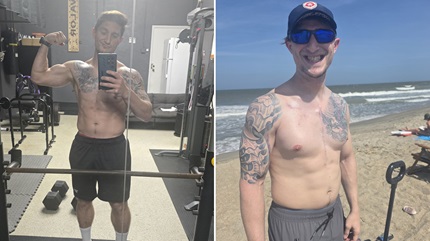
Brittany Pope is from a large family – the youngest of nine siblings and the aunt to multiple nieces and nephews – and always dreamed of having many children of her own. But in 2018, at 28 years old, that dream was suddenly put at risk. After a miscarriage, doctors in her hometown of Erie, Pa., discovered large benign cysts on her ovaries and recommended a hysterectomy as treatment. She had a 7-year-old son at the time but wanted the option to try for more children in the future, so she declined the procedure.
Brittany’s medical journey had been complex even before then. During the birth of her son in 2011, her labor failed to progress, leading to an emergency Cesarean section. It was then doctors discovered the reason: Brittany was born with two uteruses and two cervixes, a rare condition that had gone undiagnosed her entire life. Her baby had been developing in the second, less accessible uterus.
Over the next several years, Brittany, who works for a patient care management agency and owns several businesses in the Erie area, consulted multiple specialists in Pennsylvania. Despite extensive testing, no one could explain why the cysts continued to grow. The largest one eventually grew to 22 cm, about the size of a soccer ball, which painfully distended her abdomen and left her unable to exercise and hesitant to do many of the other things she enjoyed, such as traveling.
In October 2022, Brittany decided to see if doctors at Cleveland Clinic could help her. During her first appointment with a reproductive and infertility specialist, she felt something shift and knew she was finally on the right path.
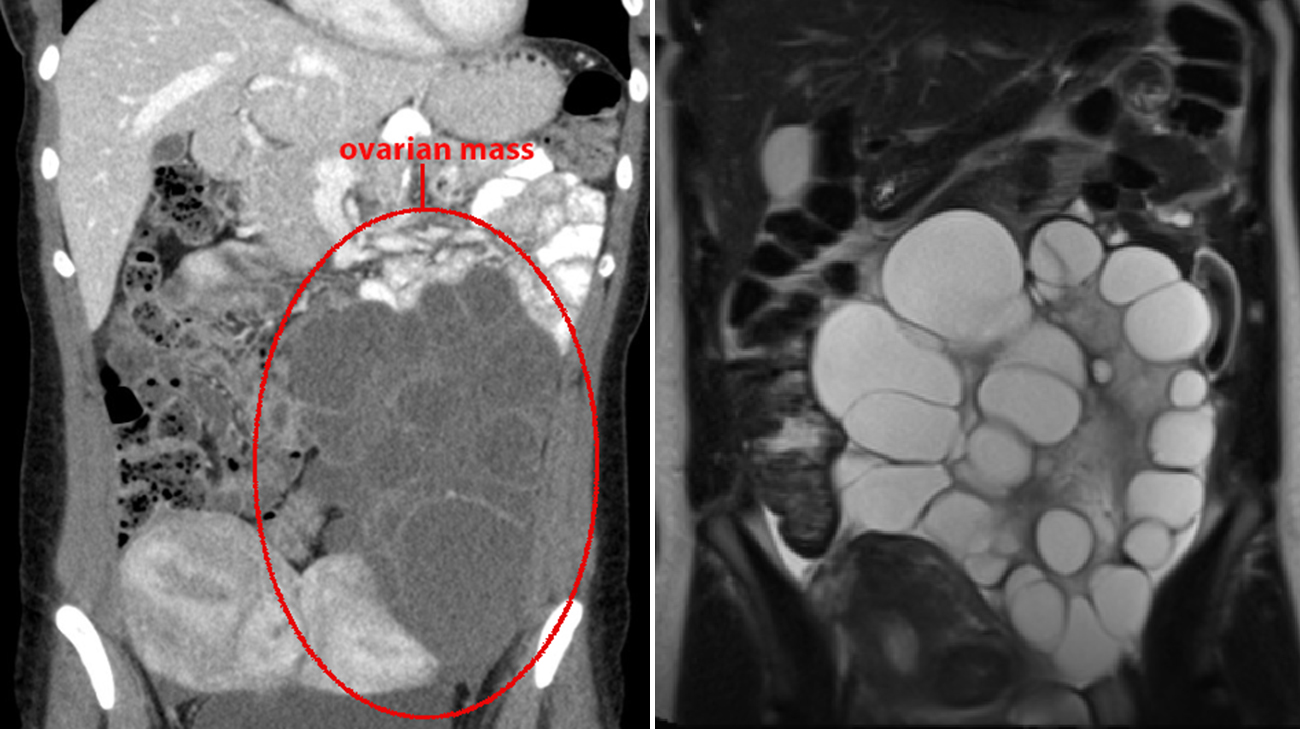
Brittany's ovarian mass eventually grew to 22 cm, nearly the size of a basketball. (Courtesy: Cleveland Clinic)
“From the outset, their approach felt different. Their questions were more detailed, the testing was more comprehensive, and for the first time in years, I had hope,” Brittany recalls.
Her care soon expanded to include a multidisciplinary team examining her condition from many angles — an approach Brittany had never experienced before.
Unfortunately, while she was still undergoing her initial round of evaluations, Brittany faced a devastating setback. She developed an ovarian torsion, a condition in which the ovary twists and cuts off its own blood supply. She underwent emergency surgery at a hospital closer to home to remove her right ovary and fallopian tube. The loss was emotionally overwhelming, especially since a large mass remained on her left ovary.
“I was so afraid this was the end of my chances of having another baby,” she recalls.
After she recovered from the surgery, Brittany returned to Cleveland Clinic, and her care team got back to work looking for answers. In-depth blood tests indicated Brittany might have congenital adrenal hyperplasia, a group of genetic disorders that affect the adrenal glands. These glands produce hormones your body needs to function properly.
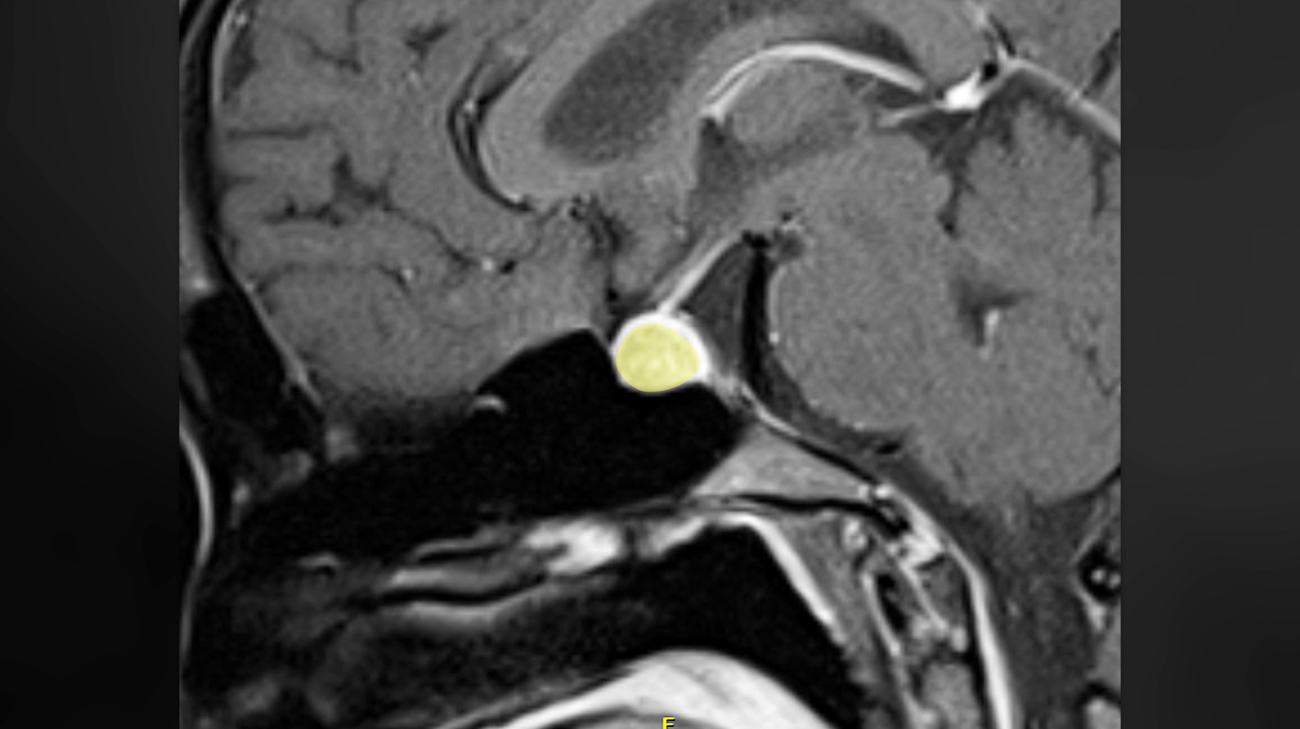
MRI showing the tumor pressing against Brittany's pituitary gland. (Courtesy: Cleveland Clinic)
To further evaluate those findings, she was referred to endocrinologist Laleh Razavi, MD. Dr. Razavi ordered additional lab work along with genetic testing. While the results appeared to rule out congenital adrenal hyperplasia, they prompted further investigation. Further imaging including a pituitary MRI revealed an enlarged pituitary gland and a pituitary tumor.
“It is extremely rare for a pituitary tumor to cause the kind of hormonal imbalances that fuel an ovarian mass,” Dr. Razavi recalls. “In fact, none of the doctors involved in her case had ever seen it before. But once we saw the results, we realized this had to be the explanation.”
In October 2025, neurosurgeon Varun Kshettry, MD, removed the tumor through Brittany’s nose. Within one month, the team knew it was the right decision. Brittany’s ovarian mass shrank dramatically, from 22 cm to 7 cm, and she began having regular menstrual cycles for the first time in nearly a decade. The outcome validated the decision not to remove her uteruses, as the hormonal imbalance caused by the tumor would likely have manifested elsewhere in her body.

Brittany now enjoys time with her family and lives without pain and exhaustion. (Courtesy: Brittany Pope)
Now 36, Brittany hopes to try again for another baby soon, though she knows it may not happen. Even so, she is deeply grateful for the thorough care she received which has given her the option to try. For now, she is enjoying a dramatic improvement in her health. She is exercising again, fitting into her old clothes, and, for the first time in years, living without constant pain or exhaustion.
“My care team looked at me as a whole person. They gave me back options I thought I had lost and allowed me to enjoy life again,” Brittany says.
She hopes sharing her story will encourage other women facing complex reproductive challenges to advocate for themselves and keep pushing for answers.
“I’m incredibly thankful for the team at Cleveland Clinic,” she says. “They didn’t just restore my health. They gave me a second chance.”
Related Institutes: Ob/Gyn & Women's Health Institute, Neurological InstitutePatient Stories
Good Health, Close to Home: How Cleveland Clinic Confirmed One Couple’s Decision to Move
Aug 25, 2026

After Devastating Knee Injury, Mental Health Support Fuels Soccer Comeback
Aug 20, 2026