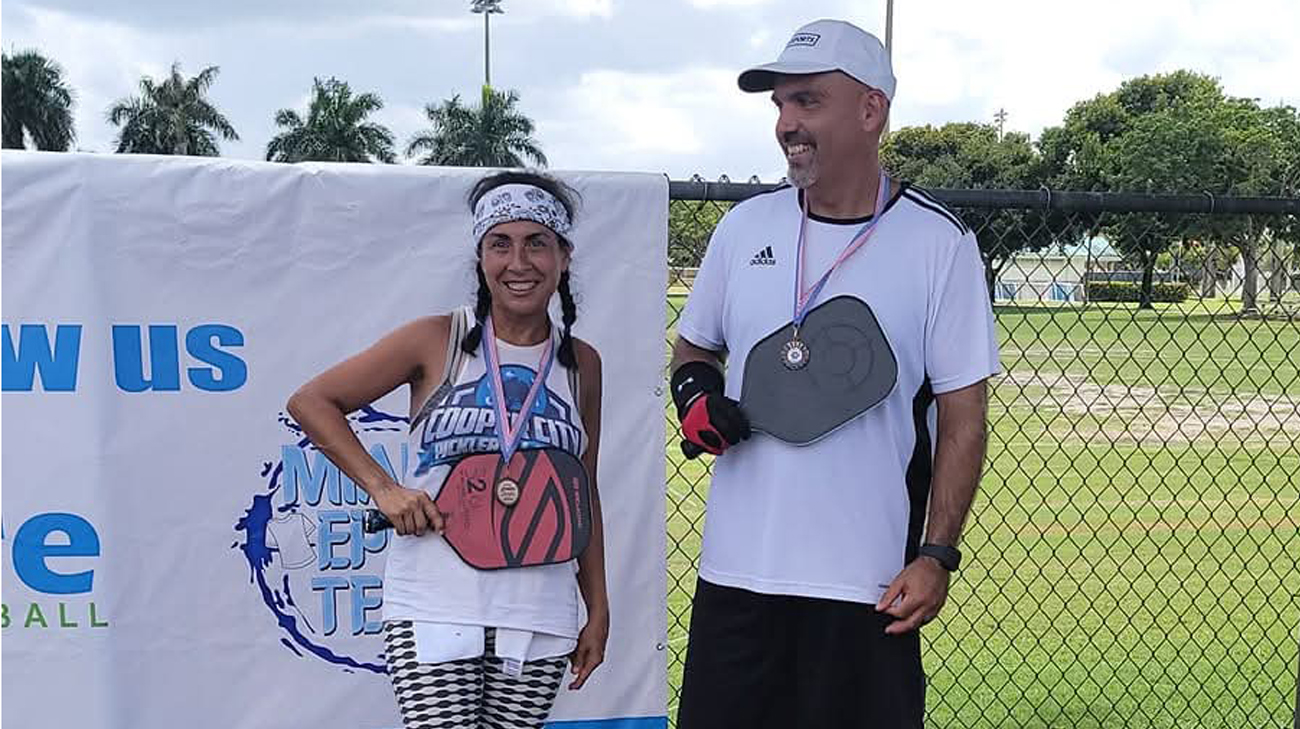
If you met Barbara Smith today, you might never guess she has Parkinson’s disease. Thanks to deep brain stimulation (DBS) surgery, she’s back to living an active, healthy life—nearly symptom-free.
Barbara, 57, was diagnosed with Parkinson’s disease—a progressive movement disorder—about 16 years ago. But the first signs showed up even earlier: shaking, twitching fingers, and stiffness in her hand and arm that began about 10 years before her diagnosis, shortly after her son was born.
As the years passed and her symptoms intensified, Barbara’s husband encouraged her to seek specialized care at Cleveland Clinic in Florida. After an evaluation with the neurology team, testing confirmed Parkinson’s disease. Medication helped at first, but over time it became less effective. Dyskinesia—uncontrolled, erratic movement—made her symptoms harder to hide. Still, Barbara found something that helped: exercise. On the pickleball court, movement brought relief, and she loved the game so much that she played twice a day, every day, for about seven years.
Eventually, the dyskinesia progressed. It started showing up not only when she slowed down on the court, but also when she was resting off the court. That’s when Barbara began taking a closer look at DBS—a procedure that delivers mild electrical stimulation to a targeted area of the brain.
“I had already read about it,” Barbara says. “And, honestly, I wanted to have it so I could improve my pickleball game because I love playing so much.”
Barbara met with Badih Adada, MD, a neurosurgeon at Cleveland Clinic Weston Hospital vice chair of the Neurological Institute with extensive experience performing DBS. After a thorough consultation and testing, she was approved as a candidate. In October 2023, Barbara underwent DBS surgery with Dr. Adada and his team.
DBS surgery involves implanting a device called a pulse generator under the skin near the collarbone. Wires connect the generator to electrodes placed in specific areas of the brain. The system delivers an electrical current that helps regulate the abnormal brain signals that can cause neurological symptoms. DBS is most often used for conditions such as Parkinson’s disease, essential tremor and epilepsy, but researchers are also studying it as a potential treatment for other conditions.

After DBS surgery, Barbara says the dyskinesia stopped—along with her other symptoms. She sleeps better now, and she no longer feels self-conscious when she goes out with friends. Best of all, she’s back on the pickleball court. The first time she played again, she says she “felt like a million bucks.”
“I love Cleveland Clinic,” Barbara says. “Everything is so easy. All the doctors and nurses are very nice, and I didn’t feel like a burden. It was a very pleasurable experience.”
Today, Barbara is a strong advocate for DBS—and she recommends Cleveland Clinic to anyone who will listen.
Related Institutes: Neurological InstitutePatient Stories

Teen Relearns To Walk and Talk After Rare 1-In-A-Million Brain Disorder
Oct 27, 2026
Cleveland Clinic Team Helps Florida Patient Breathe Easier After Complex Lung Surgery
Oct 21, 2026