



General anesthesia puts you in a deep sleep-like state so you can undergo surgeries and medical procedures. It makes you unconscious and unable to feel pain. Side effects, like nausea, confusion and muscle aches, are common. Complications are rare, but can include issues like allergic reactions and anesthesia awareness.
Advertisement
Cleveland Clinic is a non-profit academic medical center. Advertising on our site helps support our mission. We do not endorse non-Cleveland Clinic products or services. Policy
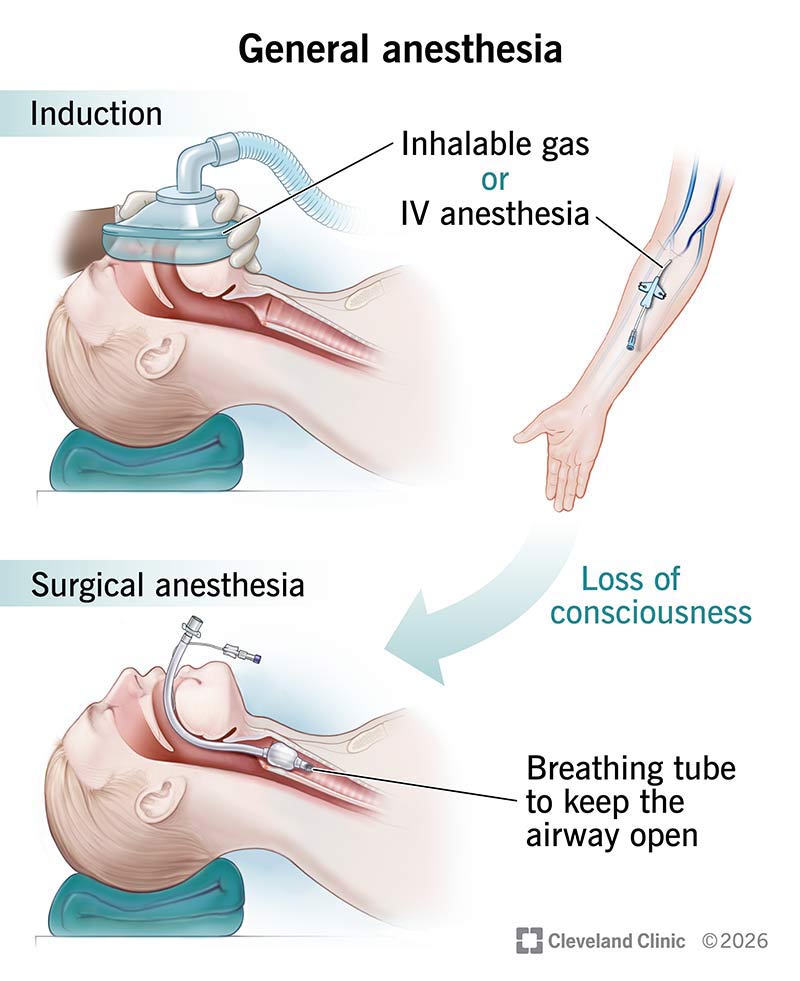
Image content: This image is available to view online.
View image online (https://my.clevelandclinic.org/-/scassets/images/org/health/articles/general-anesthesia)
General anesthesia makes you unconscious and blocks pain sensations throughout your body. It allows you to undergo complex surgeries or medical procedures. It’s a controlled and reversible process that feels kind of like a deep sleep.
Advertisement
Cleveland Clinic is a non-profit academic medical center. Advertising on our site helps support our mission. We do not endorse non-Cleveland Clinic products or services. Policy
General anesthesia involves a combination of medications that:
You receive these through an IV or as an inhalable gas through a mask. They work by blocking nerve signals to your brain and changing the activity of brain chemicals (neurotransmitters). But they also affect essential functions, like breathing and blood pressure.
Every year, millions of people safely receive general anesthesia for medical procedures. But because of its effects, it has certain risks. That’s why anesthesia specialists oversee this procedure. Anesthesiologists and certified registered nurse anesthetists (CRNAs) have specialized training to give you the correct dose and monitor your health before, during and after going under.
The stages of general anesthesia include:
Advertisement
In rare cases, there’s a fourth stage in which you have too much anesthetic in your body (overdose) and stop breathing. Your anesthesia provider will act quickly to return you to stage 3 if it happens.
If you have a planned surgery that requires this type of anesthesia, you might need to meet with an anesthesia provider days before the surgery date. They’ll go over your medical history and the medications and supplements you take. All this information helps ensure a safe anesthesia procedure.
Your provider may tell you to stop taking certain medications or supplements before going under. They’ll also recommend other ways to improve your health leading up to surgery. Better health before general anesthesia and surgery can help improve your recovery. Be sure to follow their specific instructions.
You should also be prepared to:
During general anesthesia, your anesthesia provider:
Without general anesthesia, many surgeries would be intolerable or impossible. This type of anesthesia is generally safe. But it carries some risks and complications. Overall, complications are rare but may include:
Deaths related to anesthesia are rare. Other health complications are more likely to happen if you have poor overall health and/or the surgery is very complex or long. For example, you may be at risk of a heart attack or pneumonia. Some people have long-term memory and learning problems, called postoperative cognitive dysfunction. It’s more common in people over 65 and those who have congestive heart failure, Parkinson’s disease or Alzheimer’s disease.
Advertisement
Once your medical procedure is done, you’ll go to a recovery room. Your care team will continue to monitor you. You’ll slowly wake up. It tends to take one to two hours for general anesthesia to wear off.
You may feel groggy and disoriented. It’s also common to have emotional swings as you wake up, like crying, laughing or agitation. But you may not remember this.
Side effects of general anesthesia are common and usually brief. They may include:
You may have pain from the medical procedure. Your anesthesia provider will help manage this.
It’s normal to feel nervous about general anesthesia, especially when it’s paired with a complex surgery. But you don’t have to keep those feelings to yourself. Voice your concerns and questions with your anesthesia provider. They’ll go over what to expect and how to prepare.
Advertisement



Sign up for our Health Essentials emails for expert guidance on nutrition, fitness, sleep, skin care and more.
Learn more about the Health Library and our editorial process.
Cleveland Clinic’s health articles are based on evidence-backed information and review by medical professionals to ensure accuracy, reliability and up-to-date clinical standards.
Cleveland Clinic’s health articles are based on evidence-backed information and review by medical professionals to ensure accuracy, reliability and up-to-date clinical standards.
Sometimes you have surgery planned. Other times, it’s an emergency. No matter how you end up in the OR, Cleveland Clinic’s general surgery team is here for you.
