



Dorsal root ganglion (DRG) stimulation is a chronic pain treatment that targets overactive nerve cells near your spine. A small device sends electrical signals to ease pain from conditions like CRPS. It may not eliminate all pain, but it can reduce it significantly.
Advertisement
Cleveland Clinic is a non-profit academic medical center. Advertising on our site helps support our mission. We do not endorse non-Cleveland Clinic products or services. Policy
Dorsal root ganglion (DRG) stimulation is a treatment that uses small electrical signals to target your dorsal root ganglion.
Advertisement
Cleveland Clinic is a non-profit academic medical center. Advertising on our site helps support our mission. We do not endorse non-Cleveland Clinic products or services. Policy
The dorsal root ganglion (DRG) is a group of sensory nerve cells. It sits just outside your spinal cord in a small opening in your spine. These nerve cells carry information about touch, temperature and pain. The DRG then passes that information to your spinal cord and brain, where you actually feel it.
Normally, the DRG helps you sense things like heat, cold or pressure. But if an illness or injury makes it overactive, it can keep sending pain signals even after your body heals. This can cause chronic pain (pain that lasts for months or longer).
A surgeon will implant a DRG stimulator device into your body. The device sends electrical pulses to calm the overactive DRG. This may reduce chronic pain by changing pain signals before they reach your brain.
The U.S. Food and Drug Administration 9FDA) approved DRG stimulators to manage complex regional pain syndrome (CRPS) and causalgia in the lower limbs. These are nerve-related pain conditions.
Providers are also studying this treatment for the following conditions:
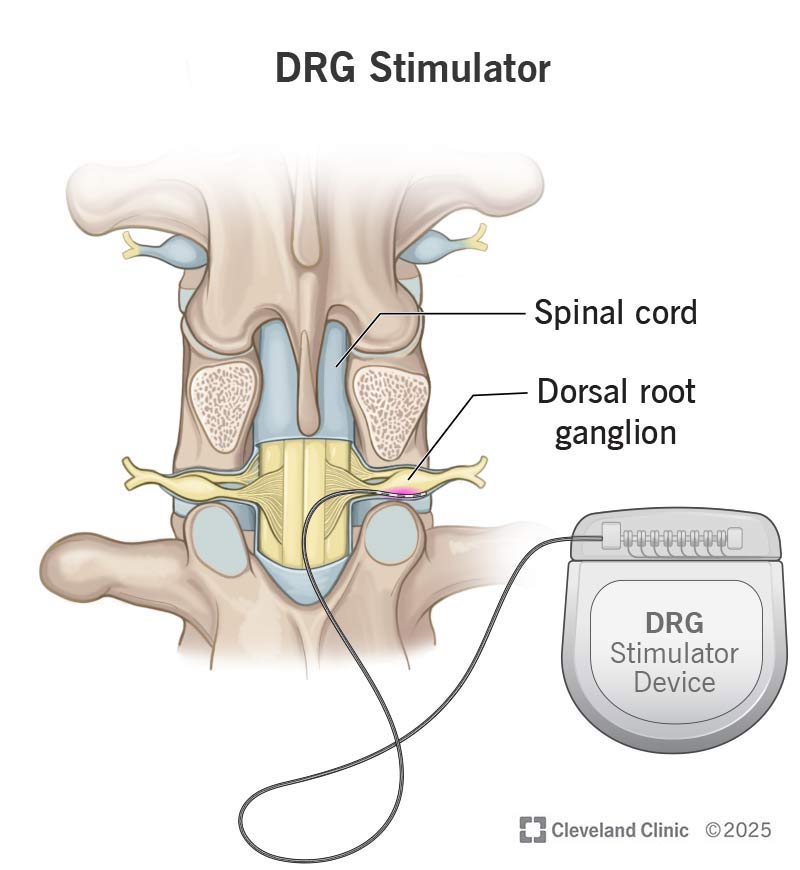
Image content: This image is available to view online.
View image online (https://my.clevelandclinic.org/-/scassets/images/org/health/articles/drg-stimulator)
DRG stimulation requires surgery to place a medical device in your body. This device sends electrical signals to the affected dorsal root ganglion.
Advertisement
Before surgery, your provider will do an exam and may order imaging tests. You’ll also get instructions to prepare, like stopping blood thinners, as they can increase the risk of bleeding.
This treatment happens in two steps:
During DRG stimulation surgery, the steps usually include:
Researchers found that many people get more than 50% pain relief with DRG stimulation. In one study, 63% of people had this level of relief after one year. Another study reported that 74% of people experienced similar results at the one-year mark.
Results vary from person to person. Your surgeon can give you a better idea of what to expect in your situation.
The benefits of DRG stimulation may include:
The treatment is also reversible. Your surgeon can remove the device at any time if needed.
There are possible side effects from a DRG stimulator. These may include:
Your surgical team will take steps to lower the risk of these problems.
After surgery, you’ll have bandages covering the incision site. These usually stay on for a few days. Your care team will show you how to clean and care for them at home.
It’s normal to feel some pain, soreness, swelling or bruising at the stimulator site. Your care team will give you medicine to help with pain. You can also use ice packs wrapped in a towel to help reduce swelling.
Advertisement
Some people stay in the hospital right after surgery. Others go home the same day. Your surgeon will tell you what to expect in advance so you can plan.
You’ll need to take it easy while you recover. Avoid rapid twisting or excessive bending. Normal, light activities are usually fine. But avoid anything strenuous. Ask your provider which activities are safe before you do them.
You’ll also get instructions on how to use the stimulator’s remote. Like a TV remote, it lets you adjust the device settings under your provider’s guidance. At first, your provider will set up general settings. Over the next few weeks, they may adjust them to better fit your needs.
Battery life depends on the type of device you get. DRG devices last much longer than everyday electronics. Most last about six to seven years. A minor outpatient procedure allows your surgeon to access the implanted device and swap it out with a new one. The lead wires usually stay in place during this procedure.
The remote batteries need recharging much sooner than the device itself. But you can easily do this at home.
Keep an eye on the incision site after surgery. Let your care team know if anything looks or feels unusual, like:
Advertisement
These could be signs of an infection.
Living with chronic pain can wear you down — not just physically, but emotionally, too. A dorsal root ganglion (DSG) stimulator offers another path to managing pain, especially when other treatments haven’t worked.
DSG stimulation can take time and a bit of patience, especially through the trial period and recovery. But if it works for you, it can bring real relief. As always, listen to your body, follow your care team’s guidance and speak up if something feels off.
Advertisement



Sign up for our Health Essentials emails for expert guidance on nutrition, fitness, sleep, skin care and more.
Learn more about the Health Library and our editorial process.
Cleveland Clinic’s health articles are based on evidence-backed information and review by medical professionals to ensure accuracy, reliability and up-to-date clinical standards.
Cleveland Clinic’s health articles are based on evidence-backed information and review by medical professionals to ensure accuracy, reliability and up-to-date clinical standards.
Struggling with chronic pain? Cleveland Clinic offers personalized ways to manage your symptoms and get back to living the life you love.
