



Dental implants are a common surgical tooth replacement option. They provide support for artificial teeth like crowns, bridges and dentures. Dental implant placement may require a few procedures and several months of healing. But once an implant heals, you can use it just like a natural tooth. With proper care, your implant can last a lifetime.
Advertisement
Cleveland Clinic is a non-profit academic medical center. Advertising on our site helps support our mission. We do not endorse non-Cleveland Clinic products or services. Policy
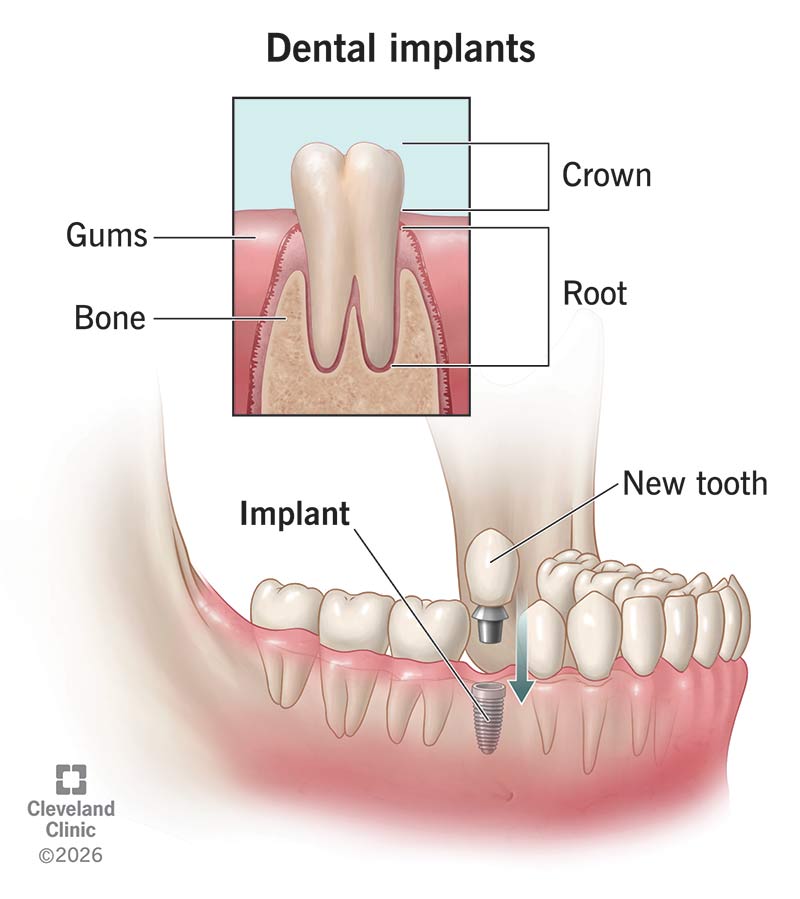
Image content: This image is available to view online.
View image online (https://my.clevelandclinic.org/-/scassets/Images/org/health/articles/dental-implants)
Dental implants are small, threaded posts that surgically replace missing teeth. In addition to filling in gaps in your smile, dental implants can help you chew and speak more easily. Once healed, implants work much like natural teeth. They’re a permanent solution for tooth loss.
Advertisement
Cleveland Clinic is a non-profit academic medical center. Advertising on our site helps support our mission. We do not endorse non-Cleveland Clinic products or services. Policy
A dental implant involves three main parts:
Most implants are titanium, but some are ceramic. Both materials are safe and biocompatible (friendly to the tissues inside your mouth).
Dental implants vary by the type of material, the procedure and the number of teeth they replace. Options include:
Advertisement
With all types, it’s important that there’s enough jawbone to support the implant. If there isn’t, your provider may need to place dental bone grafts to build up places where there’s bone loss.
Dental implant surgery will be personalized to you. But the following gives a general overview of what you can expect your dentist, oral surgeon, periodontist or prosthodontist to do:
During surgery, your surgeon will:
If your implant is near the front of your mouth, your dentist will make a temporary tooth for you to wear until you heal. That way, you won’t have a gap while you recover. If your implant is near the back of your mouth, you may not need a temporary tooth. Your provider will tell you what to expect in your situation.
During the healing phase, your jawbone should fuse to the dental implant. This process is called osseointegration. It’s critical for stability and long-term success. This process can take anywhere from three to nine months. It depends on how quickly your body heals.
Once your implant heals, your dentist can attach the abutment (small connector post) and your final restoration (crown, bridge or denture). This usually takes about one hour to complete and may require a second minor surgery.
Tooth loss changes the way you eat, speak and connect with the world around you. Dental implants are the closest thing to natural teeth and offer benefits like:
Advertisement
Another advantage is that dental implants don’t require enamel removal like bridges do. To replace one missing tooth with a tooth-supported bridge, your dentist must shave down at least one tooth on either side of the gap. This can weaken your natural tooth structure over time.
A dental implant replaces your missing tooth without involving the neighboring teeth. It’s a one-tooth solution to a one-tooth problem.
When an experienced surgeon places implants, the risk of complications is minimal.
If you’re thinking about getting dental implants, be sure to find a provider you trust.
The first round of healing takes about one week. But it takes anywhere from three to nine months for your jawbone to fuse around the implant. This process stabilizes your implant so you can use it like a natural tooth.
Your provider will check on your progress periodically. Once the implant heals, it’s then safe to add the restoration (crown, bridge or denture).
Dental implants usually last longer than alternatives that replace lost teeth (like traditional dentures that rest on your gums). With brushing, flossing and regular dental visits, implants can often last a lifetime.
The restoration part of your dental implant might need to be replaced at some point. Most crowns and bridges last around 15 years, and most dentures last at least seven years. But this timeline varies.
Advertisement
If you have a dental implant, call your dentist any time you notice:
The minimum age is typically 18, and there’s no upper limit. You must be done growing for a dental implant to be placed. The main requirement is that you have enough healthy bone in your jaw for the implant to take hold. A dentist is the only person who can tell you whether you’re a candidate.
It may not be a good idea if you have a condition that may make it difficult for the implant to anchor firmly in your jawbone or if you’re at risk of complications. It may not be the best option if you have:
It may not be a good idea if you smoke or vape, as this can disrupt the healing process.
Still, every person’s case is unique. To find out for sure if you qualify for dental implants, talk to a dentist.
In some cases, yes. A recent study shows that people both with and without autoimmune diseases have comparable success rates following dental implant surgery.
Advertisement
Still, some autoimmune diseases can cause dental issues that may make it challenging to get an implant. Also, some medications for these conditions may increase your risk of complications during the healing period.
Your provider will review your medical history carefully before suggesting dental implants. They’ll let you know if you’re a good candidate.
It often takes three to nine months for the implant to heal so your surgeon can place the artificial tooth/teeth. Much depends on how quickly your body heals. In the meantime, they may fit you with a temporary solution so you don’t have to feel self-conscious about your smile.
You won’t feel any pain during your dental implant procedure. After surgery, it’s normal to have slight discomfort and swelling. Over-the-counter pain relievers can help ease these symptoms. You should feel like yourself within a week or so. Most people eventually forget the implant is even there.
Tooth loss has a negative impact on how your teeth function and look. When you’re missing teeth, it might be difficult to chew or speak the way you used to. And it may make you hide your smile.
Dental implants offer a long-term solution that can help, and your dentist can tailor treatment to your unique needs. Whether you’re missing one tooth, several teeth or all of your teeth, dental implants might be an option for you. To learn more, talk to your dentist.



Sign up for our Health Essentials emails for expert guidance on nutrition, fitness, sleep, skin care and more.
Learn more about the Health Library and our editorial process.
Cleveland Clinic’s health articles are based on evidence-backed information and review by medical professionals to ensure accuracy, reliability and up-to-date clinical standards.
Cleveland Clinic’s health articles are based on evidence-backed information and review by medical professionals to ensure accuracy, reliability and up-to-date clinical standards.
If you’re missing teeth, dental implants can make you feel like smiling again. Cleveland Clinic’s experts will make the process as stress-free as possible.
