



A subchorionic hematoma occurs when blood collects under the chorion membrane during pregnancy. This membrane attaches your uterine wall to the fetus’s amniotic sac. The most common symptom is vaginal bleeding. But some people don’t have symptoms. Most subchorionic membranes go away on their own without causing pregnancy complications.
Advertisement
Cleveland Clinic is a non-profit academic medical center. Advertising on our site helps support our mission. We do not endorse non-Cleveland Clinic products or services. Policy
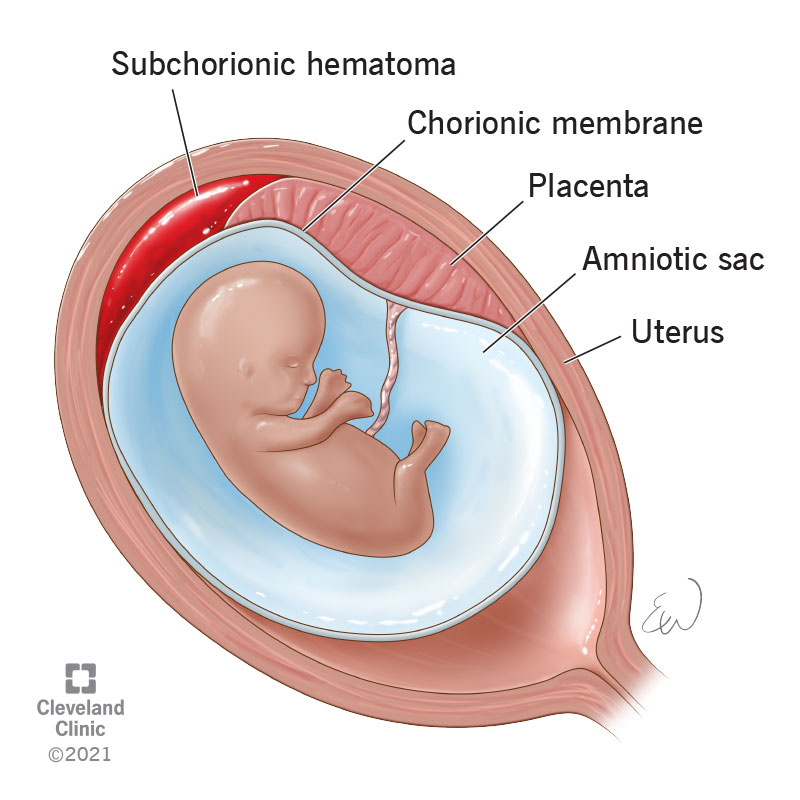
Image content: This image is available to view online.
View image online (https://my.clevelandclinic.org/-/scassets/images/org/health/articles/23511-subchorionic-hematoma)
A subchorionic hematoma happens when blood forms between the wall of your uterus and the chorionic membrane during pregnancy. The chorionic membrane is the outermost layer of the pregnancy sac. The amniotic sac, or the bag of waters, is where the fetus develops. It has two layers: the chorion and the amnion.
Advertisement
Cleveland Clinic is a non-profit academic medical center. Advertising on our site helps support our mission. We do not endorse non-Cleveland Clinic products or services. Policy
This condition can be associated with vaginal bleeding (subchorionic hemorrhage). It’s the most common finding associated with vaginal bleeding during 10 to 20 weeks of pregnancy. But some women have no symptoms.
Some hematomas may increase the risk of certain pregnancy complications. But many go away without treatment and don’t cause issues. Your healthcare provider will recommend a plan for follow-up after assessing the hematoma.
The most common symptom of a subchorionic hematoma (hemorrhage) is vaginal bleeding in the first half of pregnancy. The bleeding may:
The majority of people have no bleeding at all. They learn about the hematoma during a routine ultrasound.
Contact your provider immediately if you have any bleeding during pregnancy. Finding the cause of it as early as possible is key.
A subchorionic hematoma happens when the chorion membrane detaches from the wall of your uterus. This detachment from the uterine wall can be small or large.
Healthcare providers aren’t entirely sure what causes this separation to occur. But certain conditions may put you at a higher risk of developing a subchorionic hematoma, including:
Advertisement
Subchorionic bleeding may increase your chances of pregnancy complications. Some of the possible complications are:
Many subchorionic hematomas don’t cause complications. Your healthcare provider will evaluate your hematoma and determine if treatment is necessary. They base this on several factors, including the size of the hematoma and the stage of pregnancy.
An ultrasound is the main way healthcare providers diagnose a subchorionic hematoma. It looks like a crescent-shaped collection of blood. You’ll have a belly ultrasound or a transvaginal one.
You may get this ultrasound if you have vaginal bleeding. Or your provider may find a hematoma during a routine prenatal ultrasound.
If you have vaginal bleeding, your provider will do other tests or exams to check for complications. For example, they may do a pelvic exam to assess your cervix. They may also check the fetal heart rate.
Many subchorionic hematomas will heal on their own over time, just as a cut on your skin would. Your healthcare provider will evaluate your symptoms and review your health history. They’ll come up with a treatment plan based on the size and location of the hematoma and the fetus’s gestational age.
Your provider may recommend:
If you have a subchorionic hematoma diagnosis, contact your healthcare provider if:
There’s no set amount of time for how long it takes a subchorionic hematoma to heal. In some cases, it’ll shrink in size on its own over a few weeks without causing any complications. Other times, the hematoma can be large and require extra medical care. Your healthcare provider may be able to provide more insight.
It depends on how severe the hematoma is and whether you have other medical conditions. If your bleeding is excessive or the hematoma is large, your provider will likely consider your pregnancy high risk. But small hematomas with minimal bleeding rarely pose a problem.
Any amount of bleeding during pregnancy can cause worry. That’s why your pregnancy care provider is your go-to for care. They can see if the bleeding is due to a subchorionic hemorrhage, which is common. Lean on your provider for guidance. They can let you know if you need follow-up care or if the hematoma will likely go away on its own.
Advertisement



Sign up for our Health Essentials emails for expert guidance on nutrition, fitness, sleep, skin care and more.
Learn more about the Health Library and our editorial process.
Cleveland Clinic’s health articles are based on evidence-backed information and review by medical professionals to ensure accuracy, reliability and up-to-date clinical standards.
Cleveland Clinic’s health articles are based on evidence-backed information and review by medical professionals to ensure accuracy, reliability and up-to-date clinical standards.
From routine pelvic exams to high-risk pregnancies, Cleveland Clinic’s Ob/Gyns are here for you at any point in life.
