



A skin-sparing mastectomy is a type of breast cancer surgery that removes all your breast tissue, nipple and areola while keeping most of your breast skin. This approach allows your provider to perform immediate breast reconstruction. It may help achieve a more natural appearance after surgery.
Advertisement
Cleveland Clinic is a non-profit academic medical center. Advertising on our site helps support our mission. We do not endorse non-Cleveland Clinic products or services. Policy
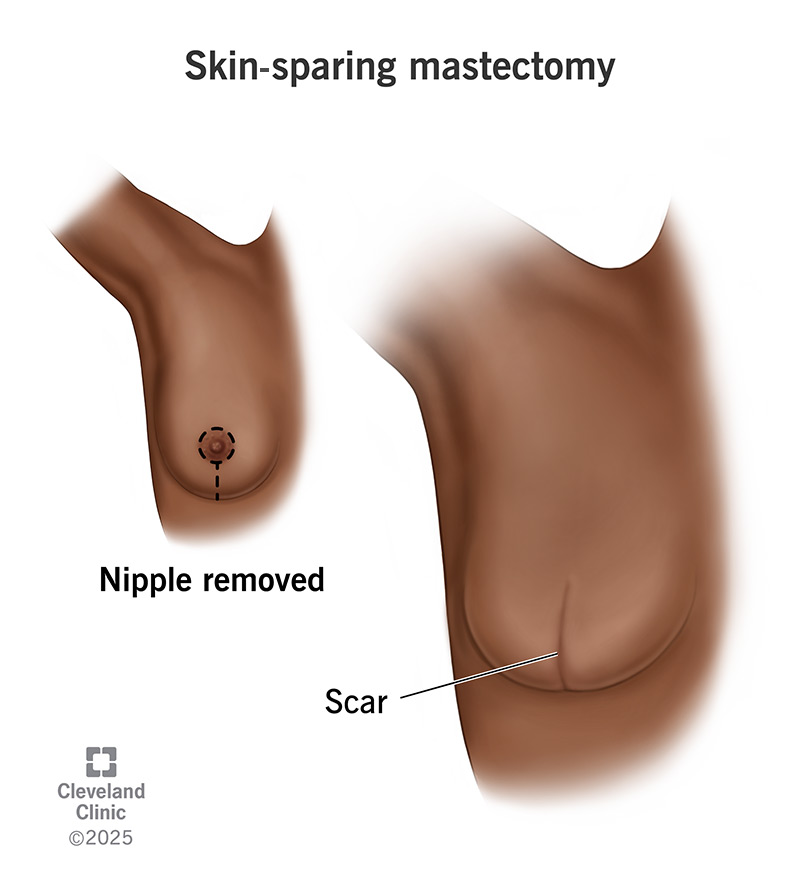
Image content: This image is available to view online.
View image online (https://my.clevelandclinic.org/-/scassets/images/org/health/articles/skin-sparing-mastectomy.jpg)
A skin-sparing mastectomy is surgery that removes all your breast tissue but preserves as much of your skin as possible. Your healthcare provider can use this skin to rebuild your breast right away. Keeping your skin in place can help maintain a natural look and feel to your breast after surgery.
Advertisement
Cleveland Clinic is a non-profit academic medical center. Advertising on our site helps support our mission. We do not endorse non-Cleveland Clinic products or services. Policy
In a skin-sparing mastectomy, your surgeon will usually remove your nipple and areola. This is done to ensure they remove all the cancer if it’s close to or involves your nipple. The size and shape of your breast and blood supply to your nipple can also affect whether your surgeon can safely preserve it.
In some cases, you may be able to spare your nipple and areola. This is called a nipple-sparing mastectomy.
If you need breast cancer surgery, your provider will talk to you about all your options. To figure out which kind of mastectomy is right for you, they’ll consider factors like:
It’s completely normal to feel nervous or have questions about a skin-sparing mastectomy. Your care team will be there to provide answers and support you through each step.
A skin-sparing mastectomy may be a good option if:
Advertisement
It’s not an option if you:
Before a skin-sparing mastectomy, your surgical team will make sure your body is ready, and you understand the procedure. You’ll have a physical exam, which may include blood and imaging tests. If you plan to have immediate breast reconstruction, you’ll also meet with a plastic surgeon to review your options.
To prepare for surgery, you may need to:
Your surgical team will also guide you on what to expect during your hospital stay and recovery. They’ll answer your questions ahead of time to help reduce anxiety and make the process smoother.
First, you’ll receive general anesthesia. That means you’ll be asleep and pain-free during the surgery.
Then, a surgical oncologist will:
A skin-sparing mastectomy is typically performed with immediate breast reconstruction. The entire surgery usually takes four to eight hours.
The exact time depends on:
Advertisement
Potential benefits of a skin-sparing mastectomy include:
Potential risks of a skin-sparing mastectomy include:
Advertisement
After surgery, you’ll go to a recovery area. Nurses and other healthcare providers will closely watch your vital signs as you wake up from anesthesia. You’ll get medication to manage the pain. First, it’ll be through an IV or a pain pump. Once you’re fully awake, you can take pain medication by mouth.
Your care team will regularly check your skin flaps and reconstructed breasts. This is to ensure proper blood flow, normal color and appropriate swelling.
You’ll start with IV fluids and gradually return to drinking and eating as tolerated. You’ll be encouraged to begin gentle arm movements to prevent stiffness. But you should avoid heavy lifting or stretching.
You’ll receive specific instructions about physical activity and arm movement. Your provider will let you know about any activity restrictions to support healing and recovery.
Hospital stays vary after surgery. You may go home the same day, or you may stay in the hospital for one to three days. It depends on the extent of reconstruction, your overall health and how well your recovery is going.
During your first two weeks at home, you’ll need to empty and care for your surgical drains. You’ll also need to keep your bandage clean and dry. Your care team will give you detailed instructions before you leave the hospital.
Advertisement
You may still feel some pain, tightness or soreness in your chest and underarm areas. If your healthcare provider prescribed pain medicine, take it as directed. Don’t skip doses. If they prescribed antibiotics, complete the full course to help prevent infection.
Some swelling, bruising or tingling around your chest and underarm is normal. Wearing a supportive surgical bra can reduce discomfort and swelling.
You’ll receive instructions on physical activity and movement. Gentle arm and shoulder movement is encouraged to prevent stiffness. It also reduces the risk of developing a condition called cording. Avoid heavy lifting, pushing or pulling for at least two to three weeks. Walking and other light physical activity are encouraged to improve circulation and prevent blood clots.
You’ll have a follow-up appointment with your provider about one to two weeks after surgery. They’ll check your healing and assess whether the drains are ready for removal. The timing of drain removal varies. It depends on your healing and drain output. Your provider will also discuss the timing of any additional treatments, like radiation or chemotherapy, if needed.
Call your healthcare provider immediately if you notice:
Go to the emergency room or call 911 (or your local emergency service number) immediately if you have chest pain that’s new, severe or different from discomfort you’d expect after surgery. Also, go if you have new or worsening shortness of breath.
A skin-sparing mastectomy removes all the breast tissue, nipple and areola while preserving most of your skin. This makes it easier to rebuild your breast right away and often gives a more natural look.
A simple mastectomy removes all the breast tissue, nipple, areola and overlying skin. You may have a simple mastectomy if:
Having a skin-sparing mastectomy can feel overwhelming. It’s normal to have a lot of questions and worries. Remember, you’re not alone. Many people find that talking openly with their healthcare providers and loved ones helps ease some of the stress and uncertainty. Your healthcare team is there to answer your questions and make sure you feel supported and informed throughout the process.



Sign up for our Health Essentials emails for expert guidance on nutrition, fitness, sleep, skin care and more.
Learn more about the Health Library and our editorial process.
Cleveland Clinic’s health articles are based on evidence-backed information and review by medical professionals to ensure accuracy, reliability and up-to-date clinical standards.
Cleveland Clinic’s health articles are based on evidence-backed information and review by medical professionals to ensure accuracy, reliability and up-to-date clinical standards.
Having a lumpectomy or mastectomy is the first step toward healing from breast cancer. Cleveland Clinic breast cancer surgeons offer expertise and compassion.
