



During a lower endoscopy, a gastroenterologist uses a scope to view your rectum and part of your colon. This procedure can help diagnose lower digestive tract conditions, like inflammatory bowel disease, or locate the cause of bleeding from your rectum.
Advertisement
Cleveland Clinic is a non-profit academic medical center. Advertising on our site helps support our mission. We do not endorse non-Cleveland Clinic products or services. Policy
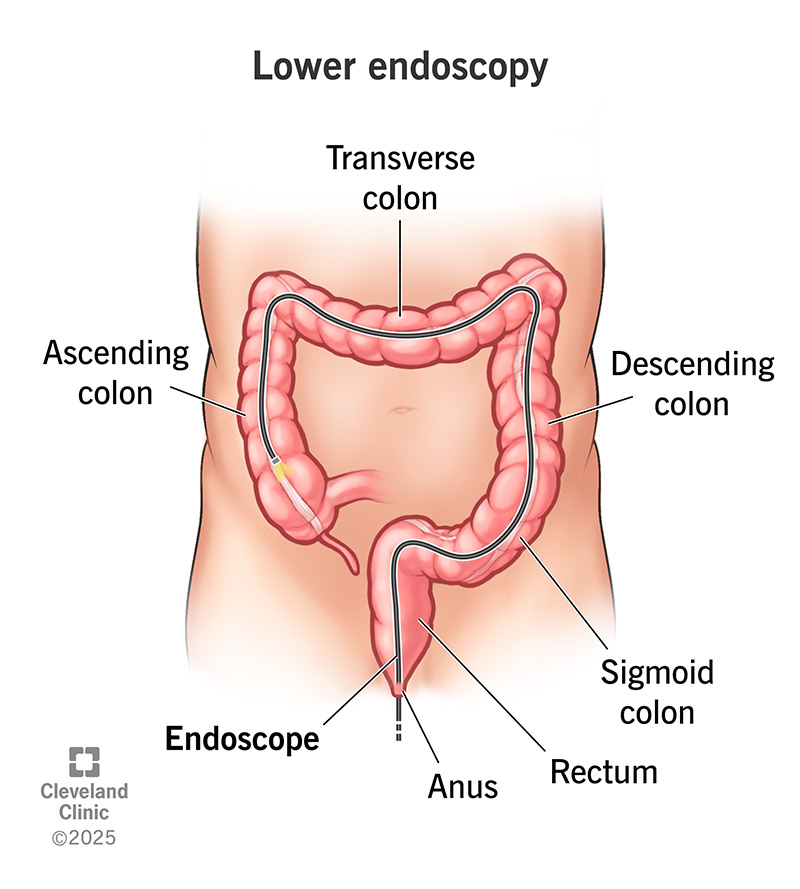
Image content: This image is available to view online.
View image online (https://my.clevelandclinic.org/-/scassets/images/org/health/articles/lower-endoscopy.jpg)
A lower endoscopy is a procedure to examine your lower gastrointestinal tract (GI tract). A gastroenterologist uses an endoscope (a thin tube with a camera at the end) to view the inside of your anus, rectum and colon.
Advertisement
Cleveland Clinic is a non-profit academic medical center. Advertising on our site helps support our mission. We do not endorse non-Cleveland Clinic products or services. Policy
Your provider may recommend one if you have symptoms like:
It can help diagnose conditions like:
It also monitors conditions like ulcerative colitis to see if the disease is getting worse.
A lower endoscopy is the counterpart to an upper endoscopy, which looks at the area from your throat to the top of your small intestine.
You’ll need to have an empty colon. The bowel preparation differs, depending on what your provider is examining. You may need to prepare with:
Ask any questions you have about the prep work for the procedure.
What you can expect depends on what procedure you have. The general steps are:
Advertisement
It shouldn’t be painful. If you’re awake, you may feel pressure when your provider inserts the endoscope. If you’re asleep for the procedure, you won’t feel anything. You may feel discomfort after you wake up, but this will only last a few hours.
It depends on the reason for the procedure and how clean your bowels are. Exams that only look at your rectum take about 15 minutes. But procedures that look at your entire colon can take an hour.
The main benefits are that it can diagnose or treat a wide range of lower GI conditions.
Lower endoscopies are safe, but all procedures carry some risks. These include:
For some lower endoscopies, you can go home right after the exam. If you were asleep for the procedure, you may need time to recover before someone drives you home.
You should be able to eat and return to your regular activities the same day. But you may have gas pains or cramping for a few hours. In some cases, your healthcare provider may recommend limiting physical activity or avoiding certain foods for the rest of the day.
Depending on the reason for the procedure, your provider may be able to give you information about what they saw right away. Other times, they send samples of tissue from your GI tract to a laboratory. These results take longer to get.
Call your healthcare provider if you have any of the following symptoms:
A lower endoscopy can mean either a colonoscopy (examines your entire colon, rectum and anus) or a sigmoidoscopy (examines the lower part of your colon, rectum and anus). It can also mean a pouchoscopy (examines a surgically created colon).
While all the procedures use an endoscope, they also have differences. Ask your healthcare provider what they’re examining and what you can expect.
It’s normal to feel a little nervous for a lower endoscopy. But if your provider is recommending one, know it’s for good reason. The procedure can help identify possible issues or find the source of unpleasant symptoms you may be having. Bowel preparation is important, so make sure you follow your provider’s instructions in the days before your procedure. And be sure to ask them any questions you have about the examination.
Advertisement



Sign up for our Health Essentials emails for expert guidance on nutrition, fitness, sleep, skin care and more.
Learn more about the Health Library and our editorial process.
Cleveland Clinic’s health articles are based on evidence-backed information and review by medical professionals to ensure accuracy, reliability and up-to-date clinical standards.
Cleveland Clinic’s health articles are based on evidence-backed information and review by medical professionals to ensure accuracy, reliability and up-to-date clinical standards.
Having an endoscopy can be lifesaving. Cleveland Clinic’s providers will help you feel comfortable with the process so you can get the care you need.
