



An ileocecectomy is a surgery that removes the very end of your small intestine (ileum) and the very start of your large intestine (cecum). Most people have this surgery to treat Crohn’s disease, which often affects this area.
Advertisement
Cleveland Clinic is a non-profit academic medical center. Advertising on our site helps support our mission. We do not endorse non-Cleveland Clinic products or services. Policy
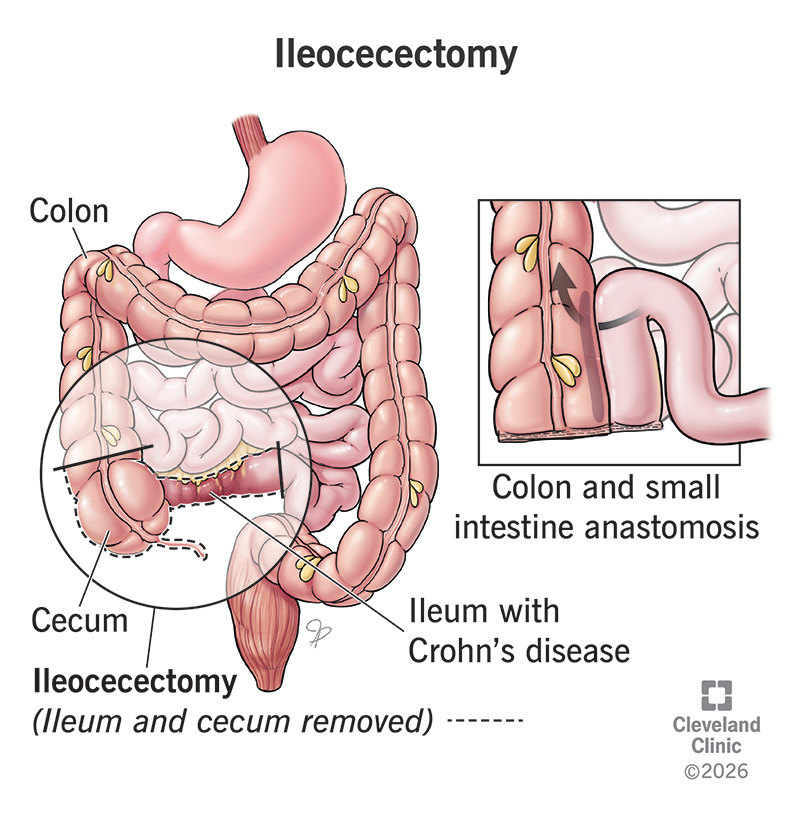
Image content: This image is available to view online.
View image online (https://my.clevelandclinic.org/-/scassets/images/org/health/articles/ileocecostomy.jpg)
An ileocecectomy is a type of bowel resection surgery — surgery that removes a part of your intestines (bowels). In an ileocecectomy, a surgeon removes the part where your intestines connect:
Advertisement
Cleveland Clinic is a non-profit academic medical center. Advertising on our site helps support our mission. We do not endorse non-Cleveland Clinic products or services. Policy
These two pieces share the same blood supply. When you remove one, you need to remove the other. That’s because one piece is unlikely to survive on its own.
An ileocecectomy is also called an ileocecal resection.
You might need this specific section of your bowel removed if disease has damaged it. Diseases that cause chronic inflammation in your bowels can lead to scarring that makes this section too narrow. Crohn’s disease is the most common cause.
Some healthcare providers recommend ileocecectomy as a primary treatment for Crohn’s disease before serious damage occurs. The idea is that if Crohn’s disease mainly affects this part of your bowels, removing it upfront may prevent the need for long-term medication. But you may need medication after surgery.
Other diseases that can cause inflammation in your bowels include:
Before scheduling the ileocecectomy, your healthcare team will assess your overall health to make sure you’re in good condition for surgery.
You might have tests like:
An ileocecectomy may be an open abdominal surgery or a minimally invasive surgery. It depends on your condition and your surgeon’s experience and preference.
Advertisement
If you’re having open surgery, your surgeon will make one long cut to open your belly (abdomen). If you’re having minimally invasive surgery, your surgeon will make a few small cuts. They’ll place a camera and special tools through these holes. They’ll also pump in gas to create more space to operate.
Your surgeon will:
If your surgeon has doubts about the health of your bowels, they might want to delay the anastomosis to give it more time to heal. In this case, they may create a temporary ostomy. This means they’ll redirect your bowel to an opening in your abdomen. They can close the ostomy in a later procedure, using the normal bowel again, so you won’t have the ostomy bag anymore.
The primary benefit of an ileocecectomy is that it removes disease located in a specific part of your intestines. Removing this part can often relieve your symptoms and prevent the disease from further damaging your bowel. Crohn’s disease may come back later. But it’s likely to be milder and easier to manage when it does.
An ileocecectomy may also replace other, more extensive treatments in some cases. For example, an early ileocecectomy for Crohn’s disease may prevent or reduce the need for long-term medications. An ileocecectomy to remove cancer may replace a larger resection (hemicolectomy). But the location of the cancer is important to decide which portion of the bowel needs to be removed.
Potential risks of an ileocecectomy include:
Other general risks of surgery include bleeding, blood clots and wound infection. These risks are low.
You can expect to stay in the hospital up to a week after the surgery. Your bowels will be slow to start working again. So, you’ll be on a liquid diet until they do. You’ll be able to go home when you can eat and poop normally and manage your pain with over-the-counter medications. You’ll be able to take care of your stoma. But in the first few weeks, some stoma care will be available after discharge.
Advertisement
The average recovery time for an ileocecectomy is one to two months. It’s usually on the shorter side if you have minimally invasive surgery. But complications can make your recovery longer. If you have a temporary ostomy, your surgeon may consider a reversal procedure after at least three months.
Call your provider if you have any unusual symptoms during your recovery, like:
If you have Crohn’s disease, surgery is often necessary to treat it sooner or later. When the disease is isolated in one part of your bowel, removing that part may relieve your symptoms. That’s where an ileocecectomy comes in. In some cases, Crohn’s may reappear later. But you may spend years free of symptoms and medications.
Advertisement



Sign up for our Health Essentials emails for expert guidance on nutrition, fitness, sleep, skin care and more.
Learn more about the Health Library and our editorial process.
Cleveland Clinic’s health articles are based on evidence-backed information and review by medical professionals to ensure accuracy, reliability and up-to-date clinical standards.
Cleveland Clinic’s health articles are based on evidence-backed information and review by medical professionals to ensure accuracy, reliability and up-to-date clinical standards.
Crohn’s disease can get in the way of living an active life. Cleveland Clinic gastroenterologists and colorectal surgeons can help you manage Crohn’s and get relief.
