



Madelung’s disease is a rare condition that causes fatty tissue to collect on your neck, shoulders and upper back. Treatment usually involves surgery or liposuction.
Advertisement
Cleveland Clinic is a non-profit academic medical center. Advertising on our site helps support our mission. We do not endorse non-Cleveland Clinic products or services. Policy
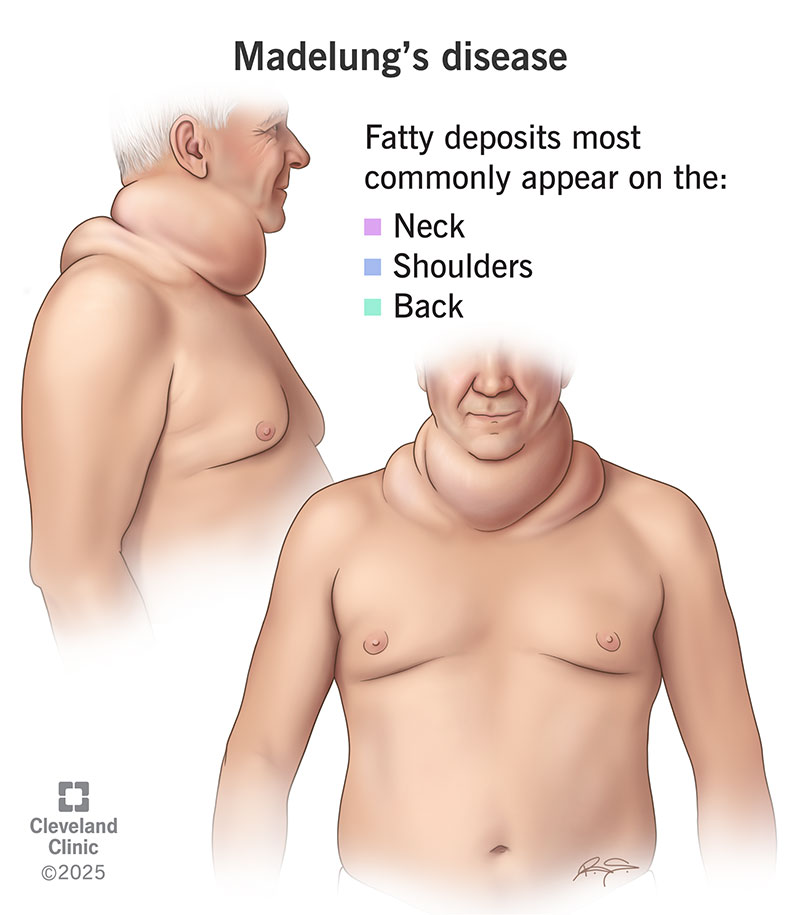
Image content: This image is available to view online.
View image online (https://my.clevelandclinic.org/-/scassets/images/org/health/articles/madelungs-disease)
Madelung’s disease is a rare condition where extra fatty tissue builds up in places it normally wouldn’t, like around your neck and shoulders. It causes painless, fatty masses that grow over time. If the lumps get too big, they can affect nearby body functions. For example, a fatty lump around your neck might make it harder to swallow or move your neck.
Advertisement
Cleveland Clinic is a non-profit academic medical center. Advertising on our site helps support our mission. We do not endorse non-Cleveland Clinic products or services. Policy
Treatments like exercise, medications and eating healthy foods won’t make Madelung’s disease go away or stop it from getting worse. Your healthcare provider usually needs to remove the fatty tissue with surgery.
Other names for this condition include benign symmetric lipomatosis and Launois–Bensaude syndrome.
The main symptom is having fatty deposits in areas where fat doesn’t typically collect. Most commonly, they appear on your:
It can make you appear hunchback or like you have a buffalo hump.
Less commonly, fatty deposits appear on your:
This fatty tissue is different than a fatty lump (lipoma) or typical body fat. It doesn’t feel rubbery or hard. It spreads and mixes under your skin — looking like jelly spread on a piece of bread. It also grows evenly. For example, it will be on both the left and right sides of your shoulders.
In severe cases, the fat buildup can cause:
Healthcare providers don’t know what causes the condition. But there’s evidence it could be due to:
Advertisement
Alcohol use disorder is one of the biggest risk factors. Between 60% and 90% of people with this disease also have cirrhosis of the liver from heavy alcohol use.
Other risk factors include:
This condition usually isn’t dangerous, but it could lead to serious issues, like:
To diagnose the condition, your healthcare provider may:
Your provider may classify the type of Madelung’s disease you have based on where the fat has built up:
Fatty tissue from Madelung’s disease doesn’t go away on its own, and there isn't a cure. Exercising more and changing what you eat won’t help make it smaller.
Treatment typically involves your provider removing fatty deposits with surgery or liposuction. This is usually necessary if the masses cause symptoms like difficulty breathing and swallowing, or nerve pain. Surgery isn’t a permanent solution. There's a chance the fatty tissue could grow back.
If your provider believes alcohol consumption is a factor, they’ll ask you to avoid it. If you need support doing this, they can offer guidance and resources.
People with severe liver dysfunction may not be able to have surgery.
If the fat deposits are small and not causing major problems, your healthcare provider will monitor them to make sure symptoms don’t start.
Getting regular care from your healthcare provider is important. While they can remove large fatty deposits that are bothering you, the deposits could come back. That’s why following your provider’s treatment plan is so important.
Your life expectancy shouldn’t change just because you have Madelung’s disease. But you’re more likely to have other related issues, like diabetes and liver disease. You can work with your healthcare provider to manage these and other health conditions so you can feel your best.
Advertisement
Madelung’s disease can be physically and emotionally exhausting. Experts don’t know how or why it happens. But that doesn't mean you're without options when it comes to feeling better.
You may have lots of questions about your diagnosis and wonder what it means for your health. Your provider is the best person to talk to. They can ease your worries and help you feel confident in the path forward.
Advertisement



Sign up for our Health Essentials emails for expert guidance on nutrition, fitness, sleep, skin care and more.
Learn more about the Health Library and our editorial process.
Cleveland Clinic’s health articles are based on evidence-backed information and review by medical professionals to ensure accuracy, reliability and up-to-date clinical standards.
Cleveland Clinic’s health articles are based on evidence-backed information and review by medical professionals to ensure accuracy, reliability and up-to-date clinical standards.
Whether you need cosmetic or reconstructive plastic surgery, you’ll need skilled, detailed and compassionate providers. At Cleveland Clinic, we’re here to help.
