



Cluster C personality disorders (PDs) involve intense fear and anxiety that affect how you relate to others. There are three types, including avoidant PD, dependent PD and obsessive-compulsive PD. If you have a personality disorder, you may not realize there’s an issue with how you think or behave.
Advertisement
Cleveland Clinic is a non-profit academic medical center. Advertising on our site helps support our mission. We do not endorse non-Cleveland Clinic products or services. Policy
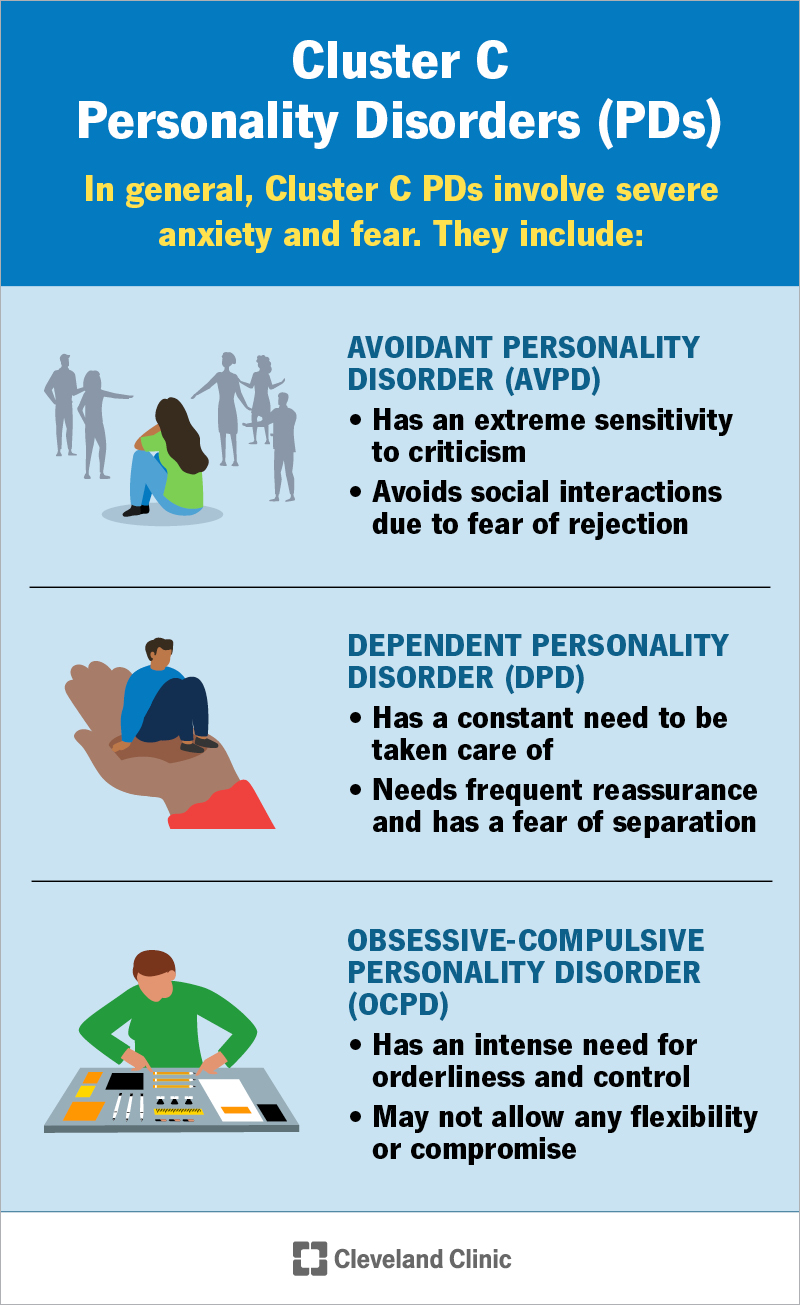
Image content: This image is available to view online.
View image online (https://my.clevelandclinic.org/-/scassets/images/org/health/articles/cluster-c-personality-disorders)
Cluster C personality disorders (PDs) are three mental health conditions that involve severe anxiety and fear. They include:
Advertisement
Cleveland Clinic is a non-profit academic medical center. Advertising on our site helps support our mission. We do not endorse non-Cleveland Clinic products or services. Policy
It’s possible to have more than one of the Cluster C PDs. For example, it’s common to have avoidant and dependent personality disorders.
These lifelong behaviors and thinking patterns can cause distress in many areas of your life, like work and relationships. Talk therapy can help manage the symptoms.
Each Cluster C personality disorder has its own unique symptoms. But they share certain personality traits. If you have a Cluster C PD, you may have:
These traits begin by early adulthood. They’re constant and affect your ability to do tasks and relate to others in a healthy way.
Advertisement
Healthcare providers don’t know the exact cause of Cluster C personality disorders. It likely involves many factors, like genetics, childhood experiences and childhood temperament. For example, studies show that genetic factors account for 27% to 66% of the traits in OCPD.
Adverse childhood experiences (ACEs) may be a significant risk factor for Cluster C personality disorders. ACEs are traumatic events that happen between birth and age 17. Researchers think these negative experiences lead to unhealthy (maladaptive) patterns of thinking that can develop into a personality disorder.
Types of ACEs that may contribute to personality disorders in this cluster include:
Healthcare providers use criteria in the DSM-5 to diagnose Cluster C personality disorders. Each type has specific criteria. Providers ask questions about your medical, personal and social history to guide the diagnosis.
This can be difficult. Most people living with personality disorders may not seek help. Mental health professionals may work with loved ones to gather more information.
Talk therapy can help manage Cluster C personality disorders. You’ll work with a mental health professional. They can provide support and education. They’ll help you learn healthier ways of working through emotions and relationships.
There are several types of talk therapy. Three types that may especially help with this cluster are:
Currently, the U.S. Food and Drug Administration (FDA) doesn’t approve any medications to treat PDs directly. But you may take medicine to help other conditions you have, like anxiety and depression.
The outlook for Cluster C personality disorders varies. It depends on symptom severity and if you get treatment. If you have a personality disorder in this cluster, you may be at an increased risk of:
Because of these complications, it’s crucial to get medical help sooner rather than later. Treatment can help improve your quality of life.
Get help immediately if you’re having suicidal thoughts. You can call the U.S. National Suicide Prevention Lifeline, now known as the 988 Suicide & Crisis Lifeline, at any time.
Advertisement
When loved ones suggest seeking care for a Cluster C personality disorder, you might find it off-putting or feel like they simply don’t “get” you. But being open to therapy can make a world of difference in how you approach each day and interact with others. It’s worth a try, even if you don’t feel it’s necessary.
If you think a loved one has a personality disorder in this cluster, encourage them to seek support. Even if they don’t respond in the way you’d hoped, your efforts are worth it. Your loved one may need more time to process these attempts at help and to realize the value of seeking care.
Advertisement



Sign up for our Health Essentials emails for expert guidance on nutrition, fitness, sleep, skin care and more.
Learn more about the Health Library and our editorial process.
Cleveland Clinic’s health articles are based on evidence-backed information and review by medical professionals to ensure accuracy, reliability and up-to-date clinical standards.
Cleveland Clinic’s health articles are based on evidence-backed information and review by medical professionals to ensure accuracy, reliability and up-to-date clinical standards.
Your mental well-being is just as important as your physical well-being. Cleveland Clinic’s mental health experts can help you live life to the fullest.
