



Schema therapy is a talk therapy that mainly treats personality disorders. It’s a long-term therapy that addresses and changes deep-rooted ways of thinking and behaving. You work closely with a licensed therapist.
Advertisement
Cleveland Clinic is a non-profit academic medical center. Advertising on our site helps support our mission. We do not endorse non-Cleveland Clinic products or services. Policy
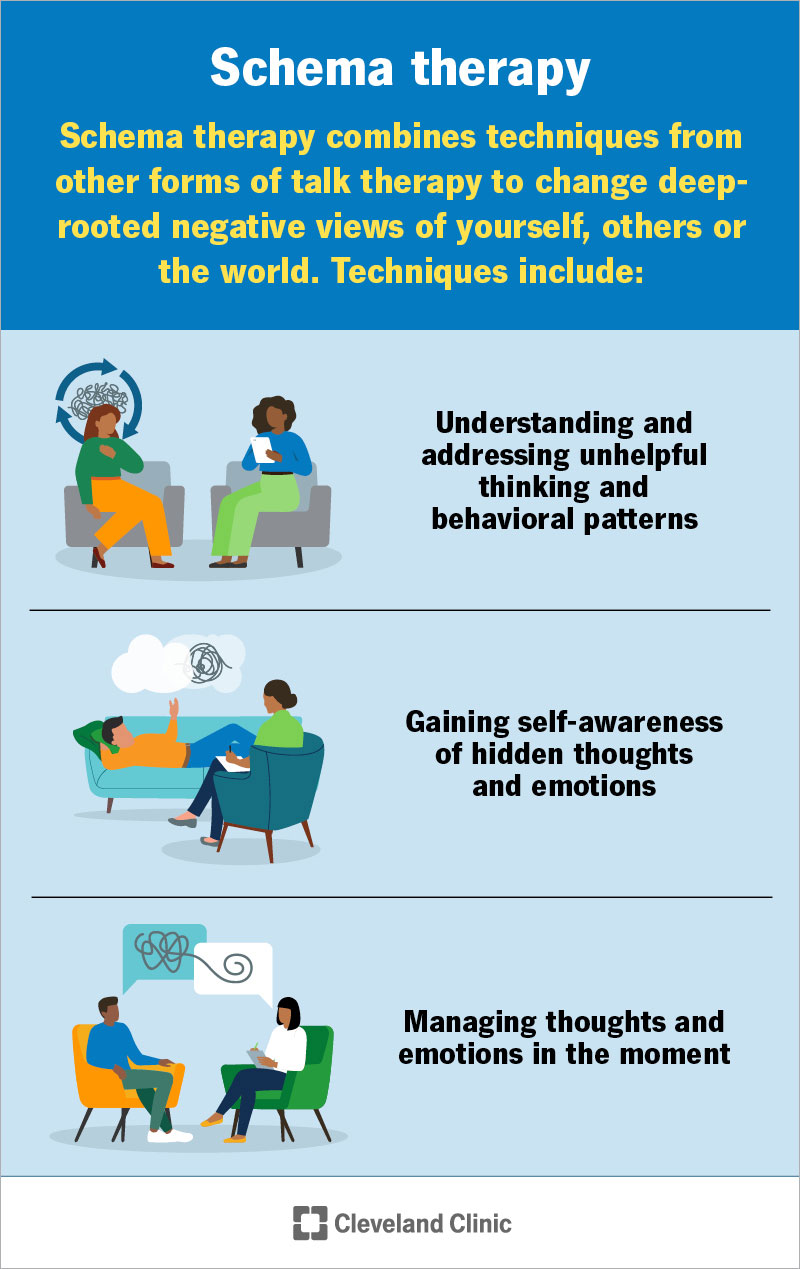
Image content: This image is available to view online.
View image online (https://my.clevelandclinic.org/-/scassets/images/org/health/articles/schema-therapy)
Schema therapy (also known as schema-focused therapy) is a type of talk therapy that aims to help you change unhealthy patterns of thinking and behavior. These patterns are deeply ingrained and affect how you interact with others.
Advertisement
Cleveland Clinic is a non-profit academic medical center. Advertising on our site helps support our mission. We do not endorse non-Cleveland Clinic products or services. Policy
To better understand this therapy, it helps to know what a schema is. In psychology, a schema is a long-lasting outlook or assumption that you have about yourself, others or the world. Negative schemas tend to develop from negative experiences. If they’re based in childhood, they’re also called maladaptive early schemas.
Some maladaptive schemas include:
These core beliefs lead to unhealthy coping responses throughout your life. For example, you may have excessive avoidance, dependence or self-sacrifice. Or you may overcompensate.
Psychologists most commonly use schema therapy to treat personality disorders, especially borderline personality disorder. Research is ongoing, but it may also help treat other mental health conditions, like eating disorders, depression and panic disorders.
The goal of schema therapy is to understand and meet your core emotional needs. In most cases, these are needs that weren’t met in childhood. You’ll learn to detect and manage your automatic thought patterns, emotions and impulses. This can help prevent extreme thoughts and behaviors.
Advertisement
You’ll work very closely with a licensed clinical therapist who specializes in schema therapy. A close therapist-client relationship is key to this treatment. So, it’s important that you feel comfortable with your therapist and trust them.
In general, schema therapy involves deep self-reflection. Your therapist will help you understand how your views may not match reality, offer advice and suggest new behaviors.
You’ll learn how to:
Schema therapy combines techniques of:
Schema therapy is typically a long-term treatment. Most people with personality disorders require at least a year of this therapy. But it could take longer.
You may have sessions once or twice a week or every other week. It may be one-on-one with your therapist or in a group setting. Speak with your therapist about what to expect.
Schema therapy is a newer type of therapy. So, it isn’t as well studied as other forms of talk therapy, like CBT. But several studies on the use of schema therapy in the treatment of borderline personality disorder (BPD) specifically found that it:
Also, people with BPD are more likely to continue schema therapy treatment compared to other types of talk therapy.
You may experience intense emotional distress during schema therapy. This is because you may address previous trauma and other negative memories. It can be difficult, but it’s part of the process. Your therapist can help you through it.
Other potential cons of schema therapy include:
It’s normal to feel uncomfortable during schema therapy. It can be painful to explore negative emotions and fears. If your symptoms get worse, contact your healthcare provider right away.
Advertisement
Get help immediately if you’re having suicidal thoughts. You can call the U.S. National Suicide Prevention Lifeline, now known as the 988 Suicide & Crisis Lifeline, 24/7.
It can be overwhelming to seek help for a mental health condition. But the sooner you reach out, the sooner you can start to feel better. Schema therapy may help you understand how your inner child shows up in your thoughts and behaviors as an adult. This is hard work. But sticking with it can help you feel and manage your emotions in healthier ways.
Advertisement



Sign up for our Health Essentials emails for expert guidance on nutrition, fitness, sleep, skin care and more.
Learn more about the Health Library and our editorial process.
Cleveland Clinic’s health articles are based on evidence-backed information and review by medical professionals to ensure accuracy, reliability and up-to-date clinical standards.
Cleveland Clinic’s health articles are based on evidence-backed information and review by medical professionals to ensure accuracy, reliability and up-to-date clinical standards.
Your mental well-being is just as important as your physical well-being. Cleveland Clinic’s mental health experts can help you live life to the fullest.
