



A Rinne test compares your hearing when sound travels through air (air conduction) and bone (bone conduction). It’s a hearing screening test to see if you have conductive hearing loss.
Advertisement
Cleveland Clinic is a non-profit academic medical center. Advertising on our site helps support our mission. We do not endorse non-Cleveland Clinic products or services. Policy
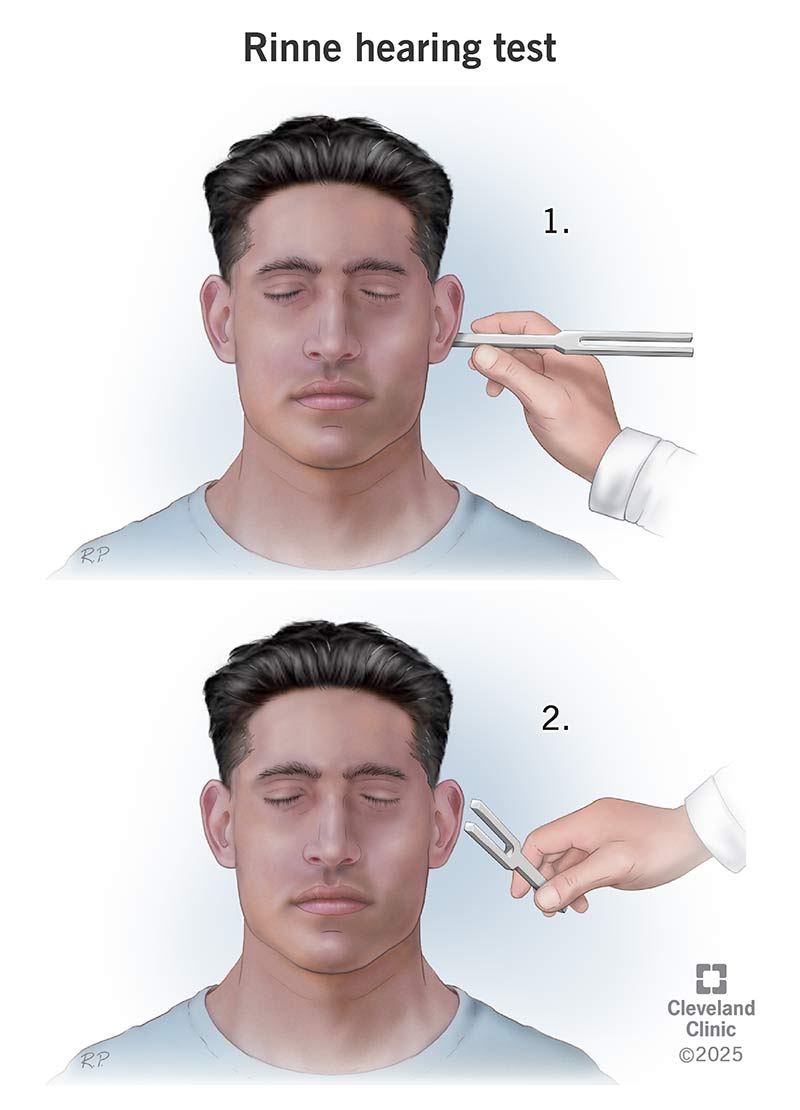
Image content: This image is available to view online.
View image online (https://my.clevelandclinic.org/-/scassets/Images/org/health/articles/rinne-hearing-test)
A Rinne test uses a tuning fork to check how well you hear when sound moves through your ear (air conduction) or vibrates your skull (bone conduction). A primary care provider or otolaryngologist may do this test to diagnose conductive hearing loss.
Advertisement
Cleveland Clinic is a non-profit academic medical center. Advertising on our site helps support our mission. We do not endorse non-Cleveland Clinic products or services. Policy
Hearing turns sound waves into vibrations. Normally, the vibrations travel from your eardrum to tiny bones in your middle ear. Next, the vibrations go to tiny hair cells in your inner ear. The hair cells vibrate, sending messages to your auditory nerve and then to your brain.
In conductive hearing loss, something blocks the sound from getting to your inner ear. The sound you hear happens when vibrations go through your skull to your inner ear. The detour disrupts the way messages from your inner ear get to your brain.
A Rinne test detects any difference in your hearing when a tuning fork tone moves through air or bone. It involves the following steps:
Your healthcare provider may say you have a positive or negative Rinne result:
Advertisement
Your healthcare provider may do a Weber test. This is another hearing test that uses a tuning fork. A Weber test checks for sensorineural hearing loss. Damage to the tiny hairs in your inner ear causes this hearing loss.
Your provider may refer you to an audiologist for more hearing tests. But don’t hesitate to contact your provider if you notice a sudden change in your hearing.
Hearing is complicated. Tuning forks, not so much. But this simple tool is one way healthcare providers screen for common types of hearing loss. The Rinne test is an example of a tuning fork test for hearing. Audiologists use other tests to diagnose hearing loss. If a Rinne test is your introduction to hearing tests, your healthcare provider will explain how it works and what you can expect.
Advertisement



Sign up for our Health Essentials emails for expert guidance on nutrition, fitness, sleep, skin care and more.
Learn more about the Health Library and our editorial process.
Cleveland Clinic’s health articles are based on evidence-backed information and review by medical professionals to ensure accuracy, reliability and up-to-date clinical standards.
Cleveland Clinic’s health articles are based on evidence-backed information and review by medical professionals to ensure accuracy, reliability and up-to-date clinical standards.
Hearing is an important part of your everyday life. Hearing loss can impact your life in so many ways. Cleveland Clinic experts can help you hear clearly again.
