



The five deep tendon reflexes (DTRs) in your body are automatic reactions. Your nervous system controls them without you thinking about it. A healthcare provider might test your DTRs during an office visit to see if your nerves and muscles are responding like they should. Neurological conditions that affect your nerves can change these reflexes.
Advertisement
Cleveland Clinic is a non-profit academic medical center. Advertising on our site helps support our mission. We do not endorse non-Cleveland Clinic products or services. Policy
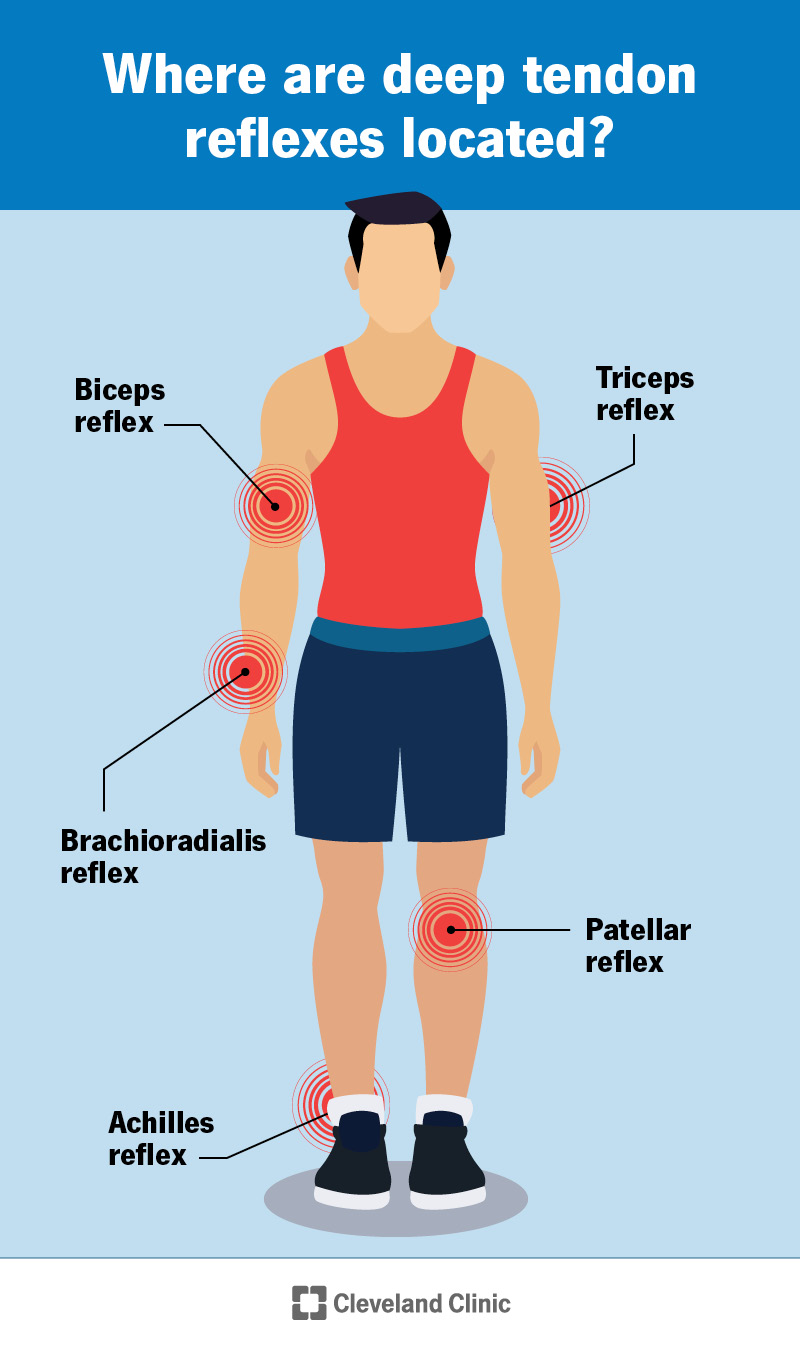
Image content: This image is available to view online.
View image online (https://my.clevelandclinic.org/-/scassets/images/org/health/articles/deep-tendon-reflexes)
Deep tendon reflexes (DTRs) are reflexes that make certain muscles in your body squeeze or flex when a healthcare provider taps a tendon connected to them. That’s why they’re also known as muscle stretch reflexes.
Advertisement
Cleveland Clinic is a non-profit academic medical center. Advertising on our site helps support our mission. We do not endorse non-Cleveland Clinic products or services. Policy
A reflex is something that happens automatically, without you controlling it. Your body uses lots of different reflexes to help you react to the world around you and stay safe. Deep tendon reflexes keep your muscles ready to react and help you keep your balance.
DTRs get their name from how they work. They happen when something triggers nerves connected to tendons and muscles deep in your body. The nerves react instantly, and tell those muscles to move or twitch without you thinking about it.
There are five deep tendon reflexes:
A healthcare provider might test your DTRs if they’re checking for a neurological disorder. These conditions affect your nervous system, including your:
Advertisement
Your reflexes might not work like they should if something is interrupting the connection between any of the parts in your nervous system.
Your provider may use a DTR test to help diagnose conditions like:
Your provider may also test some of your reflexes as part of a regular checkup.
The specific steps will vary depending on which DTR your provider is testing. But these are the general steps:
Where your provider taps with a reflex hammer changes based on which reflex they’re testing:
Your provider might use the Jendrassik maneuver if typical tests aren’t triggering your patellar or Achilles reflexes. You will:
Your provider will then tap on your knee or ankle after you’re clenching your teeth and pulling your hands apart.
This might feel silly, but it helps. Your brain sometimes interferes with your natural reflexes. If you know a tap is coming, your brain might anticipate it and stop you from reacting on pure reflex. The Jendrassik maneuver occupies your brain and nerves higher up in your body. This lets nerves and muscles in your legs react like they should, without interference.
There are no risks to having your deep tendon reflexes tested. All the tests are quick and painless. And your healthcare provider can do them as part of a regular office visit. They won’t need special equipment or a separate appointment.
Healthcare providers classify your DTRs with one of five grades. The higher the number, the more your muscle moved when your reflex was triggered:
Advertisement
"Normal" isn’t a very scientific word. In this case, it means typical compared to the average for most people. It also means that nothing has changed too much if your provider has tested your reflexes in the past.
You might have naturally bigger or smaller reflexes than usual, even if nothing is wrong. Your provider might test the same reflex on the other side of your body. This can help them know what’s normal for you, versus what might be a sign of an issue.
Your provider will probably suggest some other tests if your muscle stretch reflexes seem unusual. They'll tell you which tests you’ll need and why.
It might be hard for you to feel something wrong with a specific deep tendon reflex. But you may notice signs of a neurological issue. Visit a healthcare provider if you feel like you can’t move or react like usual. You know what’s normal for you and when something isn’t quite right.
Advertisement
Your body works in so many ways that you may never think about. Most people haven’t thought about their deep tendon reflexes since the last time their healthcare provider tapped their knee with that little rubber hammer. And that’s how they’re supposed to work. They’re automatic processes and reactions that help move you through your day.
An issue with your muscle stretch reflexes can be a clue that something is affecting your nervous system. If your provider suspects a neurological issue, they might test your DTRs. From there, they’ll help you understand what the issue is and what’s causing it.
Advertisement



Sign up for our Health Essentials emails for expert guidance on nutrition, fitness, sleep, skin care and more.
Learn more about the Health Library and our editorial process.
Cleveland Clinic’s health articles are based on evidence-backed information and review by medical professionals to ensure accuracy, reliability and up-to-date clinical standards.
Cleveland Clinic’s health articles are based on evidence-backed information and review by medical professionals to ensure accuracy, reliability and up-to-date clinical standards.
Cleveland Clinic’s primary care providers offer lifelong medical care. From sinus infections and high blood pressure to preventive screening, we’re here for you.
