



Reflexes are quick reactions your body makes without thinking — like shivering when you’re cold or moving away from danger. They help keep you safe, steady and functioning by controlling things like balance, muscle movement and even digestion. If they’re off, your provider can help figure out why.
Advertisement
Cleveland Clinic is a non-profit academic medical center. Advertising on our site helps support our mission. We do not endorse non-Cleveland Clinic products or services. Policy
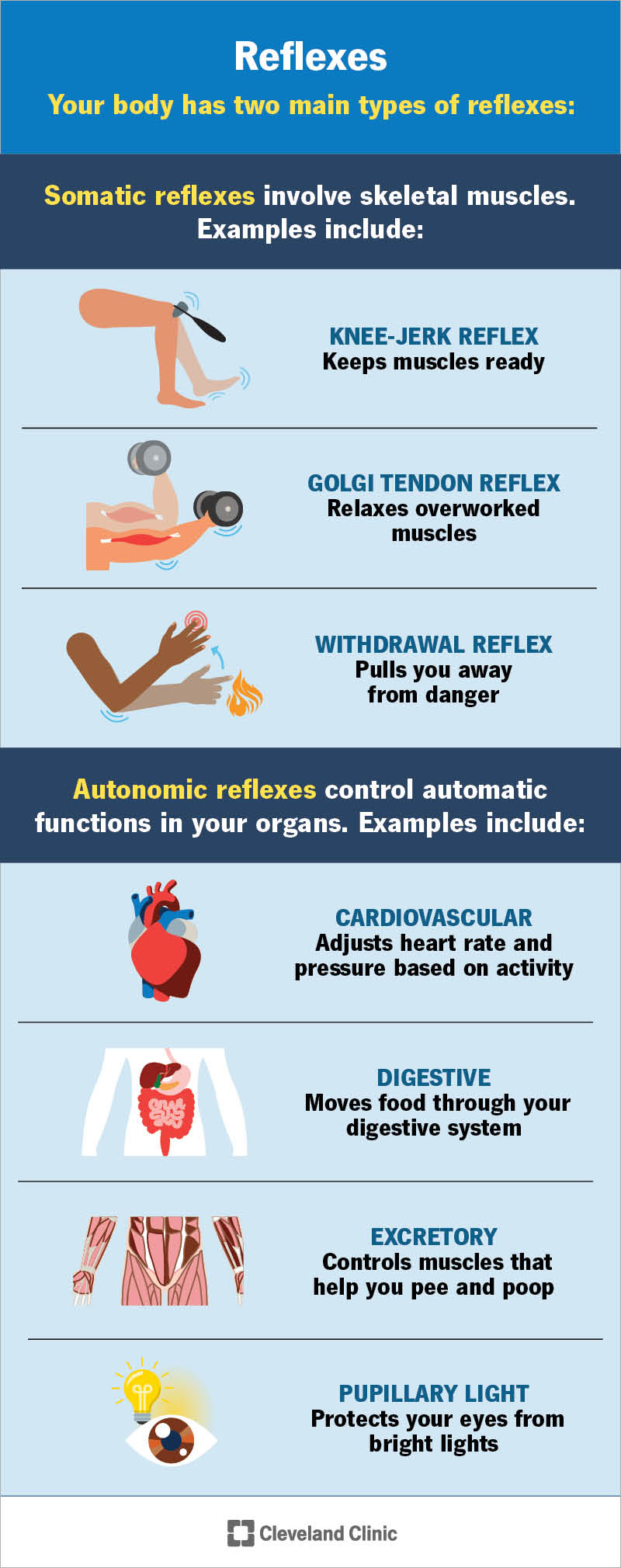
Image content: This image is available to view online.
View image online (https://my.clevelandclinic.org/-/scassets/images/org/health/articles/reflexes)
A reflex is a quick, automatic movement your body makes. You do it without thinking about it. It’s your body’s way of reacting to something right away.
Advertisement
Cleveland Clinic is a non-profit academic medical center. Advertising on our site helps support our mission. We do not endorse non-Cleveland Clinic products or services. Policy
A common example is when your provider taps your knee during a checkup. Your leg kicks out on its own. You didn’t tell it to move — your body just did it. You might only notice after it happens. Other examples include gagging (to prevent choking), blinking (to prevent eye harm) and shivering (to regulate body temperature).
Reflexes are usually predictable. That means you react in the same way to certain things. You have some that go away when you’re a baby and some that stay with you your entire life. Reflexes have an important role in protecting you and keeping your body working properly.
Sometimes, reflexes don’t work the way they should. If that happens, a healthcare provider can help figure out what’s going on and how to manage it.
You have several reflexes in your body. They’re grouped into two categories:
Somatic reflexes protect your body and keep your muscles working properly. Common ones include:
Advertisement
Autonomic reflexes keep your body’s systems running smoothly. Common ones include:
Since you’re not thinking about them, you probably aren’t expecting reflexes to have a purpose, but they do have important jobs. These include keeping you:
Reflexes happen on a special pathway in your nervous system called a reflex arc. You can think of the arc like a shortcut that lets your body react without needing to think about it. Here’s how it works:
This process skips the thinking part in your brain, which is why it works so quickly. Your brain will eventually get the message, but only after the response happens.
You’ve probably had these checked at your provider’s office. It’s a common test that helps show how well your nervous system is working.
Advertisement
To do the test, your provider uses a small rubber tool called a reflex hammer. They gently tap on tendons. These connect muscles to bones.
The most common test is the knee-jerk test. Your provider taps just below your kneecap. Your leg should kick out immediately. They may test other areas, too, depending on what they’re looking for.
It’s best to stay relaxed during the test. Take a few deep breaths and try not to focus on where the tapping is happening. That way, your body reacts naturally.
The test doesn’t hurt. It’s very quick.
Other common tests include:
Sometimes, reflexes don’t work the way they should. They may be overactive (hyperreflexia) or underactive (hyporeflexia). This can cause your muscles to twitch, tighten too much or not move at all when they should. A healthcare provider can help find the cause and recommend treatment.
Advertisement
Some conditions that can affect these include:
Reflexes may naturally slow down with aging. This is normal. But if you notice big changes or if your reflexes stop responding like they used to, it’s a good idea to talk to your provider.
Your body is always working to protect you. It acts so fast, you might not even notice it. Your reflexes might move you away from something sharp or make you blink to stop a bug from flying into your eye.
The best part? You don’t have to think about them at all. They just happen automatically.
But if you notice your reflexes seem slower or aren’t working right, it’s a good idea to talk to your provider. They can help you learn more about these responses and how they connect to your nervous system.
Advertisement



Sign up for our Health Essentials emails for expert guidance on nutrition, fitness, sleep, skin care and more.
Learn more about the Health Library and our editorial process.
Cleveland Clinic’s health articles are based on evidence-backed information and review by medical professionals to ensure accuracy, reliability and up-to-date clinical standards.
Cleveland Clinic’s health articles are based on evidence-backed information and review by medical professionals to ensure accuracy, reliability and up-to-date clinical standards.
Cleveland Clinic’s primary care providers offer lifelong medical care. From sinus infections and high blood pressure to preventive screening, we’re here for you.
