



The pupillary light reflex (PLR or light reflex) changes the size of your pupil when there’s a change in the light in your environment. It closes your pupil to protect your retina from bright light. It opens it to help you see in dim light or darkness. How your pupil reacts to light may be a symptom of serious medical conditions, like stroke.
Advertisement
Cleveland Clinic is a non-profit academic medical center. Advertising on our site helps support our mission. We do not endorse non-Cleveland Clinic products or services. Policy
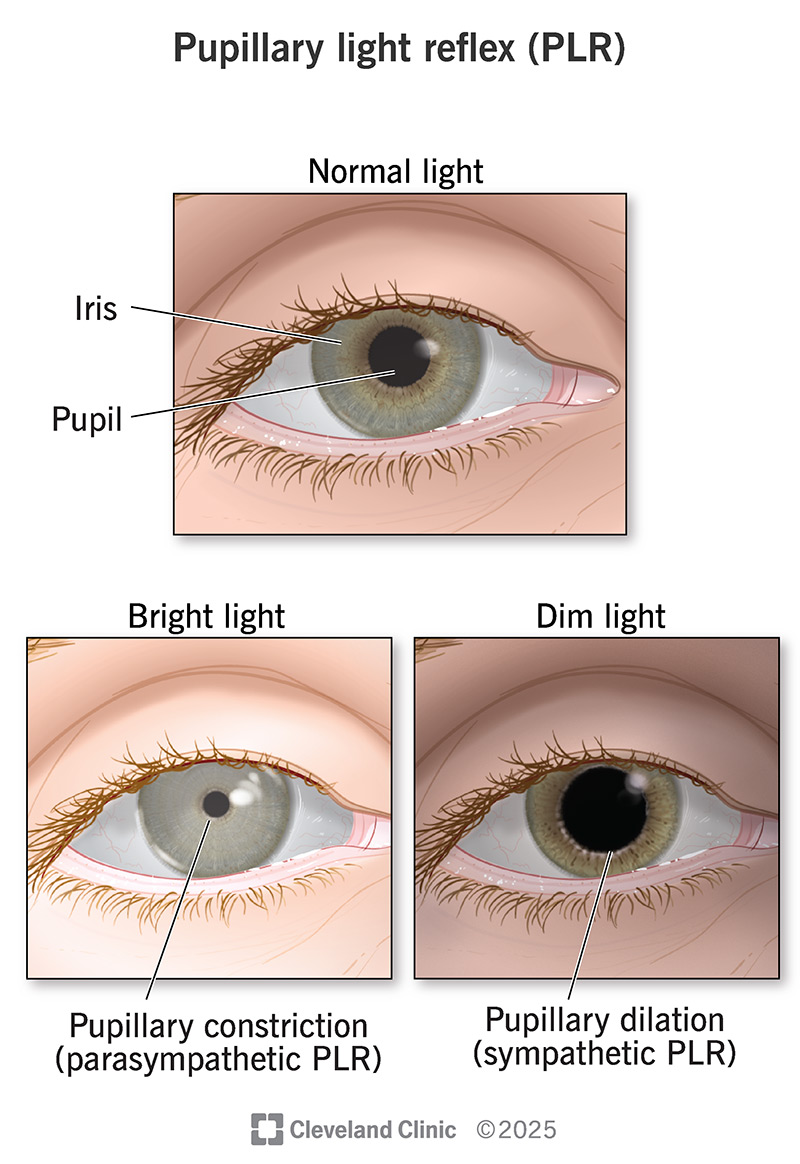
Image content: This image is available to view online.
View image online (https://my.clevelandclinic.org/-/scassets/images/org/health/articles/pupillary-light-reflex)
Your pupillary light reflex, or light reflex, is a reflex of the eye that automatically makes your pupils get bigger or smaller.
Advertisement
Cleveland Clinic is a non-profit academic medical center. Advertising on our site helps support our mission. We do not endorse non-Cleveland Clinic products or services. Policy
Your pupils are the black holes in the middle of your irises. They manage how much light gets into your eyes. For example, your pupils shrink if you leave a room without windows for one with lots of windows that let light in. They get bigger to help you see in dim light or darkness. Experiencing strong emotions or pain also triggers this reflex.
The reflex affects both of your eyes, even if the change in light affects one eye. Healthcare providers may refer to this as a consensual reflex. For example, if a healthcare provider shines a light into your right eye, the pupils in both eyes shrink.
Your pupillary light reflex is a team effort led by your parasympathetic and sympathetic nervous systems. The team includes your retina, iris, brainstem and optic nerve.
Your parasympathetic nervous system handles many activities that you don’t control. Making your pupils shrink is one example. This process starts with your photoreceptors in your retina. Photoreceptors are cells that detect light and colors. When a bright light shines into your eyes:
Advertisement
Your sympathetic nervous system is a group of nerves. These nerves manage your body’s reaction to stressful situations. One reaction makes your pupils bigger to let in more light and make it easier for you to see in dim light or darkness. When that happens:
There’s a long list of conditions that may affect your pupillary reflex. Remember, your brainstem, iris, pupil and optic nerve all need to work as they should. Issues with this reflex may be a symptom of conditions like:
The most common test is part of a comprehensive eye exam. An eye care specialist shines a light into your eyes to see if both of your pupils shrink. A healthcare provider may check your pupillary light reflex if they suspect you have a condition that affects the reflex. For example, pupils that don’t shrink in light may be symptoms of serious conditions like stroke or a brain injury.
Your pupillary light reflex has a constant and complicated job: It makes sure your pupils open and close on demand depending on changes in the light and your environment. That may sound like a simple process. It’s not. It involves coordination between your nervous systems, your brain and parts of your eye.
This reflex is also a way for healthcare providers to check for potentially serious medical conditions. How your pupils react to light may be the first step toward diagnosing issues like stroke or concussion.
Advertisement



Sign up for our Health Essentials emails for expert guidance on nutrition, fitness, sleep, skin care and more.
Learn more about the Health Library and our editorial process.
Cleveland Clinic’s health articles are based on evidence-backed information and review by medical professionals to ensure accuracy, reliability and up-to-date clinical standards.
Cleveland Clinic’s health articles are based on evidence-backed information and review by medical professionals to ensure accuracy, reliability and up-to-date clinical standards.
Cleveland Clinic’s ophthalmologists and optometrists have the highest training available. We provide exams, vision correction and care for many eye conditions.
