



Oppositional defiant disorder (ODD) causes ongoing anger, conflict and resistance to authority. It often begins in childhood and can affect school, home and relationships. Adults can have it, too. With early support and therapy, many learn to manage emotions and behaviors over time.
Advertisement
Cleveland Clinic is a non-profit academic medical center. Advertising on our site helps support our mission. We do not endorse non-Cleveland Clinic products or services. Policy
Oppositional defiant disorder (ODD) involves ongoing patterns of anger, irritability and resistance to rules or authority, like parents or teachers. It’s a mental health condition that often starts in childhood.
Advertisement
Cleveland Clinic is a non-profit academic medical center. Advertising on our site helps support our mission. We do not endorse non-Cleveland Clinic products or services. Policy
Children with ODD may throw tantrums, argue a lot, refuse to follow directions or annoy others on purpose. These can cause problems at home, at school and with peers.
It’s more common in children, but it can continue into adulthood. Symptoms may lessen with age, especially with support.
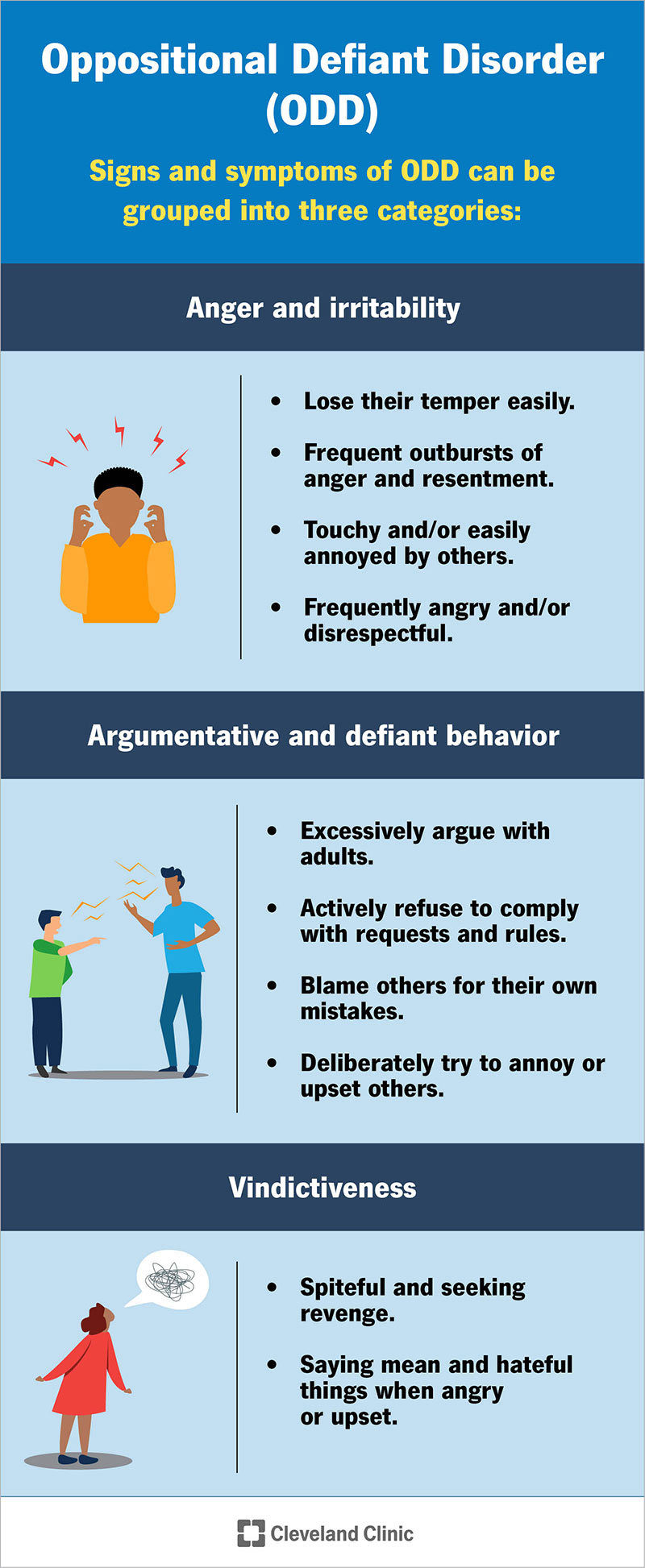
Image content: This image is available to view online.
View image online (https://my.clevelandclinic.org/-/scassets/images/org/health/articles/9905-oppositional-defiant-disorder)
This condition most often affects children and teens, but it can also occur in adults. Symptoms usually begin in preschool years.
It’s common for children to test limits as they grow. But frequent behavior that gets in the way of school, relationships or daily activities may be a sign of ODD.
Mood-related symptoms may include:
Behavior-related symptoms may include:
Vindictive signs may include:
Your child must show several, but not all, of these behaviors to get a diagnosis.
ODD usually develops from a mix of factors rather than one single cause. These may include genetics, how your child’s brain works and their environment.
Advertisement
Many of these factors can overlap. Having one doesn’t mean your child will develop ODD. There’s also no proven way to completely prevent it.
Your child may be more likely to develop ODD if one or more of the following are present:
Over time, ODD may affect many parts of a child’s life. Possible complications include:
Some kids with ODD also have other mental health conditions. These may include:
Some children with ODD may go on to develop a more serious condition called conduct disorder, but most do not. Even when conduct disorder doesn’t develop, children with ODD may still be at higher risk for anxiety or depression.
To diagnose this condition, a healthcare provider looks for patterns of behavior that happen often and over time, not just occasional bad days. They use guidelines from the Diagnostic and Statistical Manual of Mental Disorders (DSM-5). This is a standard book used to diagnose mental health conditions.
If your child shows signs, they’ll likely see a child or adolescent psychologist or psychiatrist. These providers use interviews and assessment tools to better understand your child’s behavior.
Advertisement
They may also gather information from parents, caregivers, teachers and sometimes other adults who know your child well. This helps give a full picture of how their behavior shows up in different settings.
ODD is a recognized diagnosis, but not all experts agree about it. Some professionals feel that the behaviors linked to ODD are better explained by a poor fit between a child and their environment, like a stressful home, school or social setting, rather than a problem within the child.
Some experts worry that the diagnosis can unfairly label a child as “the problem,” when the real difficulty is the situation around them. At the same time, many families find that having a name for what their child is going through helps them understand the behavior and find effective support.
The diagnostic criteria focus on three main areas:
In children younger than 5, behaviors usually need to happen on most days for at least six months. In children age 5 and older, behaviors usually need to happen at least once a week for six months. They also need to show up with people other than siblings.
Advertisement
Behaviors must cause clear stress or problems in daily life, like at home, school or work. Providers also make sure the behaviors aren’t better explained by normal development or another mental health condition.
Treatment for ODD focuses on behavior support and family involvement. The goal isn’t punishment. It’s to build skills and support better behavior over time.
Treatment can vary based on several factors, such as:
Different therapies work best when families, schools and healthcare providers work together.
Parent management training is the main treatment for ODD. It helps caregivers learn new ways to respond to behavior. PMT focuses on:
Many families notice progress in the first few months.
Individual therapy helps children learn skills to manage emotions and behavior. Therapy may help with:
Advertisement
Another option is family therapy. This type looks at how family patterns may affect behavior. It helps families work together more effectively. It may help:
It’s often used along with parent training and individual therapy.
Support at school may help behavior and learning. It may include:
Medication isn’t usually the first treatment for ODD. Providers may consider it if your child’s behavior is severe or if they have another condition.
Medications may help manage:
Providers will monitor medications closely.
It’s a good idea to talk with a healthcare provider early if:
Seek immediate help if your child:
If something doesn’t feel right or seems to be getting worse, it’s OK to ask for help. A healthcare provider can figure out what’s going on and recommend the support they may need.
The outlook can vary from child to child. Many improve over time, especially when they get early and consistent support. Symptoms may reduce as children get older.
Without support, ODD may continue to affect daily life. Children could have ongoing struggles at home, at school or with friends. These challenges can place stress on their family and make learning and social relationships harder.
With parent training, therapy and school support, many children learn better ways to manage their emotions and behavior. Treating other conditions, like ADHD or anxiety, may also improve outcomes.
Some things can make progress harder, like more serious symptoms or learning issues. But ODD doesn’t always lead to more serious behavior disorders. With the right support, many children build skills that help them do better over time.
It’s not easy to parent a child who seems angry or constantly on edge. You might feel like you’re always in conflict, always correcting — and still not making progress. But oppositional defiant disorder (ODD) is more than just “acting out.” It’s a real condition that can impact your child’s emotions, relationships and daily life.
Support can make a big difference. With the right tools — like parent training, therapy and school-based strategies — meaningful change may be possible. You’re not expected to figure this out alone. A healthcare provider can guide you toward a plan that works for your child and your family.



Sign up for our Health Essentials emails for expert guidance on nutrition, fitness, sleep, skin care and more.
Learn more about the Health Library and our editorial process.
Cleveland Clinic’s health articles are based on evidence-backed information and review by medical professionals to ensure accuracy, reliability and up-to-date clinical standards.
Cleveland Clinic’s health articles are based on evidence-backed information and review by medical professionals to ensure accuracy, reliability and up-to-date clinical standards.
Your mental well-being is just as important as your physical well-being. Cleveland Clinic’s mental health experts can help you live life to the fullest.
