



Restless legs syndrome (RLS) makes you feel a strong urge to move your legs when you’re resting. You may also feel sensations like itching, pulling, crawling or throbbing. There isn’t a cure for RLS, but treatments can help manage the symptoms.
Advertisement
Cleveland Clinic is a non-profit academic medical center. Advertising on our site helps support our mission. We do not endorse non-Cleveland Clinic products or services. Policy
Restless legs syndrome (RLS) is a sleep-related movement disorder that causes a strong, nearly irresistible urge to move your legs. Symptoms are usually worse when you’re at rest in the evening or at night.
Advertisement
Cleveland Clinic is a non-profit academic medical center. Advertising on our site helps support our mission. We do not endorse non-Cleveland Clinic products or services. Policy
You may also have uncomfortable sensations in your legs, like throbbing or aching. The urge to constantly move can disrupt your ability to relax or fall asleep.
This condition can affect anyone, including children and adults. But it’s more common in people over 50. Some people call it restless leg syndrome or Willis-Ekbom disease.
There are two main types of RLS. Healthcare providers describe them in a few different ways:
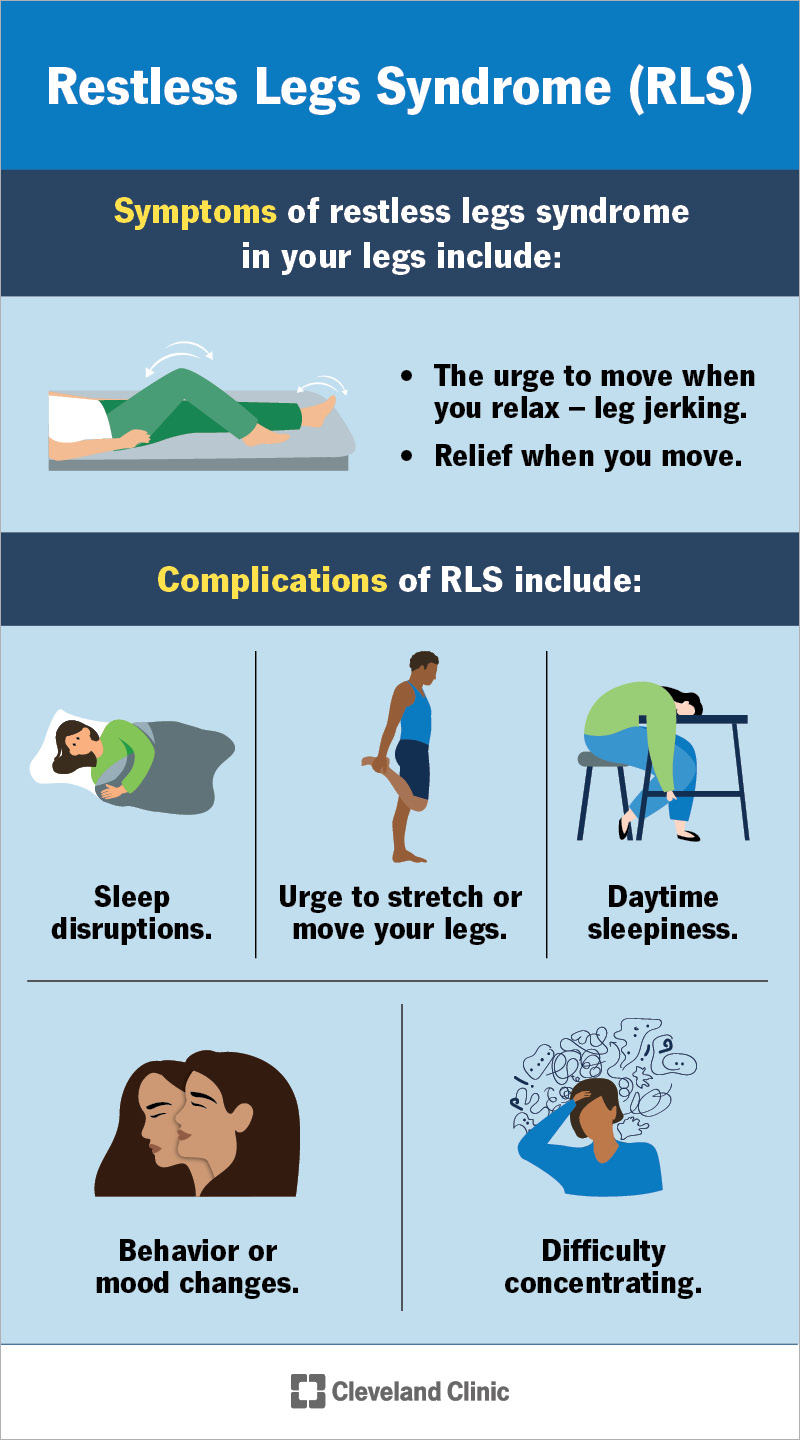
Image content: This image is available to view online.
View image online (https://my.clevelandclinic.org/-/scassets/images/org/health/articles/9497-restless-legs-syndrome)
Symptoms of restless legs syndrome can range from mild to severe in intensity. They include:
About 8 to 9 in 10 people with RLS also have periodic limb movements of sleep (PLMS). So, you may also have repetitive leg and/or arm movements during sleep.
Restless legs syndrome causes sensations that make you want to move your legs. These sensations most often happen in your legs. But they can also affect your arms or your entire body. You may experience the following feelings:
Advertisement
Sensations can happen on one side of your body. But they more commonly affect both sides equally, like both legs.
Researchers don’t know the exact cause of restless legs syndrome. They think it likely involves many factors, including:
Other factors may contribute to this condition. Researchers are still studying it. There’s no way to prevent RLS.
Factors that increase your risk of developing RLS include:
Late-onset or secondary RLS is associated with several conditions. You’re more likely to have it if you also have:
The main complication of RLS is disrupted sleep. You may find it hard to fall or stay asleep. A lack of quality sleep may cause:
There isn’t a test to diagnose RLS. A healthcare provider will do a physical exam and review your symptoms and medical history to diagnose it.
To confirm a diagnosis of RLS, your provider will look for the following criteria:
Your provider may suggest a neurological exam and blood tests to rule out other conditions. They may also recommend an overnight sleep study to check for other sleep conditions.
Advertisement
Yes, it’s sometimes difficult for healthcare providers to diagnose RLS in children. Your child may not be able to describe their symptoms or what they feel. RLS in children may look like attention-deficit/hyperactivity disorder (ADHD) or growing pains.
There’s no cure for restless legs syndrome. But certain treatment options can help manage symptoms. Treatment varies, too. Treatment depends on the severity of RLS and if an underlying condition is causing it.
For example, if you have low blood iron levels, taking an iron supplement or getting an iron infusion may help. If end-stage kidney disease is the cause, a kidney transplant may make RLS go away.
Your healthcare provider will also check if medications you take may be the culprit, like SSRIs and dopamine antagonists. They may adjust your medications if so.
After these initial treatment approaches, you and your healthcare provider will discuss other options. It may include at-home therapies, medications and/or nerve stimulation.
Video content: This video is available to watch online.
View video online (https://cdnapisec.kaltura.com/p/2207941/sp/220794100/playManifest/entryId/1_jhfkgoj5/flavorId/1_5f3sgelj/format/url/protocol/https/a.mp4)
To ease restless legs at night, try heat or cold therapy, massage, stretching, compression wraps or moving. Avoid triggers like nicotine and alcohol.
If you have mild RLS symptoms, your provider may recommend these at-home therapies to help:
Advertisement
Certain medications can help relieve RLS symptoms. The first-line choice is a gabapentinoid, like gabapentin or pregabalin. Your provider may prescribe one of these if you have bothersome RLS symptoms that disrupt your sleep.
If other forms of treatment don’t help, your provider may recommend a low-dose opioid. At a small dose, the risk for opioid misuse and dependence is low. But it’s important to tell your provider if you have risk factors for substance use disorders.
If you have occasional symptoms, your provider may suggest levodopa or a dopamine agonist. You’ll need careful monitoring if you take a dopamine agonist. It can worsen your symptoms over time (augmentation syndrome).
Your provider may recommend peroneal nerve stimulation if medications alone don’t help your symptoms. You wear a device on your lower legs that sends electrical impulses to your muscles. You use it 30 to 60 minutes before going to bed.
This is a newer therapy that researchers are still studying.
Each case of RLS is different. Medication and iron supplements help reduce symptoms for many people with RLS. But the symptoms can persist, causing difficulty falling and staying asleep.
Restless legs syndrome doesn’t affect your life expectancy. But it can affect your overall wellness. Your healthcare provider will be your guide to help curb symptoms. Reach out to a mental health professional if RLS causes distress.
Advertisement
Restless legs syndrome (RLS) can make you feel like you’ve lost control of your body as you try to fall asleep or stay still for long periods. This can drain you both physically and mentally. But with behavioral changes and medication, you may be able to quiet that urge to move. Your healthcare provider can tailor a treatment approach to your specific needs. Lean on them for support.



Sign up for our Health Essentials emails for expert guidance on nutrition, fitness, sleep, skin care and more.
Learn more about the Health Library and our editorial process.
Cleveland Clinic’s health articles are based on evidence-backed information and review by medical professionals to ensure accuracy, reliability and up-to-date clinical standards.
Cleveland Clinic’s health articles are based on evidence-backed information and review by medical professionals to ensure accuracy, reliability and up-to-date clinical standards.
Sleep-movement disorders cause involuntary muscle spasms, twitches and cramps. Cleveland Clinic’s sleep specialists treat these conditions so you can rest easy.
