



Tuberous sclerosis is a rare genetic disorder that causes cells in parts of your body to reproduce too quickly. The excess cells form noncancerous tumors. They grow in your brain, kidneys, heart, skin and more. It can lead to seizures, learning delays or skin changes. Regular care and treatment may help manage symptoms.
Advertisement
Cleveland Clinic is a non-profit academic medical center. Advertising on our site helps support our mission. We do not endorse non-Cleveland Clinic products or services. Policy
Tuberous sclerosis, also known as tuberous sclerosis complex (TSC), is a genetic condition that causes small, noncancerous tumors to grow in different parts of your body. It can affect your brain, kidneys, heart, lungs and skin.
Advertisement
Cleveland Clinic is a non-profit academic medical center. Advertising on our site helps support our mission. We do not endorse non-Cleveland Clinic products or services. Policy
This condition looks different in every person. Some people have seizures. Some have learning or developmental delays. Others may notice changes in their skin. Some may have a mixture of the above.
Living with a rare condition can feel overwhelming at times, but support and treatment are available. There’s no cure yet, but your provider can help you manage symptoms and protect your health over time.
Researchers found different patterns of symptoms with TSC. They call these patterns clusters. The different clusters include:
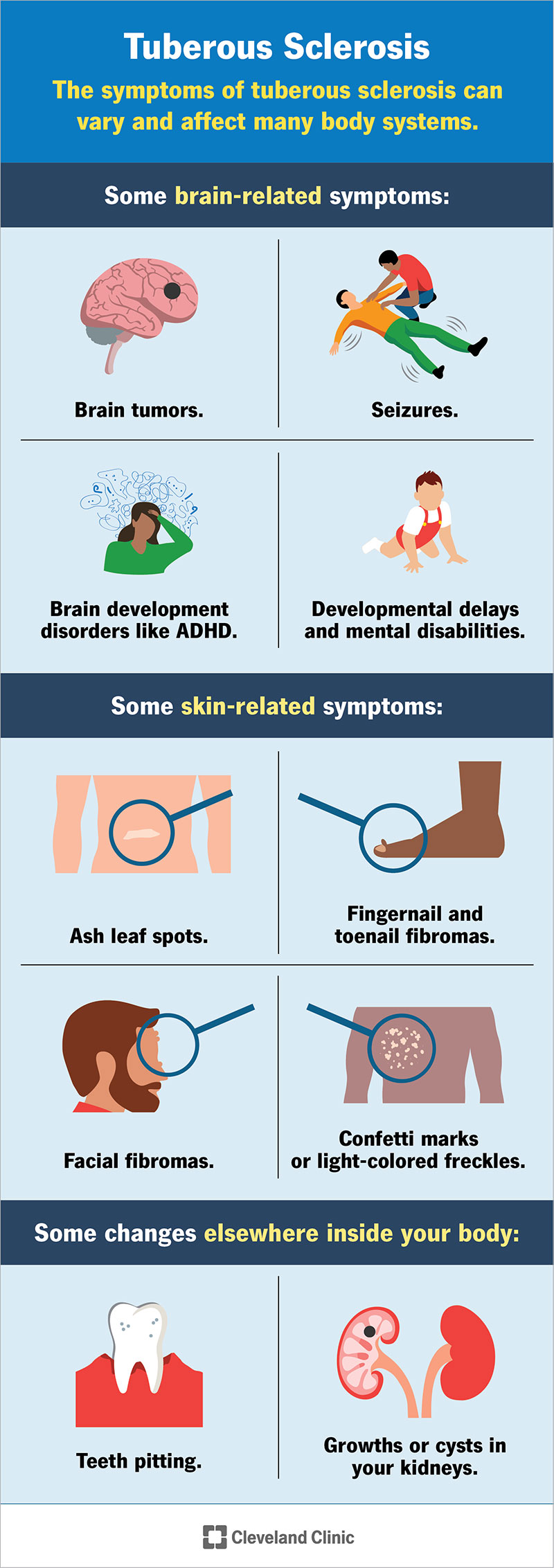
Image content: This image is available to view online.
View image online (https://my.clevelandclinic.org/-/scassets/images/org/health/articles/17586-tuberous-sclerosis)
Tuberous sclerosis complex can affect many parts of your body. Symptoms usually affect your:
Advertisement
These symptoms happen when growths form in your brain. You may have:
Not everyone with TSC has all these symptoms.
TSC can cause seizures when small growths in your brain change the way electrical signals work. These growths, called tubers, form before birth. They can send out mixed or extra signals. The extra signals can cause seizures.
Skin changes are often the first sign of TSC. You may have:
TSC can also cause growths or cysts in other parts of your body, like your:
You might not notice organ symptoms at first, so regular imaging, tests and checkups are important.
TSC happens because of a genetic variation in one of two genes: TSC1 or TSC2. These genes normally make proteins called hamartin and tuberin. The proteins help control how fast cells grow.
When there’s a change in the TSC1 or TSC2 gene, the proteins don’t function as expected. A growth pathway in your body, called the mTOR pathway, becomes too active. This makes cells grow and divide more than they should.
Over time, this extra cell growth can lead to noncancerous tumors and other tissue changes in different parts of your body.
Tuberous sclerosis complex can run in families. TSC is autosomal dominant. This means a biological parent only needs to pass on one changed gene for a child to develop the condition. But it can also happen if you don’t have any family history.
Since it has a genetic cause, there’s no way to prevent tuberous sclerosis.
TSC can lead to problems in different parts of your body. Some of these can be life-threatening. Possible complications include:
This condition may affect your mental health, especially if the skin changes make you feel uncomfortable about your body. If you’re having a hard time with your emotional well-being or the stress of ongoing medical care, talking with a therapist may help.
Advertisement
Doctors diagnose TSC by looking for signs of the condition and reviewing the symptoms you experience. They’ll do a full skin exam. They may use a special light to look for light patches. They may also do an eye exam.
Imaging tests can help find growths linked to TSC. These may include:
Genetic testing can also help diagnose TSC. It looks for changes in the TSC1 or TSC2 gene. Not everyone needs genetic testing, but it can confirm the diagnosis and help guide family planning.
TSC treatment focuses on managing symptoms and watching for new changes over time. You may need a mix of treatments, like:
Advertisement
Tuberous sclerosis affects people in different ways, and the symptoms can change over time. Some people have mild symptoms that don’t disrupt daily life. Others may have more challenges and need regular medical care. Your experience will depend on how strongly it affects your body.
If you have mild symptoms, you may only need routine checkups and a few treatments — like medicine to manage seizures, behavior support or skin growth creams. Severe symptoms need more, like help with learning or doing your daily tasks. Some cases may require full-time medical care, which means you may not be able to live independently.
TSC can also affect your lungs. If you have LAM, your provider will talk with you about things that may trigger symptoms (make them worse), like air travel or certain hormone medicines.
Your healthcare provider can help you understand what you can expect in your situation.
Life expectancy with TSC depends on how severe the symptoms are. Many people live normal lifespans. Others may have serious complications, especially from seizures, kidney or lung problems. Serious complications may reduce your life expectancy.
Staying connected with your care team and keeping regular visits may catch issues early and protect your health.
Advertisement
Tuberous sclerosis can affect many parts of your life, from your physical health to how you learn and develop. And because it shows up differently for each person, it can bring a lot of questions and uncertainty.
Your care team can help you learn more about this condition and what you can expect. From medications that target the root cause of tumor growth to therapies that support learning and behavior, there are ways to manage symptoms and support what your body needs.
If you or your child is living with TSC, regular care matters. These check-ins help spot any changes early and give your care team a chance to guide you through each stage. You don’t have to figure it all out at once — take it one appointment and one decision at a time.



Sign up for our Health Essentials emails for expert guidance on nutrition, fitness, sleep, skin care and more.
Learn more about the Health Library and our editorial process.
Cleveland Clinic’s health articles are based on evidence-backed information and review by medical professionals to ensure accuracy, reliability and up-to-date clinical standards.
Cleveland Clinic’s health articles are based on evidence-backed information and review by medical professionals to ensure accuracy, reliability and up-to-date clinical standards.
Do certain health conditions seem to run in your family? Are you ready to find out if you’re at risk? Cleveland Clinic’s genetics team can help.
