



A C-section (or cesarean birth) is a surgical procedure used to deliver a baby when a vaginal delivery can’t be done safely. A C-section can be planned or performed in an emergency. It carries more risk than a vaginal delivery, with a slightly longer recovery period.
Advertisement
Cleveland Clinic is a non-profit academic medical center. Advertising on our site helps support our mission. We do not endorse non-Cleveland Clinic products or services. Policy
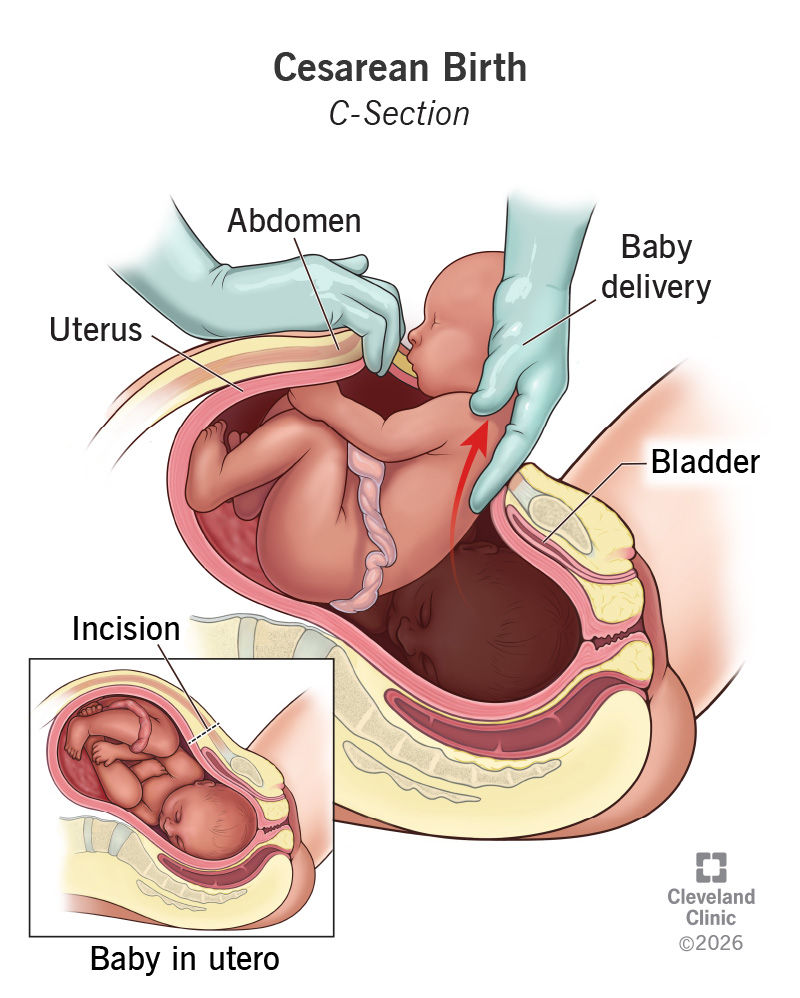
Image content: This image is available to view online.
View image online (https://my.clevelandclinic.org/-/scassets/images/org/health/articles/7246-cesarean-birth-c-section)
A C-section (also called a cesarean or cesarean delivery) is surgery to deliver your baby through your abdomen and uterus. C-sections happen when a vaginal delivery isn’t possible or safe.
Advertisement
Cleveland Clinic is a non-profit academic medical center. Advertising on our site helps support our mission. We do not endorse non-Cleveland Clinic products or services. Policy
A planned C-section happens when any of the following conditions exist:
An unplanned or emergency C-section delivery might be necessary if these things happen during labor:
Advertisement
C-sections happen in about 3 in 10 deliveries in the U.S.
If you have a planned C-section, the following will happen:
If you need an unplanned C-section, your obstetrician delivers your baby during labor because a vaginal birth is no longer the safest option. Most unplanned C-sections aren’t emergencies. An emergency C-section is when delivery needs to happen quickly due to very high risk of complications.
Here are the steps of a C-section:
If you're awake for surgery, you’ll be able to see and hold your baby shortly after they’re born.
A typical C-section takes about 45 minutes to an hour and a half from start to finish, including delivering the baby and closing the incision. In emergencies, it may happen much faster, sometimes within 10 to 15 minutes.
You’ll be under anesthesia to prevent you from feeling any pain. You may feel a tug or pull when your baby is removed and as they repair your incision.
C-sections can be planned or unplanned. They can also be different based on the type of cut your obstetrician makes. The different types are:
Your obstetrician will deliver the placenta after your baby is born. Next, they’ll stitch your uterus and stitch or staple your abdominal muscles. A typical C-section surgery requires at least three to four days in the hospital.
Your abdomen will be sore for several days or weeks. In some cases, your provider may prescribe pain medication. You can expect to limit your activities, take it easy, and rely on family and friends once you go home.
Advertisement
In most cases, the biggest benefit of a C-section is that it’s safer for both you and your baby. It’s a way to eliminate risks of a vaginal delivery.
The risks of complications are slightly higher with C-sections than with vaginal delivery. These include:
Other disadvantages of having a C-section are:
Vaginal births are usually safer. But a C-section may be the only safe option depending on your situation.
Once the anesthesia wears off, you’ll begin to feel the pain from the incisions. You might also experience gas pains and have trouble taking deep breaths. Make sure an adult is there to help you get up from bed the first several days.
A full recovery can take between four and six weeks. Ask your healthcare provider what you can expect during recovery. Most providers recommend limiting walking and lifting, and avoiding exercise and other strenuous activities for several weeks. Ask your friends or partner for help with errands, cooking and cleaning so you can rest and recover. Avoid driving for about two weeks. Before driving again, make sure you can comfortably turn your body and press the brake and gas pedals.
Advertisement
You can expect cramping and bleeding for up to six weeks, as well as some discomfort around the incision. Taking over-the-counter pain relievers like acetaminophen or ibuprofen for pain may help. Avoid sex for at least six weeks or until your healthcare provider gives you the OK.
You will also have a vaginal discharge after the surgery. It will be red at first and then gradually change to yellow. Be sure to call your healthcare provider if you experience heavy bleeding or a foul odor from the vaginal discharge. Use sanitary pads, not tampons, until you’re completely done bleeding.
You may be able to have a vaginal delivery after a C-section if:
You should discuss this with your healthcare team. They can help you weigh the pros and cons.
Call your provider if you have these symptoms after a C-section:
There isn’t an exact number. Factors like your health history and reasons for previous C-sections all play a role. Your healthcare provider will talk to you about the risks of having several C-sections if they apply to you.
Advertisement
A C-section (cesarean delivery) may or may not be part of your birth plan. Some women know they’ll need one, while others don’t have it on their radar at all. C-sections are sometimes necessary for the health of you and your baby. If you know in advance, your doctor can explain what to expect during and after surgery. If your C-section happens suddenly, it’s OK to feel disappointed or sad that your plans have changed. Just know that while you can plan for a vaginal delivery, a C-section may be the safest option when the time comes.
The best thing you can do after a C-section delivery is rest and allow others to help you. A C-section is major surgery. Be gentle with yourself and allow yourself time to rest while your body heals.



Sign up for our Health Essentials emails for expert guidance on nutrition, fitness, sleep, skin care and more.
Learn more about the Health Library and our editorial process.
Cleveland Clinic’s health articles are based on evidence-backed information and review by medical professionals to ensure accuracy, reliability and up-to-date clinical standards.
Cleveland Clinic’s health articles are based on evidence-backed information and review by medical professionals to ensure accuracy, reliability and up-to-date clinical standards.
Cleveland Clinic childbirth experts coach you through every step — from labor to delivery to what to expect when you and your newborn head home.
