



Aphantasia is when you can’t create mental pictures to “see” things in your mind. It’s just a difference in how your brain works. People often don’t realize they have it. There’s no treatment for aphantasia — it’s not a disability or medical condition.
Advertisement
Cleveland Clinic is a non-profit academic medical center. Advertising on our site helps support our mission. We do not endorse non-Cleveland Clinic products or services. Policy
Aphantasia is when your brain doesn’t form or use mental images as part of your thinking or imagination.
Advertisement
Cleveland Clinic is a non-profit academic medical center. Advertising on our site helps support our mission. We do not endorse non-Cleveland Clinic products or services. Policy
It isn’t a medical condition, disorder or disability. Instead, it’s a characteristic, like being left- or right-handed. Aphantasia is simply a difference in how your mind works. Aphantasia that you’re born with may be a type of neurodivergence. In rare cases, it can develop after a brain injury.
Imagination is how your brain “simulates” something based on knowledge or experiences. For most people, it can take many forms, including things you can see, hear and taste. If you have aphantasia, mental pictures aren’t part of your imagination.
Aphantasia is uncommon overall. Experts estimate that between 2% and 4% of people have it. But research on it — including how many people have it — is limited. Many people don’t realize they think differently from most people.
There are two forms of aphantasia:
There are degrees of aphantasia. For example, you may:
Advertisement
Because your “mind’s eye” doesn’t use images, your imagination works in other ways. You can still have a creative imagination with aphantasia. For example, people with it have designed video games and animated movies.
The brain is very complex. Researchers have found connections between aphantasia and other ways your brain works. Studies show that, compared to people without aphantasia, those with it tend to have:
But each person — and brain — is different. You may find that some, all or none of these features are true for you. Researchers mainly study aphantasia to better understand how parts of the brain work overall. They don’t study it because they’re trying to find a fix for it.
Experts don’t know the exact cause of aphantasia. Congenital aphantasia may be genetic. People with aphantasia are much more likely to have a close biological family member who also has it.
Acquired aphantasia can develop due to damage to certain areas of your brain, like your occipital lobe and visual cortex. In rare cases, it may develop after:
Data from one study in 2021 showed people with aphantasia are also more likely to have autism-like traits. However, the study only measured the traits, not whether the participants were actually autistic. It also didn’t measure whether autism causes or contributes to aphantasia or vice versa.
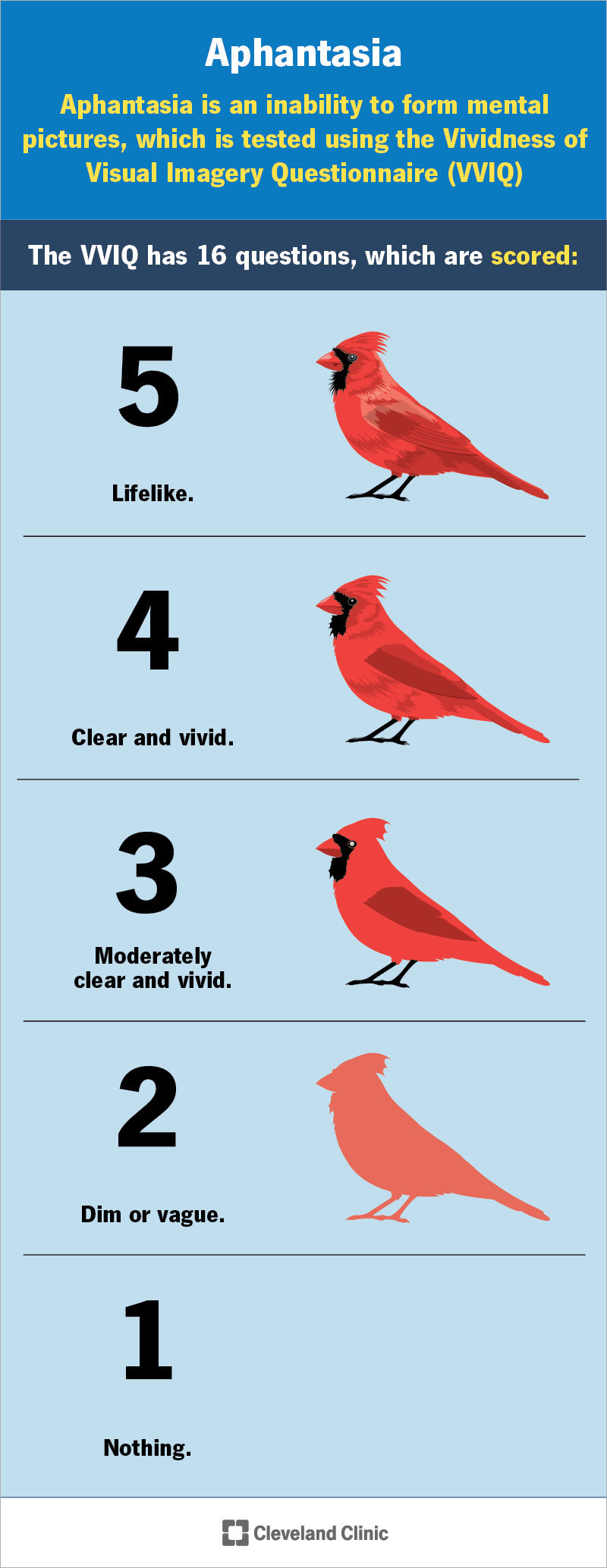
Image content: This image is available to view online.
View image online (https://my.clevelandclinic.org/-/scassets/images/org/health/articles/25222-aphantasia)
The most common test experts use to assess aphantasia is the Vividness of Visual Imagery Questionnaire (VVIQ) or a variation of it. The original VVIQ consists of 16 questions divided into four groups. Each question can have a score of 1 to 5.
The meaning of those scores is as follows:
The VVIQ then adds up the score from each answer. The lowest possible score is 16. The highest is 80. Most experts define aphantasia as a score of 32 or less. If you have a score of 16, you have total aphantasia.
Advertisement
Most people with congenital aphantasia don’t realize they have it until they’re teenagers or adults. Many just assume everyone thinks the same way they do. If you have the congenital form, it’s not necessary to get a diagnosis because it doesn’t need treatment.
Acquired aphantasia is something that generally needs a diagnosis. It’s a sign that something has changed in your brain. Your provider may use a combination of imaging and diagnostic tests, along with the VVIQ, to diagnose it.
If you have acquired aphantasia, you may need treatment for the underlying cause.
If you notice a sudden change in how your imagination or mind works, see your healthcare provider. Sudden changes can be a sign of an underlying brain issue.
Aphantasia means you can’t picture things in your mind, and while most people don’t have it, it isn’t a disease or disability. Just as being left-handed isn’t a disability in a world where most people are right-handed, having congenital aphantasia is no more than a difference in how you use your mind. Some people develop it due to illness or injury, but that’s rare.
Advertisement



Sign up for our Health Essentials emails for expert guidance on nutrition, fitness, sleep, skin care and more.
Learn more about the Health Library and our editorial process.
Cleveland Clinic’s health articles are based on evidence-backed information and review by medical professionals to ensure accuracy, reliability and up-to-date clinical standards.
Cleveland Clinic’s health articles are based on evidence-backed information and review by medical professionals to ensure accuracy, reliability and up-to-date clinical standards.
If you have a neurological condition, you want expert advice. At Cleveland Clinic, we’ll work to create a treatment plan that’s right for you.
