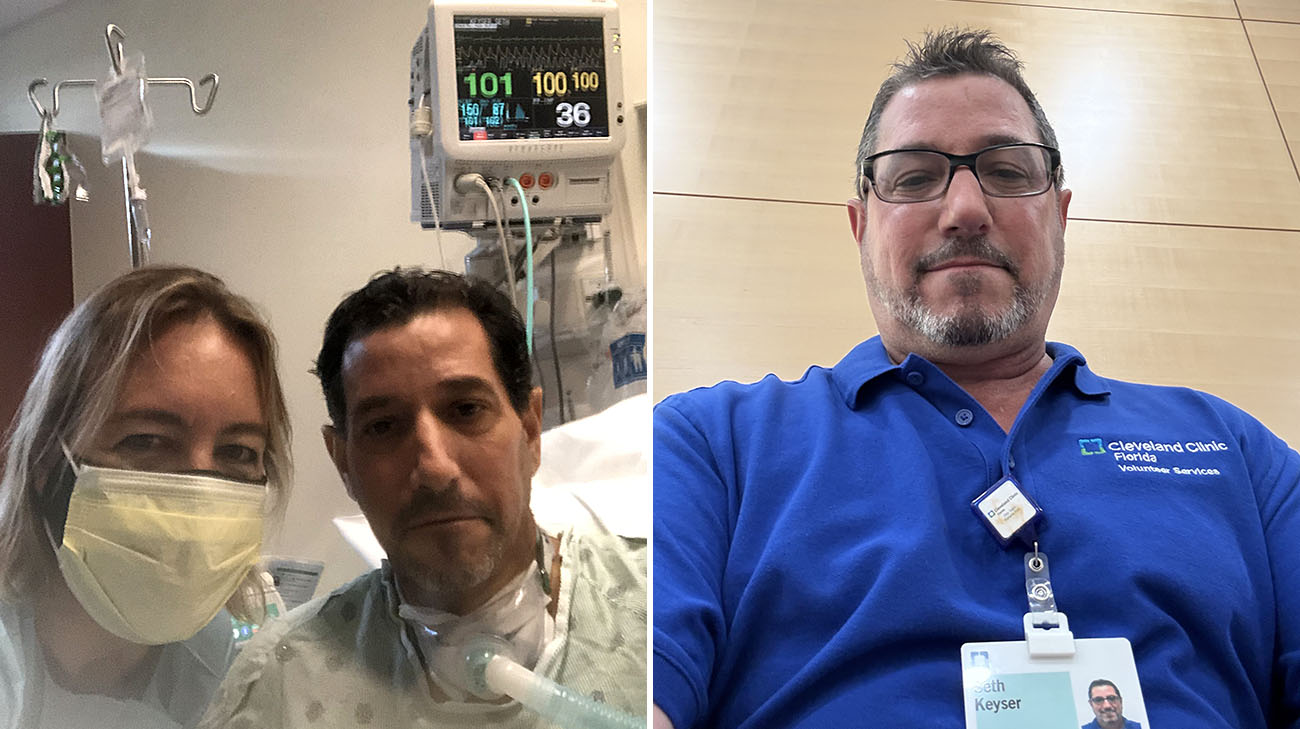
As a business owner, husband and father of four, Seth Keyser was living a busy and full life in 2020 at the age of 48. So, when he woke up one morning at the end of August “throwing up like crazy” he brushed it off as either a virus or illness from the sushi he had eaten the previous night when he was out to dinner with friends. But as the vomiting continued all day and his back began to hurt, he started to sense something was really wrong. He asked his wife Jessica to drive him to the emergency department at nearby Cleveland Clinic Weston Hospital.
“By the time we got there, I couldn’t even get up,” he says. “They rushed me straight in. All I remember is someone saying they were going to give me a tube to help me breathe.”
When he woke up later, he was in the surgical intensive care unit (ICU), recovering from a procedure in which a stent had been placed in the main artery of his heart (the left anterior descending artery, or LAD), and an intra-aortic balloon pump (IABP) was being used to support his blood pressure. Seth had suffered a massive heart attack resulting from a full blockage of the LAD, which is the heart’s biggest artery. This type of heart attack, also called a “widowmaker,” is immediately life-threatening because the LAD artery provides about 50 percent of the blood supply to the heart muscle.
Seth’s extensive heart attack weakened his heart function to 10 percent and caused the development of profound cardiogenic shock as his heart could not pump enough blood to support other organs. Seth was in a life-threatening condition that required immediate escalation of life support therapies, and he was placed on VA ECMO (veno-arterial extracorporeal membrane oxygenation). ECMO is one of the highest levels of life support and is used in only the most severe cases to provide support to failing hearts or lungs. As his clinical condition stabilized, Seth was later transitioned to a simpler cardiac support device, the Impella 5.5., that would ease the work of his heart during the phase of recovery.
“Patients in profound cardiogenic shock requiring ECMO support face over 50 percent risk of mortality, requiring a close coordination of care between cardiology, critical care, cardiothoracic surgery, perfusion, and nursing teams to successfully recover,” says Nicolas Brozzi, MD, a cardiothoracic surgeon at Weston Hospital
Seth’s team of caregivers at Weston Hospital continuously assessed the potential for his long-term recovery, including the potential need for a heart transplant or an implantable mechanical heart. But his heart eventually recovered enough to undergo coronary bypass grafting (CABG) to increase blood flow to the blocked artery, restoring his heart function.
“It was a miracle,” Seth says.
He remained hospitalized for more than three months as he recovered from this extreme condition and faced additional health challenges due to his weakened heart.
“I wanted to be able to walk my daughter down the aisle when she got married,” Seth says.
He said he kept photos of his family nearby to look at as inspiration and to remember his “reason to fight.” Eventually he was able to use a walker to get around rather than a wheelchair.
He became strong enough to undergo a procedure to place an implantable cardioverter defibrillator (ICD) in his chest, which John Bibawy, MD, a cardiac electrophysiologist at Weston Hospital, performed. An ICD is a device that constantly monitors the heart and fixes life-threatening irregular heart rhythms through electric shock.
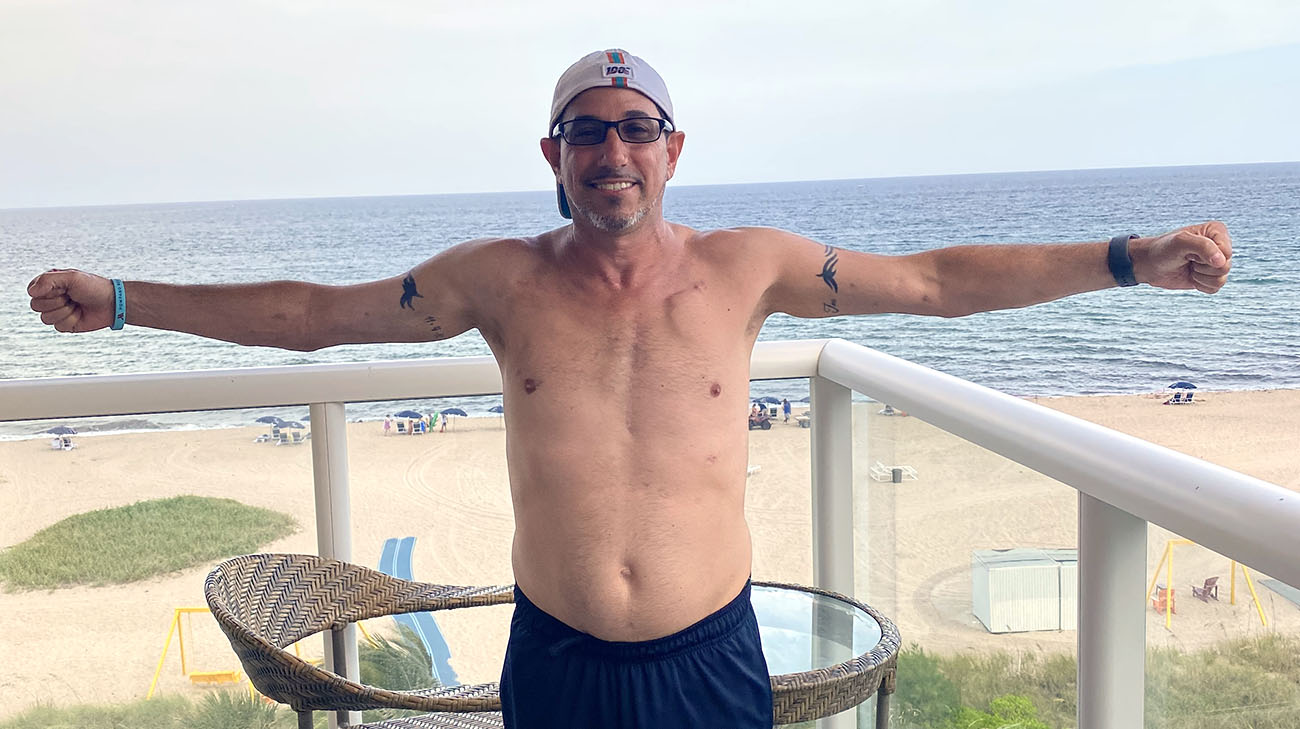
Seth Keyser post-surgery (courtesy of Seth Keyser)
David Snipelisky, MD, a specialist in heart failure and transplantation cardiology at Weston Hospital, continues to monitor Seth’s condition. Although he is still dealing with some kidney disease, his health is improving.
“Slowly but surely, I’ve been able to get better,” he says. “There are still days I wake up and don’t feel the best, but it’s calmed down.”
Seth spends one day a week volunteering at the surgical ICU at Weston Hospital. He does it, he says, to help and be of service to the caregivers who helped him and to help and provide support to the patients any way he can, having been one himself and understanding what they may be going through.
“I consider myself a blessed individual,” Seth says. “My goal is to give my time to Cleveland Clinic. I feel in my heart the dedication and commitment of all of the teams. The care was unbelievable. I felt like I was being treated by my family. It was just beautiful.”
Perhaps the most beautiful outcome of Seth’s journey, though, was when his first grandchild was born in late January and he was there to meet him.
Related Institutes: Heart, Vascular & Thoracic Institute (Miller Family)Patient Stories
Marathon Runner Crosses the Finish Line After Knee Replacement
Jul 10, 2026
A Small Knee Bump Led to a Rare Sarcoma Cancer Diagnosis — and Lifesaving Care
Jul 10, 2026
"Dr. Manrique spoke to me in such a way that I had complete confidence in him, and I knew that he could help me"