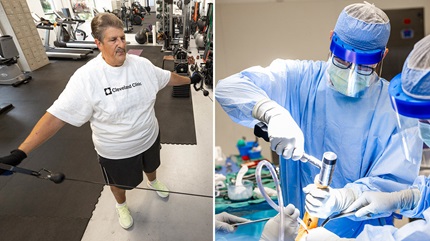
Gillian Pridgen, of Coral Springs, is very happy she had an innovative treatment for her fibroids at Cleveland Clinic in Florida. She only wishes she had done it sooner.
Now 50 years old, Gillian was diagnosed with uterine fibroids, a common type of noncancerous tumor that grows on the uterus, about 10 years ago. She did not have discomfort or pain from them, but she did experience unusually heavy bleeding during menstruation.
“Professionally it was very challenging,” Gillian, who is an educator, says of the bleeding. “You are on your feet all day in front of large groups of people who, in my case, were teenagers. It is very challenging to be battling the personal side of your body while you are trying to be attentive to your students.”
Dealing with the heavy bleeding meant frequent trips to the bathroom, which Gillian says was disruptive and embarrassing.
Going out socially was difficult as well. Gillian is a sports fan and enjoys going to events like hockey games. But rules regarding bags that could be brought into a sports facility made it difficult for her to bring an adequate supply of feminine hygiene products.
“I am very social so having this medical challenge created a lot of social anxiety for me,” she says. “I was always concerned about how I would function or manage when I was out. I wondered how I would manage a Christmas party or a road trip.”
Though Gillian’s primary care doctor referred her to a gynecologist, she says she didn’t have a lot of time for medical appointments because of her job, so she neglected to follow through on making them. She spent two years participating in a private study on medication for uterine fibroids and, though it was educational, it did not help her condition.
“For the most part I was just dealing with the heavy bleeding,” she says. She had been anemic because of it for years and became accustomed to having low energy levels.
What prompted her to finally take action two years ago was when, after almost eight years of dealing with the issue, the bleeding got even more aggressive. The amount of blood she was losing was “actually terrifying,” Gillian says. She realized that her symptoms were not normal and that it was time to do something about them.
So, she made an appointment and went to see Michael Sprague, MD, a Cleveland Clinic in Florida gynecologic surgeon.
“It has been a complete change of my entire life. It’s an absolute pleasure to be on the other side of this simple procedure.”
“He was lovely,” she says. “He sat with me and I told him the whole story, and he gave me some options.”
Gillian chose an innovative procedure called uterine artery embolization (UAE). During a UAE procedure an interventional radiologist injects tiny particles into the blood vessels leading to the uterus. The particles are guided through a thin flexible tube to the appropriate vessels feeding the fibroids. By blocking the vessels and cutting off the blood supply to the fibroids they cause them to shrink.
Rodolfo Blandon, MD, performed Gillian’s procedure at Cleveland Clinic Weston Hospital in November 2024.
“It has been a complete change of my entire life,” Gillian says. “It’s an absolute pleasure to be on the other side of this simple procedure.”
She spent one night in the hospital and, she says, within a couple of days she was back on her feet. The bleeding, she says, has almost completely disappeared. Her periods are now very light. An MRI scan about six months after her procedure showed the fibroids had decreased by 75 percent.
Gillian says she had a very good experience with Cleveland Clinic.
“It was very smooth and very organized,” she says. “The staff was wonderful and the doctors were very thorough. My only regret is that I didn’t do this earlier.”
Patient Stories

Cleveland Clinic Team Helps Florida Patient Breathe Easier After Complex Lung Surgery
Oct 21, 2026

Teen Athlete Returns to Sports After Two Head Injuries Trigger Yearlong Headache
Oct 19, 2026